Virgo and its Decan Constellations.
Virgo
On the Denderah Zodiac, Virgo is seen as a female figure in a long robe, holding in her left hand what appears to be a sprig of wheat.
Are the Nile Lotus and the wig of Hathor both symbols of the object held in the hand of the constellation Virgo? Or is it a sprig of wheat, an ear of corn, or a flower. The Coptic name is Aspolia, meaning station of the desired, the branch.
In "The Witness of the Stars," by E.W. Bullinger, page 33 "Her (Virgo) name is called Aspolia, which means ears of corn, or the seed." |
 Virgo as seen on the Grand Temple as located above Decan 6. 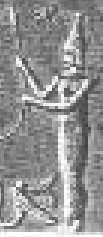 As seen above on ESNE Plate 79 to the left of the figure of Saturn it seems to be a Virgo like figure holding the long tail of the Sphinx in her hands. This is most likely Virgo since it is in sequence before Leo. As seen under the star name e Vindemiatrix in Virgo Star Names is Cyril Fagin's comment, "The constellation Virgo contains an important star known to the Egyptians of Ramesside times as t3.nfr (tsha-nefre), 'the beautiful' or "goodboy' which the Egyptians of the late period identified with their infant Horus in the arms of his mother Isis. The Greeks called this star Protrygeter, the 'first fruit picker' and the Romans called it Vindemiatrix, the 'grape gather,' or Ampelos, the favorite of Bacchus. Ampelos is represented as an infant holding a grape, in the arms of his mother Erigone (born in the morning), because the helical rising of Ampelos ushered in the grape harvest." |
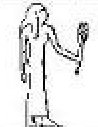 
No hieroglyphic origin is seen here. 
Demotic

Virgo Sign
One source claims she is Isis to the Egyptians, who is seen holding a child in her lap. 
In the image above we see Ophiuchus seated on a throne on a serpent, and to the right is the disk of Libra, and a small jackal (Centaurus) standing upon the disk. Cyril Fagan comments, "Virgo, the harvest constellation, the 'Maid,' rose after sunset in the lunar month Pharmouthi (Sun in Pisces). The first part of the month was devoted to flower planting; but with the acronychal rising of Spica, 'the ear of corn,' the harvest began. This period tallied with the month of February-March, Gregorian. The Full Moon of the lunar month Pharmouthi, was known as the Harvest Moon." |
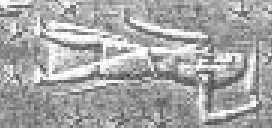 ESNE Plate 79 shows this Virgo like figure which is probably Bootes and not Virgo, and seen as a male figure with a club or bone in his lowered right hand, and has a knife in the hand of his raised left arm. It is located directly above Leo and Coma. 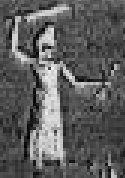 ESNE Plate 87 upper section shows the figure above as between Leo and Cancer, but seen with a knife in the raised right arm, and a bow and arrow in the left hand. It is very similar to the previous image above, and is probably also Bootes a constellation that I propose is in Virgo. Cyril Fagan comments on the above image, "But in the Egyptian zodiac they were known as the 'Bow Stars' and were included in the constellation Cancer. Both the 'Bow' and 'Arrow' (Sirius) rose simulataneously in Egypt during the dynastic period. The Bow Stars were the goddess Satis, who holds a bow and arrow [See Argo Navis or Canis Major Star Names], beneath the lion. In the Esne zodiac she walks before the lion holding in her right hand a reed sickle above her head while carrying her bow and arrows in her other hand. Satis' companion Anqet [See Crater], goddess of the inundation, is seen seated behind Satis, and holding in each had a water vase." |
In the season Akhet II (Aakhet also Hiver) - Nile overflow, Inundation or "the Rising."
The month of Virgo, as seen on Calendar Dates the month dates as:  The star is in Leo (Denebola) and as I mentioned in Libra, which uses the star Arcturus in Bootes, which is connected more to Virgo. Even in Virgo the star Denebola, which is in Leo was acknowledged in lieu of Spica for some reason.
On the Grand Temple these first two deities are between Libra and Virgo. To the right is the horned deity, which may be Saturn. All three are located above and between Decan 6-7. 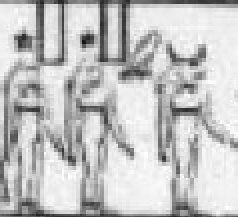 |