From The Alpha and the Omega - Volume III
by Jim A. Cornwell, Copyright © July 20, 2002, all rights reserved
"Volume III - Gods/Goddesses of Ancient Egypt"
ASET
(Ast, Eset, Isis)


    To return to the
Virgo Decan (Virgo as Isis),
Corvus Decan (Isis as many goddesses),
Draco Decan (Isis as the chain),
Denderah Decan 7 - Grand Temple Decan 14 (Deity),
Denderah Decan 17 - Grand Temple Decan 4 (Deity),
Aker (Isis hacks Apophis into pieces) ,
Apis (Isis as a heifer),
Heru (Amset was protected by the goddess Isis),
Pakhet (associated with Aset),
Soped (associated with Isis),
or List of Netjeru.
To see information click on Aset or Isis.
    Aset and Isis are two different deities.    When the worship of Isis began, Aset had already been forgotten for hundreds of years.    Isis was a Roman deity, reminding of Demeter, a great and loving mother goddess, but her Egyptian origin had sunk into oblivion.    The mixup with Aset comes from the Greek and Roman interpretation.


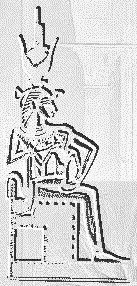
    Aset was the original ancient Egyptian deity of Dynasty IV, a sister-spouse of Wesir (Greek Osiris), and her name means "throne" or "seat."    She is depicted wearing the sun-disc crown with two horns on top of her head, as was later for Isis leading to much confusion reading their hierogylphs.    It is noteworthy to remember that Aset was associated with the sun, whereas Isis with the moon.
    Together with her sister Nebt-Het (Gr. Nephtys) she is seen on coffins in the form of a kite with outstretched wings protecting the deceased or in the Hall of Judgment standing protectively behind the throne of Wesir.    In this aspect her and her sister are as mentioned in the Pyramid Texts as the "mooring posts" (Also see Tauret) to which the deceased laid to after their hazardous travel in the Underworld.
    In myth she is more strongwilled than motherly, and lashes out against attackers.    She sometimes appears as the scorpion goddess Serket and as the star Sopdet (Star- Sirius, Gr. Sothis).
    Her epithet "Great of Heka" (Mistress of Magic) which she uses to help her son (Heru, Horus) regain the throne of Wesir (Osiris) from his uncle Set.

    As seen on Grand Temple Decan 4 this deity was called     Aset or Ast (Isis) or Tuamutef (the children of Horus, ou les enfants d'Horus), note that Isis (Auset) was a magician, sister and wife of Osiris, sister of Set, twin sister of Nephthys.    Mother of Horus the Child (Hor-pa-kraat, see Grand Temple Decan 3), and protected Horus’ son Amset, but was not worshipped till after 1500 B.C.

    As seen on Grand Temple Decan 14 the deity is called     Aset, nebhet, also Ast Nebt-Het note that Nephthys (Nebt-het) is the sister and wife of Set, sister of Isis and Osiris, mother of Anubis, who protected Hapi.


    Isis is the Roman name for Aset, who had a center of worship (in Roman times) at P-aalek/Philae, and other sites were Esna/Contralatopolis (opposite Esna), Djamet/Medinet Habu (Deir el Shelouit), Waset/Diospolis Magna/Thebes, Koptos/Gebtu/Qift, Iunet/Tentyris/Dendera, Diospolis Parva/Hut-Sekhem/Hiw, Sebennytos/Tjebnutjer/Sammanud, and the islands of Pharos, Alexandria.
    Isis is the Goddess of Ten Thousand Names, the Great Mother Goddess.    She is the goddess for all women, the protector at childbirth, for nurturing and caring of children.    She absorbed most of the different Egyptian goddesses' properties and abilities during the Roman days.    Her popularity spread far beyond Egypt, all around the Mediterranean, becoming a Creator Goddess, associated with the moon (Greek Selene, or Hera (Juno)).

From other sources:
    Isis, Sister of Nephthys, Mistress of Magic...     Unlike her twin sister Nephthys, Isis (Ast, Aset) is one of the most famous goddesses of ancient Egypt.    Her worship originated in Africa, was nurtured and refined in Egypt, then spread through the ancient world by the Greek tourists the Romans conquerors, albeit in a different form with the original myths of the goddess long forgotten.    Her fame quickly spread to all corners of the Roman empire.    There was even a temple to Isis on the River Themes in Southwark, London!    The last recorded festival of Isis was held in Rome in 394 A.D. but it was one of the last of the old faiths to die out.
-- Mystery Religions II, Dr M D Magee
    Isis was, of course, sister to Nephthys, and also to Osiris and Set, and mother of Horus.    To the ancient Egyptians, she was all that a mother should be - loving, clever, loyal and brave.    Many statues and images show Isis holding the infant Horus on her knee, suckling the young god.    To the Egyptians, she was the purest example of the loving wife and mother, and that was how they worshiped her - and loved her - the most.    In a culture where fertility was a sign of success and attractiveness, it's no wonder that the Egyptians cherished the fruitful Isis.
    She wasn't just a mother - Isis was also a great magician.    She became one of the most powerful magicians in Egypt when she managed to trick Ra into revealing his secret name to her.    Thus when she wished to make Ra reveal to her his greatest and most secret name, she made a venomous reptile out of dust mixed with the spittle of the god, and by uttering over it certain words of power she made it to bite Ra as he passed.    When she had succeeded in obtaining from the god his most hidden name, which he only revealed because he was on the point of death, she uttered words which had the effect of driving the poison out of his limbs, and Ra recovered.    Now Isis not only used the words of power, but she also had knowledge of the way in which to pronounce them so that the beings or things to which they were addressed would be compelled to listen to them and, having listened, would be obliged to fulfil her bequests.
-- Isis, TourEgypt
    With her magical powers, she was able to bring her husband back to life, when he had been torn apart by his brother Set.    She then fashioned a replacement for Osiris' missing penis, and blew life - with the appropriate magic words, intonations and rituals... and a little help from Thoth - back into husband.    Sharing a night of passion, the deities conceived Horus and Osiris died again, and went on to become Lord of the Underworld.
    But despite all of her magic, there were things that even she could not do without help.
    Isis hid her son Horus in the papyri and water lily (lotus) thickets of Chemmis, in the delta area of Lower Egypt.    She knew that if Set ever found out about her son, he would kill him.    She had to hide with her son, and watch over him, day and night.
    Even though she was a goddess, and a great magician, she still had to leave the safety of the thickets to beg for food.    On one of her trips, Set found out where the mother and child were hiding.    Knowing that Isis would be gone for a while, he transformed himself into a snake and reached the child unseen.    Biting the young god, shooting poison through his body, Set then made a quick getaway.
    Returning to the thicket, Isis found Horus lying lifeless on his back.    She could hardly hear his heartbeat.    Not knowing what sort of illness affected her song, she tried to work her great magics, but her powers had deserted her.    She was alone, her husband was dead and none of the gods were there to help her.    Despairing, she took Horus in her arms and ran to the nearby village.    The fishermen of the village took pity on her, and did their best to try to cure her son, to no avail.    A wise woman examined the child, who told the goddess that it had been Set, disguised as either a snake or a scorpion, who poisoned him.    Realising that the woman was right, Isis became angry.    She let out a great wail:

"Horus has been bitten!
O Re! a scion of yours has been bitten!
Horus has been bitten!
The heir to your heir, a direct link with the kingship of Shu,
Horus has been bitten!
The babe of Chemmis, the infant of the House of the Prince,
Horus has been bitten!
The beautiful golden child, the innocent orphan child
Horus has been bitten!
The son of the "Beneficent Being", born of the 'Tearful One',
Horus has been bitten!
Him I watched over so anxiously, for I foresaw that he would avenge his father....
"
-- Horus' Childhood, Nebet Mirjam

    Nephthys heard Isis' cries, and came in her bird form of a kite, flying to the mashes, "Pray, tell what has happened to Horus the son of Osiris?    Ah Isis, my sister!    Beseech heaven and the divine crew will bring Ra's boat to a standstill and the cosmic wind will cease to blow for the boat of Ra while Horus lies on his side."    Serqet joined the two, saying "What is it?    What is it?    What has happened to the child Horus?    O Isis, pray to heaven so that the sailors of Ra will stop rowing, so the Barque of Ra may not leave from the place where Horus is."
    Raising her voice, she cried to the Boat of a Million Years with a cry so great that it stopped the sun boat in its course and shook the earth, because Isis knew the secret name of Ra.    Looking down at the grieving goddess, Ra sent Thoth to find out what happened.    When he heard, Thoth consoled the goddess: "What is the matter, O Isis, you who are so divine and skilful and know your spell?    Surely nothing has gone amiss with Horus?    An assurance of his safety is in the boat of Ra.    I have just come from the barge.    The sun is in its place of yesterday so that all has become dark and the light has been driven away until Horus recovers his health - to the delight of his mother Isis."
-- Horus' Childhood, Nebet Mirjam
    Thus it was that Thoth worked great magic and the poison was driven out of Horus' body, bringing the baby back to life again, to the delight of his mother.     Thoth then ordered the people of the marshes and all birds and animals who lived there to keep watch over them.    Their life in the delta was still hard, but they stayed until Horus was old enough to have revenge on his uncle for the death of his father.
    Her heavenly symbol was the star Sirius (when connected to the goddess Sopdet), the star that marked the beginning of not only the Egyptian new year, and the season for inundation of the Nile, but also the arrival of spring.    It was a sign of renewed wealth and prosperity for the whole country.
    During her history, Isis was a goddess who took on the attributes of the other goddesses (including Nekhbet, Wadjet (Edjo), Ma'at, Bast and Hathor), even from a very early stage in Egyptian history.    As such, she became a goddess of limitless attributes, a goddess of water, earth, corn, star, wind, motherhood and a goddess of the underworld.    She, along with her twin, was both a goddess of mourning and a friend of the dead, and a patron goddess of childbirth and motherhood.    In her role of guardian of the dead, she was thought to protect the liver, along with Imsety - a human headed Son of Horus - in the canopic jar on the south cardinal point.
    Isis was a winged goddess who represented all that was visible, birth, growth, development and vigour.    Having wings, she was a wind goddess (as was her sister).    She travelled widely, moaned and cried loud enough to shake the heavens and used her wings to blow life into her husband.    The kite was sacred to her, and she could transform herself into this bird at will.    She brought the heavenly scent with her through the land, leaving lingering scenes of spices and flowers her wake.    She brought fresh air with her into the underworld when she gave food to the dead.    She represented both the life-giving spring winds of Egypt and the morning winds that hailed the arrival of the sun each day.

Some of her many specific titles included:
The Great Lady
The God-Mother
Lady of Re-a-nefer
Isis-Nebuut, lady of Sekhet
Lady of Besitet
Isis in Per Pakht
The Queen of Mesen
Isis of Ta-at-nehepet
Isis, Dweller in Netru
Isis, Lady of Hebet
Isis in P-she-Hert
Isis, lady of Khebt
Usert-Isis, Giver of Life
Lady of Abaton
Lady of Iat-Rek (Philae)
Lady of the Countries of the South

    Among her general titles may be mentioned those of "the Divine One, the Only One, the Greatest of the Gods and Goddesses, the Queen of all Gods, the Female Ra, the Female Horus, the Eye of Ra, the Crown of Ra-Heru, Sept, Opener of the Year, Lady of the New Year, Maker of the Sunrise, Lady of Heaven, the Light-Giver of Heaven, Lady of the North Wind, Queen of the Earth, Most Mighty One, Queen of the South and North, Lady of the Solid Earth, Lady of Warmth and Fire, Benefactress of the Duat, She Who is Greatly Feared in the Duat, the God-Mother, the God-Mother of Heru-ka-Nekht, the Mother of the Horus of Gold, the Lady of Life, Lady of Green Crops, the Green Goddess (Wadjet), Lady of Bread, Lady of Beer, Lady of Abundance, Lady of Joy and Gladness, Lady of Love, the Maker of Kings, Lady of the Great House, Lady of the House of Fire, the Beautiful Goddess, the Lady of Words of Power, Lady of the Shuttle, Daughter of Geb, Daughter of Neb-er-tcher, the Child of Nut, Wife of Ra, Wife of the Lord of the Abyss, Wife of the Lord of the Inundation, the Creatrix of the Nile Flood."
-- Isis, TourEgypt

    Isis's name comes from the hieroglyph of the throne with a female ending reading "Mistress of the Throne" (Osiris also has the throne in his name, meaning "Occupier of the Throne").    Originally it was the symbol for 'flesh', reading "Mistress of Flesh".    Not only did her name suggest that she was Queen of the Gods, but that she had also once been a mortal woman.    In Egyptian art and myth, she has been depicted as both human and divine.    She was represented as a goddess with the headdress of a miniature throne.    Later on, she took on the aspects of Hathor, and took on the bovine goddess' headdress of cow's horns with the sun disk between them.    As a human woman, she was shown with a queen's headdress, with the uraeus on her forehead.
    Her cult originated at Per-hebet, and spread over the whole of Egypt and beyond.    Ancient Egyptian festivals for Isis included 'The Festival of Isis', 'The Birthday of Isis', 'The Marriage of Isis and Osiris', 'The Feast of Lights of Isis', 'The Lamentations of Isis and Nephthys for Osiris', 'Isis Seeks the Body of Osiris', 'Isis Rejoices as She Finds Osiris' and 'The Birth of Horus, Child of Isis'.    Originally, she was a black goddess, identifying her as of African origin.


    This file was created on June 18, 2005.

Return to the Table of Contents or the Zodiac of Denderah