From The Alpha and the Omega - Volume III
by Jim A. Cornwell, Copyright © July 20, 2002, all rights reserved
"Volume III - Gods/Goddesses of Ancient Egypt"
WESIR
(Ausar, Wasir,
Wsir, Usir,
Osiris, Wennefer
)


    To return to the
Taurus Decan (The duat or ladder to heaven through the gate formed by Auriga and Perseus above Orion),
Orion Decan (Orion with the embellished crown of Osiris),
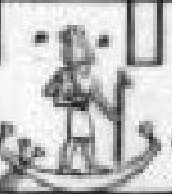
Denderah Decan 10 - Grand Temple Decan 11 (Osiris seen as a lion-headed mummy, with the flails),
Denderah Decan 25 - Grand Temple Decan 32 (fourteen stars are the fourteen parts of Osiris),
Denderah Decan 36 - Grand Temple Decan 21 (an image of Osiris lying in a bed on a boat),
Benu (connection with Osiris rebirth),
Heru (son of Osiris),
or List of Netjeru.
    Wesir the name Osiris is the Greek word for the hieroglyph "Wesir" or "Wsr," which is thought to mean "He who is strong," but not definite, and also may mean "the place of the eye."    Also pronounced Ausar or Usir, and sometimes Wennefer (Gr. Onnophris) which means "the eternally good being" or "the perfect one."
    Wesir/Osiris has been called:

    His name relates to the word "woser" which would mean "Mighty One."    Some place him as being a foreign human king during Predynastic times, entering Egypt from the North and settling finally in Djedu (Busiris) in Lower Egypt, where his cult center grew, and where he was associated with an earlier deity Andjety.
    Others believe he developed from the primitive fertility god, Nepri ("one who lives on after death," a corn, grain, barley, harvest god Neper, shown in human form, often as a child being suckled by Renenutet), in Lower Egypt and connects to other Near Eastern deities like Adonis, Dionysos, Tammus, but a common origin has not been proven.
    As "Lord of Djedo", where Wesir acquired his symbol, the djed-pillar, which came to symbolize strength and resurrection, and the royal insignia the crook and flail.    The Djed-pillar preceded Osiris around 2600 B.C., the word "djed" means "stability" or "continuity of power" symbolizing the strength and endurability of kingship.    It has been called the vertebrae or backbone of Wesir (Osiris), and there are papyri showing the Djed pillar (seen also as a scepter of Ptah) with human arms holding a crook and flail, and surrounded with the "atef" crown.    There is also a ritual called the "Raising of the Djed pillar," performed by Senwosret I (Dyn. 12).
    His main center of worship was at Abedju/Abydos.    Other sites were in Saqqara, Hut-Heryib/Athribis, Busiris/Abusir, Taposiris Magna, Djan'netTanis, Bigeh by Philae, and Waset/Thebes,
    On Senmut's Tomb the hieroglyph for Osiris is .
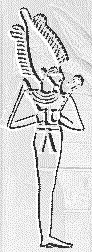
    Fifth Dynasty (King Izesi) shows Wesir hieroglyphs, an eye and a throne.    He is depicted in human form, in white mummy wrappings and with his skin white or black, alluding to the realm of the dead, or green as a symbol of resurrection.    His arms protrude out of the mummy wrappings and he carries the crook and the flail a sign of kingship.    He wears the "Atef" crown, the tall, conical crown of Upper Egypt, flanked by a plume at each side, and ram's horns as its base.
    As seen above Denderah Decan 10 is seen as a mummified figure with a lion-like face with the (Hedjet) white crown of Upper Egypt on its head.    It has two flails with one on each shoulder, grasped by both hands against the chest, the flail and crook is a symbol of royalty, majesty and dominion.    In front of its legs are two stars aligned vertically.
 
    As seen above the Grand Temple Decan 11 as seen on Osiris image, the shepherd’s crooked end scepter but also seen as the Egyptian waas-scepter in his left hand and in his right hand a flail on his right shoulder with the Osiris crown emblem.    The crooked end scepter is also seen on Grand Temple Decan 1 and 11.
    Other titles of Wesir:
    In myth handed down orally, and in the Greek style by Plutarch, he is the son of Geb, the earth god, brother and the husband of Aset, and brother to Nebt-Het and Set.    He was slain by his brother at the shore of "Nedyet," resurrected by his sister-spouse who gave him his son Heru whom in the end took revenge upon his brother Seth.

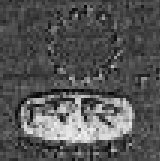
    Below is an undefined image seen on the upper section of ESNE Plate 87 with a circle of 12 stars connected to a figure with eyes.    This could be the Eye of Re/Hathor - or the Utchat (Udjat).


    It is seen under Taurus and above an image of Osiris lying in a bed on a boat, this is seen before Aries and Pisces in the image below.
    As to the Osiris-bed in the New Kingdom there were found in tombs wooden frames in the form of Osiris - so-called Osiris-beds.    These were filled with silt and seeds of barley thought to symbolize resurrection and regrowth, and his triumph over Set.
    Also in the myths Osiris became the ruler of the Underworld, king of the deceased, and was seen as the night form of the sun, even the moon sometimes.
    Osiris in the Late Ptolemaic Period was merged with the Hellenistic Serapis in the Alexandria cult center called the Serapion, a relation here to Osiris-Apis.    The cult of Serapis rose during the early Ptolemian period, and Serapis was an anthropomorhic deity, and with the combining of Apis with Osiris to get Osirapis, which in Greek became Serapis.    On his head could be seen a corn measure, as protector of the corn supply, and eventually became a religion of the Mithras.    One source claims that Serapis was the protector of locust, which identifies it as one of the gods to be discredited in the eighth plague of Egypt regarding the attack of locust upon the land.


    This file was created on June 18, 2005.

Return to the Table of Contents or the Zodiac of Denderah