From The Alpha and the Omega - Volume III
by Jim A. Cornwell, Copyright © July 20, 2002, all rights reserved
"Volume III - Gods/Goddesses of Ancient Egypt"
RENENUTET
(Renenet, Rennuti,
Renen, Renwet,
Emutet, Ernutet,
Thermuthis, Thermouthis,
Termuthis
)


    To return to the
Pisces Decan (Renenutet the netjer of the eighth month Pharmuthi, Parmutit, Renwet, Coptic Baramouda, at Ramesseum: Rennuti, at Edfu: Renen),
Corvus Decan (goddesses portrayed as Isis nursing Horus are Renen-t, Serk-t, Ra-t, Amen-t),
Neheb-khau (son of Geb and Renenutet),
or List of Netjeru.
    Renenutet was the "Lady of the fertile land," "Lady of Fertile Fields" and "lady of granaries," a deity of fertility and harvest, but she was also a protector of linen, bandages, children and their nourishment.
    She was believed to be the mother of the grain god Nepri ("one who lives on after death," a corn, grain, barley, harvest god Neper, shown in human form, often as a child being suckled by Renenutet, who has a connection to Wesir).
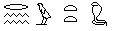
    Her Greek name was Thermutis, name "rnn" equals nourishment, and "wtt" equals snake, showing something of her character.
    Renenutet, "She Who Rears," was a cobra goddess of nursing or rearing children, fertility and protector of the pharaoh.    Known as the "Nourishing Snake," she not only was a goddess who was sometimes shown nursing a child, but she offered her protection to the pharaoh in the land of the dead.
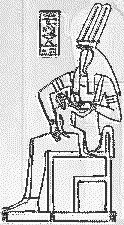
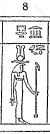
    She was depicted either as a woman, a cobra/snake or a woman with the head of a cobra (and sometimes the head of a lioness), wearing a double plumed headdress or the solar disk.    She was occasionally confused with Meskhenet and took the form of a birth brick.
    The hieroglyph for a cobra is and for a snake it is .
    Another source claims she is a woman with two plumes on her snake head who is seated on a throne, with a child (Horus) in her lap as if feeding it, or giving it a destiny, while others claim it is Amenhotep III.
    One note of interest is her similarity to the decan constellation Corvus, showing a woman seated on a throne with a child.

    In later times she was the netjer of the eighth month of Pisces (Pharmuthi, Parmutit, Renwet, Coptic Baramouda) was called Renenutet, at Ramesseum: Rennuti, at Edfu: Renen, note Renwet mentioned.

    Her main cult was in Faiyum, Lower Egypt and was located at Kom Abu Billo (Terenuthis, Tarrana) in Greco-Roman times.    Amenemnhat III and Amenemnhat IV founded the temple of Renenutet at Medinet Maadi.    This temple is one of the only temples left at Medinet Maadi, and was dedicated to the triad of Renenutet, Sobek and Horus.    Later, the Ptolemaic rulers added to and expanded the temple.    Inside was a large statue of the goddess with both Amenemnhat III and IV standing on either side of her.
    She was both linked to Sobek and Osiris, and thought to be linked with Isis in her role as mother of Horus.
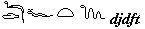
    She was thought to be responsible for looking after the harvest, probably because the Egyptians saw snakes hiding in the fields at harvest time, especially in the city of Dja (Medinet Maadi, Narmouthis) where an annual festival was dedicated to her.    There was also often a shrine dedicated to her near a wine press or vat, so she could receive the offerings of the wine makers.
    What other sources state about Renenutet.
    In the afterlife, Renenutet was seen as a fire-breathing cobra who was liked to Wadjet (Edjo).    The was also seen by the Egyptians as the protector of the clothing worn by the pharaoh in the underworld, and thus thought to instill fear in his enemies.    Because of this, she was also linked to mummy bandages, offering them to the dead.    In Ptolemaic times, she was called "Lady of the Robes" due to her association with clothing.
    "O Osiris-Pepi, I bring you the Eye of Horus which is in Tait, this Renenutet-garment of which the gods respect, so that the gods may respect you like they respect Horus."
-- Utterance 635, Pyramid of Pepi II
    She was also linked to the coming of the inundation and to Hapi, the god of the Nile:
    "I will make the Nile swell for you, without there being a year of lack and exhaustion in the whole land, so the plants will flourish, bending under their fruit.    Renenutet is in all things - everything will be brought forth by the million and everybody ...... in whose granary there had been dearth.    The land of Egypt is beginning to stir again, the shores are shining wonderfully, and wealth and well-being dwell with them, as it had been before."
-- Famine Stele on the Island of Setet Island (Sehel Island)
    As her name might suggest, she was also though to be the goddess who gave a child his or her "true name."    The Egyptian for name rn are the same hieroglyphs used at the start of Renenutet, and so she could also be called "She who is in the Name."    To the Egyptians, as shown by the story of Ra's secret name (which Isis manages to find out, through trickery), if someone knew the true name of a person, then that person has power over the other - a name was very important to the ancient Egyptians.
    It was believed that if both the image of the dead and the name of the dead was obliterated, then the deceased's souls would also be destroyed.    It was because of this that she also became a goddess of fortune.    Her name, and the name of the god of destiny, Shai, were often found together in The Book of the Dead.    Ramses II even called himself "Lord of Shai and Creator of Renenutet."    She was also seen in The Book of the Dead at the judgement of the deceased together with Meskhenet, a goddess of childbirth.    Where Meskhenet presided over the actual birth itself, Renenutet looked after the newborn child; She offered her protection, nurtured the child and gave the child his or her secret name.    Shai was originally the deity who "decreed" what should happen to a man, and Renenutet, as may be seen from the pyramid texts, was the goddess of plenty, good fortune, and the like; subsequently no distinction was made between these deities and the abstract ideas which they represented.
    Some texts claim that she, along with Geb, were the parents of a snake god known as Nehebkau.    She was the protector of the Egyptian people, the nurse of pharaohs and goddess of the secret name of each Egyptian.


    This file was created on June 18, 2005 and updated on May 30, 2006.

Return to the Table of Contents or the Zodiac of Denderah