From The Alpha and the Omega - Volume III
by Jim A. Cornwell, Copyright © July 20, 2002, all rights reserved
"Volume III - Gods/Goddesses of Ancient Egypt"
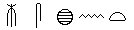
MESKHENET
(Meshkenet, Mesenet,
Meskhent, Meshkent
)


    To return to the
Ara Decan (Bekaty 'The One Who Relates to Pregnancy'),
or List of Netjeru.
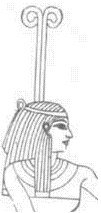
    Meskhenet a goddess of birth, personification of the "birthing bricks" upon which ancient women used to squat when giving birth.    She is shown as a woman with a brick as a head, or as a brick with a woman's head.    Sometimes she is fully human, with the image of a cow's uterus above her head.
    In ancient Egypt, where child mortality was high, Egyptians called upon the help of their gods through magical objects, like birth bricks, and special ritual practices during childbirth.    The Egyptian birth brick was associated with a specific goddess.    On the newly discovered birth brick, the main scene shows a mother with her newborn boy, attended on either side by women and by Hathor, a cow goddess closely associated with birth and motherhood.    Archaeologists have uncovered a 3700-year-old 'magical' birth brick in Egypt.
    She was thought to act as a midwife, and presided over the birthplace as seen with Hatshepsut's (1473-1458 B.C.) record of her birth at Deir-el-Bahari: Khnum, and other deities associated with child birth are there to assist the birth, Isis the great mother and her twin sister Nephthys, Bes the protector of children, and Meskhenet, protectress of the Birthing-Place, and Taweret, the protectress of childbearing women, all were present to hail the birth of Hatshepsut, the great king, the daughter of Amen-Ra and Royal Wife Ahmose.    After the birth all the deities surround the mother and child while Meskhenet, sits on her throne and promises the royal child, "I am behind you, protecting you, like Ra."
    In the tale of Raddjedet and her triplets, it was Meskhenet who foretold that each one would be a ruler.    Then Meskhenet went to him and said, "A king who will rule throughout this entire land."
    She was also a goddess of fate who read the destiny of the child.    She guarded the baby through infancy using her protective powers.
    Meskhenet also appears in the Hall of Judgement when the heart of the deceased was thought to be weighed.    She would testify to the character of the newly dead, and perhaps continued her guardianship role in "rebirth" in the underworld.    In the Papyrus of Ani, she appears next to the scales, as a human headed birthing brick.    She is then depicted as a female goddess, along with Renenutet, in front of Ani and his wife.    She was linked to Shai, the god of destiny, and often found with him in The Book of the Dead.
    In the papyrus of Ani, Shai stands by himself near the pillar of the Balance, and Renenutet is accompanied by Meskhenet, who appears to be the personification of all the conceptions underlying Shai and Renenutet and something else besides.
    There was no cult centre for Meskhenet, but she was represented on birthing bricks and in The Book of the Dead.    She was the goddess of birth, of fate and destiny, as well as the goddess of rebirth into the afterlife.


    This file was created on June 18, 2005.

Return to the Table of Contents or the Zodiac of Denderah