Pisces and its Decan Constellations.
Pisces
On the Zodiac of Denderah and to the ancient Egyptians, Pisces is known as the Coptic Pi-Cot Orion, or Pisces Hori, the Fish of Him Who Comes, or Cometh.
Pisces is seen, as two fish with a cord attached to their tails, and between them is a rectangular figure (tablet-like) with three hieroglyphic seen as Egyptian water signs, nnn, on it. Other sources call this the "She" where the Egyptians portrayed equally spaced vertical wavy lines inclosed by a rectangle denoting a lake or pool (body of water). The cord is connected to a figure, which seems to be Cetus. Some sources claim that the Band has an Egyptian name of U-or, which means He Cometh or He cometh binding them together. Another sources states the Band has an "Egyptian name U-or, meaning He cometh binding them together as seen in Hosea 11:4." Some believe that "The Fish of Him Who Comes," is the fishes that belong to that One who is coming, or fishes that belong to Christ. The fishes are symbolic of swarms or multitudes. In "The Witness of the Stars," by E.W. Bullinger, and seen on page 93, "The ancient Egyptian name, as shown on the Denderah Zodiac, is Pi-cot Orion, or Pisces Hori, which means the fishes of Him that cometh." |
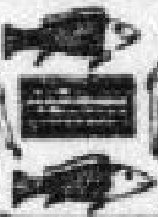 In the image above we see Pisces with no Bands, but a tablet/body of water is shown between the two fish on the Grand Temple and located above Decan 24. 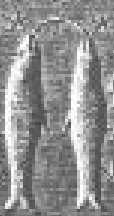 As seen above ESNE Plate 79, Pisces is seen with the band in their mouths, but no tablet/body of water is between them. 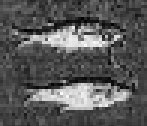 Finally on the upper section of ESNE Plate 87, Pisces is seen with the band in their mouths instead of the tails, but no tablet/body of water is shown between them.
One source claims, Pisces "Between the two fish is a tablet with markings. These markings are the same as those upon which the Teacher of Righteousness (assuming Ara, most likely Lupus) stood at the initiation of the search for truth." See the notes in Pegasus for more information. Gerald Massey refers to Horus as the "evercoming one."
In "The Witness of the Stars," by E.W. Bullinger, page 100, referring to The Band, "Its ancient Egyptian name was U-or, which means He Cometh." Bullinger believes that the Band was a constellation, which is just not possible. That would be like stating that the two fish or the tablet shown were separate constellations, or that Pleiades was a separate constellation from Taurus. |

The hieroglyphic origin is a fish.

Demotic

Pisces Sign
Cyril Fagan comments, "Pisces ... the oldest known, so-called decan list were found on coffin lids at Asyut, which Egyptologist assigned to the IXth and Xth Heracleopolite dynasties, circa 2300 B.C. One of these decans shows a device of two fishes with the legend hnwy (Khonuy). Treated as a pentade it synchronizes with the constellation Pisces. Khonuy (Pisces) rose at sunset during August (Month Phaophi, Sun in Virgo), when the inundation made Egypt like a sea, abounding in fish a river life and shipping was the only means of transport." |
In the season Peret IV (Pert, also Printemps) - seed time, whereas others call it Proyet, meaning "Emergence." So besides a time to sow seeds, it also is when they sent the sheep and horses to pasture.
The month of Pisces, as seen on Calendar Dates the month dates as: 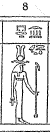
The star for Pisces is in "The Great Square," one of the four stars in Pegasus, as it will be for Aquarius also.
As seen on "http://home.main.rr.com/ imyunnut/Den.Round.html" by Joanne Conman, "Above the figure in the circle are the two fish of Pisces. Willy Hartner thought that the square of water between the two fish represent the modern constellation Pegasus."
On the Grand Temple image seen below, these first two deities are between Aries and Luna (in Pisces) and located above Decan 26, and it is possible that the figure to the right may be Cetus, although it is wearing an Atef crown as seen on the figures on Grand Temple Decan 20, 24, 29 and 35. 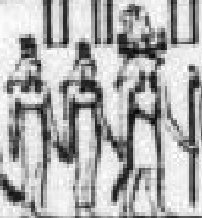 This deity in the image below is between Pisces and Luna and is located above Decan 24-25. 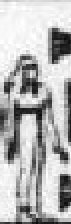
I put this here for interest only, but as can be seen from the original Denderah Zodiac the following icons do not connect as presented in the following, which the author admits is an error on the tracing. From www.siloam.net/denderah "Note the tails on Aries, the baboon (Triangulum-Cassiopeia), the ear of the goat (Triangulum-Andromeda), at the ox leg (Ursa Major), the staff of the beast, Bastet (Eridanus), and the east line of Pisces. De Lubicz mistakenly connected these in his tracing. However, the mistake was not without merit. These images are all drawn with the specific intent of connecting them to the east line of Pisces, which contains the Eye of Ra. That location is a very unique position in the heavens. It is a place where an asterism crosses the apparent path of the sun at nearly a right angle. As such, it is a precise measure of a precessional moment, and therefore, time. The vernal equinox, which is the Tabernacle of the Sun, crossed the east line of Pisces in 30 A.D. Thus, the reference date ... the very year Caesar Augusta was deified by the Romans, and Christ was crucified in the Gospels." |