|
Decan 33-34

|
Decan 34 seen below Luna is a male figure with a black wolf or jackal head, no crown and with one star under its left hand. This is definitely Anubis.
Since Decan 34 is seen as a netjeru in human form, therefore it represents a spiritual understanding.
The hieroglyphs are clearly seen on the Denderah Zodiac as only consisting of
a long straight object, probably the pool sign, Egypt. s (ah or sh)
and ending with a star.
The other source seems to be using the Egypt. Tep a, from the Denderah Decan 32 or 35 in error.
 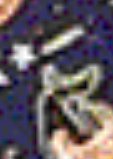 
Denderah Decan 34 is stated by one source to mean the following "Uncreative tyrants rob individual freedom to satisfy the rule of law."
|
If compared to Denderah Decan 34, we definitely can see a major connection, with the jackal head and the one star.
 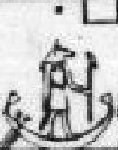
Grand Temple Decan 23 is a male figure with a wolf or jackal head, no crown and with one star above its head.
Anubis (Egypt. Inpw, Anpu, Ano-Oobist) a son of Nephthys and either Set or Osiris. In most cases it is seen as a jackal or jackal headed man. He is associated with embalming. He was worshipped as "Wepuat" (Wepwawet), "Opener of the Ways" (another entrance to heaven), also called Apuat. Also seen with a rabbit’s head, conducting the souls of dead to judgment and monitoring the Scales of Truth. See notes in Decan of Centaurus.
In "The Dawn of Astronomy" by J. Norman Lockyer, New York, The McMillian Company 1897, as seen on page 328, "... it would appear that in those cases a Lyra was the star personified by Anubis."
Decan 23 is called  Akhouy, Akhwey, Akhouy, Akhwey,
Tepi-a Akhwey, or KhuKhu,
the first two are the ibis bird sign, Egypt. Akh,
and then the \\, i, double ii or y, ouy is used.
Cyril Fagan comments, "In the decan lists from Asyut, three pentades which ended Aries and commenced Taurus were known to the Egyptians as 3hwy (Akhuy), the 'shining ones,' because about the Pyramidic period, the sun rose in one or the other of them on New Years's Day of the lunar calendar. In other words, they marked the place of the vernal equinox, Taurus 2767 B.C. The feminine form of Akhu (Akh, Khu, Ikhu) namely Akhot, means the 'place of sunrise,' or the Ascendant."
As seen on "http://home.main.rr.com/imyunnut/Den.Round.html" by Joanne Conman, "Akhwey," which means "The Two Akh-Spirits." She also refers to it by the name "Tepi-a Akhwey," and claims it means "The One Preceding the Two Akh-Spirits."
The question here is: 'Who are the Akh spirits?'
Are they the hour deities on the Grand Temple square zodiac?
Or are they the Denderah Decans of the round zodiac?
See Akhu (Akh, Khu, Ikhu), which encompasses the Egyptian concept of the soul.
It had no deity referenced to it.
Associated with CEPHEUS,
it has stars
in Perseus as Mirfak,
and Andromeda as Almach.
|