Pisces and its Decan Constellations.
Cetus
On the Denderah Zodiac beneath Aries’ hind feet and at the end of the band of Pisces there are two figures.
The first is Cetus and is seen as a female figure with a cat-like face, seen as wearing a long robe and holding the Egyptian waas-scepter in front of her with both hands. This cat-like face leads us to surmise that this is (Adept and Bastet), where Bastet was known as a cat goddess. Some sources state that Cetus may be known as Knem, meaning subdued. The second figure at the end of the band of Pisces is Eridanus, possibly a male figure, which would mean it is known as Adept, but is actually Bastet, but other sources claim that Eridanus is to be known as Peh-ta-t, the mouth of the river. |
On the Grand Temple image seen below, these first two deities are between Aries and Luna (in Pisces) and located above Decan 26, and it is possible that the figure to the right may be Cetus, although it is wearing an Atef crown as seen on the figure on Grand Temple Decan 20, 24, 29 and 35. 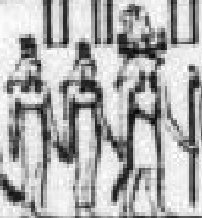
Bast (Bastet) on the Denderah Zodiac one of the two figures at the end of the band of Pisces is seen as Cetus and Eridanus (i.e. Adept and Bastet). The first figure is a female with a catlike head. Bastet was a cat-goddess, worshipped in the Delta city Bubastis. She was the protector of cats, who were seen in papyri as killing the serpents, which attacked the sun god. Also Bastet was seen as a consort of Ptah-Seker-ausar, and is joined with Sekhmet and Ra to form Sekhmet-bast-ra.
The constellation of Cetus is seen under Pisces normally. One source claims "Cetus is shown as the back half of Capricornus. The joining of the whale and the goat are a metaphor for the union of the body and mind."
In "The Witness of the Stars," by E.W. Bullinger, page 113 "Its (Cetus) name in the Denderah Zodiac is Knem, which means subdued. It is pictured as a monstrous head, trodden underfoot by the swine, the natural enemy of the serpent. The hawk also (another enemy of the serpent) is over this figure, crowned with a mortar, denoting bruising." I cannot see the connection for the above reference. Either it is a mistake or we are not looking at the same Denderah Zodiac. I think he is describing Triangulum.
From www.siloam.net it states this about Cetus, "The adept holds the scepter with both hands close to his bosom. The adept does not pass the sensual Bastet, but follows her into eternity." "Bastet symbolizes nine lives for any sensation ... including the seven spirits of being." Thoth is the ruler of nine. "The ninth life of Bastet is certainty of wisdom." From www.siloam.net/denderah it states regarding his reference to "Sculptor" the following "the hands of the beast. The beast is the Egyptian neter, Bastet (Eridanus). She stands for sensibility, while the man behind her (Cetus) stands for rationality (knowledge)." This continued with comments about the crossing of the bands seen in Pisces, "which connect to Bastet's hands as the mark of the beast, 666." It would seem logical that the two figures at the end of the cord (or bands) would represent the constellations Cetus and Eridanus. There is not much information of the Egyptian connection to the two. |