Aries and its Decan Constellations.
Eridanus
On the Denderah Zodiac below the forefeet of Aries, Eridanus is seen as described as a female figure, but upon a closer look at the Denderah image it may have a male face, wearing a long robe and holding the Egyptian waas-scepter in front of both hands.
Some sources claim Eridanus to be known as: In "The Witness of the Stars," by E.W. Bullinger, page 129 "In the Denderah Zodiac it (Eridanus) is a river under the feet of Orion. It is named Peh-ta-t, which means the mouth of the river." Some claim that this Eridanus is known as Adept, but is actually Bastet, which is seen in Cetus (in the Pisces section) for a connection with Adept and Bastet (Bast, Pasht). The place where the bands of Pisces come together, meet at the hands of Eridanus and also represent the beginning of the age of Pisces, which I have proposed to be around 210 B.C. It is very possible that the Magi may have referenced their star as being on the Ecliptic at a certain place under certain conditions (specific planets Mercury and Jupiter in alignment) representing the coming of the one foretold and acknowledged in Matthew 2:9-10 in the time frame of 7 B.C. to 1 A.D.. |
On the Grand Temple the two deities in the image below are between Aries and Cassiopeia (Triangulum) and located above Grand Temple Decan 28. Notice the figure on the right is a male with an animal on his head, similar to the figure seen on Grand Temple Decan 25, which is in the Pisces section and connects with Andromeda (Triangulum). It is also possible that this figure may be Eridanus. It is very possible that the figure to the left may be the Utchat (Eye). 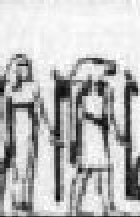
On Denderah Decan 27
One source states this about Cetus; "The adept holds the scepter with both hands close to his bosom. The adept does not pass the sensual Bastet, but follows her into eternity." "Bastet symbolizes nine lives for any sensation ... including the seven spirits of being." Thoth is the ruler of nine. "The ninth life of Bastet is certainty of wisdom." From www.siloam.net/denderah it states regarding his reference to "Sculptor" the following "the hands of the beast. The beast is the Egyptian neter, Bastet (Eridanus). She stands for sensibility, while the man behind her (Cetus) stands for rationality (knowledge)." This continued with comments about the crossing of the bands seen in Pisces, "which connect to Bastet's hands as the mark of the beast, 666." It would seem logical that the two figures at the end of the cord (or bands) would represent the constellations Cetus and Eridanus. There is not much information of the Egyptian connection to the two. |

 in the Taurus section