Aries and its Decan Constellations.
|
Decan 29-30 
|
Decan 29 seen below the feet of Cetus is a young male figure sitting with knees up on a lotus flower, in his right hand is a flail laying over his right shoulder and his left hand has his finger to his mouth. In front of the lotus flower are two stars aligned vertically. Also above his head are two stars aligned vertically, but these may be part of the hieroglyphics.
The hieroglyphs seen here are   
One source calls Denderah Decan 29 as representing the Future Conscious, which is setting on a Lotus. As mentioned on the Virgo Decan the Lotus Flower is called Sesen a symbol of the sun, of creation and rebirth, because at night the flower closes and sinks underwater, at dawn it rises and opens again. It is also a symbol of Upper Egypt.
According to Alvin Boyd Kuhn, who refers this to Horus at the vernal equinox. Denderah Decan 29 shows Harpocrates, i.e. Horus as a young child, and Mr. Kuhn refers to the two figures above his head, near Aries (See Triangulum i.e. Cassiopeia - Adept and Bastet as seen in Cetus).
Horus is usually depicted as wearing the Double Crown (Pshent, unification of the white and red crown) or combination of the upper and lower crown headdress with the little curly item on it. He is also hawk-headed and carries a spear in his left hand.  |
If compared to Denderah Decan 29, we find a definite major connection, with the young male, sitting on a lotus flower and touching his mouth with his finger.  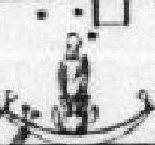 Grand Temple Decan 28 is a young male figure wearing a sun disk crown, with three stars above it, and is sitting with knees up on a lotus flower, in his right hand may be a serpent and his left hand has his finger to his mouth. Also see Grand Temple Decan 2 and 27 as seen below.  
Also see the fifth figure from the bottom right hand corner of the upper section of ESNE Plate 87 for a similar figure to that seen above on Grand Temple Decan 28, both are specified under Aries. 
Decan 28 is named
On "http://www.creatures-kbc.com/ae_senmut_sah.htm" by Ken Bakeman promotes that the hieroglyphs on Senmuts' Tomb after the 'front facing' stars are followed by the hieroglyphs for the "twin pot makers"
Its deity is called Hor, Hor-pa-kraat (Horus the Child) - Heru, Hoor-par-kraat, was the son of Isis and Osiris, and seen as a young boy with a child’s sidelock of hair, sucking his finger. His silence developed the common "shhh" gesture. Also see Lupus under Libra for more information on this subject. "The Greco-Romans called him Harpocrates (god of silence), meaning ‘justice’ or the ‘Victim of Justice,’ ‘Vindication of Majestic Law,’ or the quiet submission. This has great significance and a connection with Libra as the coming of Justice as the opposite of Aries." Denderah Decan 29 and the Grand Temple Decan 28 shows Horus as a young child, with his finger over his mouth, signaling silence.
Associated with ERIDANUS, |
 Qed or Qet, and possibly may be called Khentu heriyew (see Denderah Decan 30 and Grand Temple Decan 27), and seen as
 and in sequence by the imagery of the pottery wheel of the Qed ('builder') twins. In this case we can see first "Qed" and then "Sasa Qed," as seen on Grand Temple Decan 28 and 29 Perhaps this was envisioned as turning or revolving the attention of Herf-haf to the celestial events which took place before the Sah-related group of decans.