From The Alpha and the Omega - Volume III
by Jim A. Cornwell, Copyright © July 20, 2002, all rights reserved
"Volume III - Senmut's Tomb and the Denderah Zodiac Decans"
Senmut's Tomb and the Denderah Zodiac Decans.
Go to the bottom of this page
This file created on March 7, 2004 as a Volume III continuation of that which originated from:
the Volume II file 12/31/1995 Chapter Five "The Birth of Moses through the Exodus" at http://www.mazzaroth.com/ChapterFive/TheBirthOfMoses.htm
The following image was from my "Birth of Moses" site to show that the tomb of Senmut (Senenmut) was basically in the time frame of Moses and Hatshepsut.
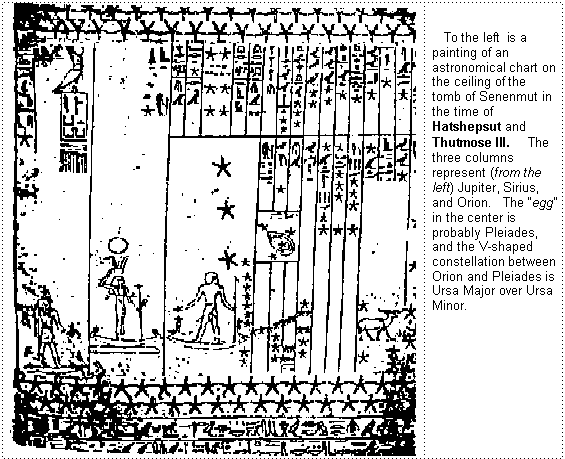
Originally I stated that "In the above picture in the second column, the image of a female deity is the Dog Star, or Sirius who looks similar to one of the Set Hound figures seen as Cassiopeia (in Triangulum) above the Aries, ram figure in the Zodiac of Denderah," whereas Cassiopeia is called Set, which means "Set up as a Queen."
Also, it is noted to the right of the image, with a reference to planets and constellations.
After the fact, I now see a better view of this in that the first figure on the left column is Jupiter,
the second column figure is most likely Sirius (Canis Major),
in the next column it may be Orion or possibly another entity as you will see later,
then in the next one we see a pattern of stars that resemble Taurus (V-shaped Hyades) in lieu of the Ursa Major/Minor comment,
and above it the egg-shaped object is probably the Pleiades.
Above all of this is hard to see hieroglyphs representing decans and deities, which will be seen in more detail in the following information.
On the following address "http://www.creatures-kbc.com/ae_senmut_sah.htm," we find a page created by Ken Bakeman, and is a good resource for a more detailed look at the above information. Mr. Bakeman can be contacted at kbcbugs@earthlink.net.
His page is entitled "The Senmut 'Astronomical' Ceiling: An Evaluation of the Sah-related Decan Group" and the following will be highlights and images from his work and will be interconnected with my own work about the decans of the Zodiac of Denderah Zodiac and the Grand Temple Decans.
The name Senmut (or Senenmut) is found in tomb TT353 and the hieroglyphic entitles him as "Overseer of the House (Chief Steward) of Amun" and although a commoner was an influential official of state during the reign of Hatshepsut. The partly finished "ceiling of Hall C of what is considered to be his second tomb (TT 353 at Deir el-Bahri) has what is often referred to as an 'astronomical' design. The southern half of this design features a range of 'time stars', also known as 'decans'. These at least in part relate to the observation of celestial events relative to the horizon in a sequence of time intervals."
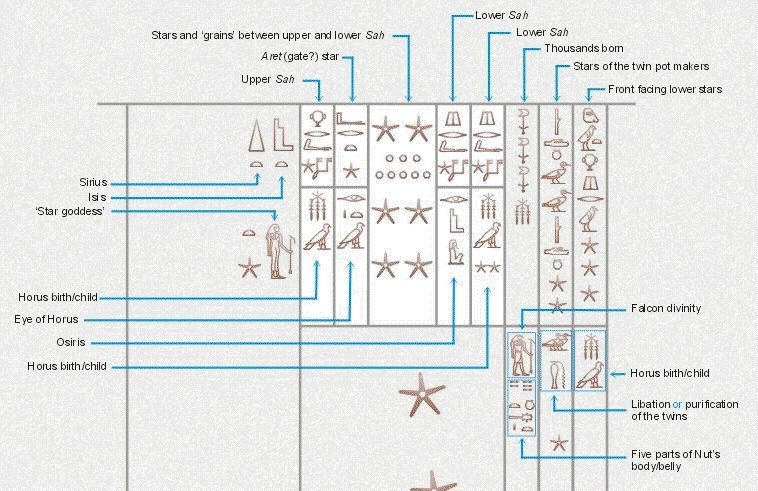
In Ken Bakeman's image below, he presents some of the decans from Senmut's tomb ceiling.
From left to right they are: Sirius (Sepdet), the Sah-related group (shown with a white background) and the three preceding this group.
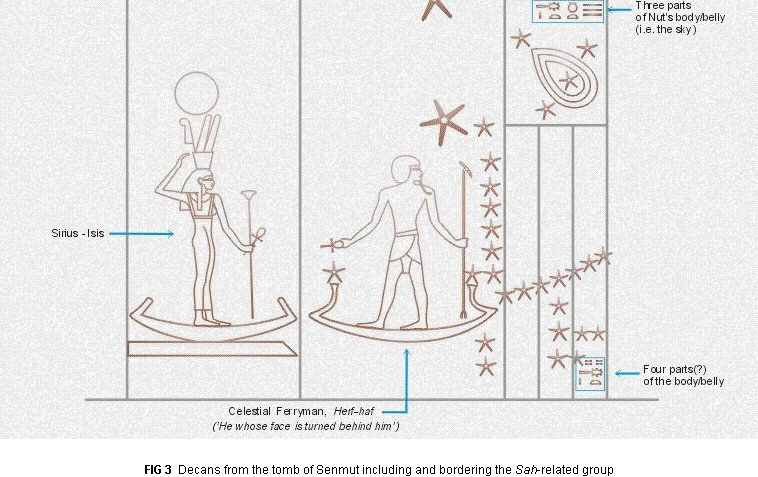
In both Senmut's tomb seen above and the Ramesseum (seen below), the celestial ferryman Herf-haf is a part of the range of Sah-related decans.
In hieroglyphs Herf-haf is written either as 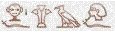 . The expression, 'back of the head' is indicated by the last three signs, so the general idea about Herf-haf as a celestial ferryman seems to deal with the idea of the face turned backwards and of looking backwards.
I have no argument with Ken's assessment of this figure not being Orion, in every case that I have seen of Egyptian images of Orion, he is always moving in the direction of his scepter, although in some cases he is looking backwards, but he seems to always be wearing a (Hedjet) white crown of Upper Egypt.
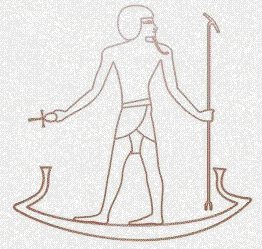
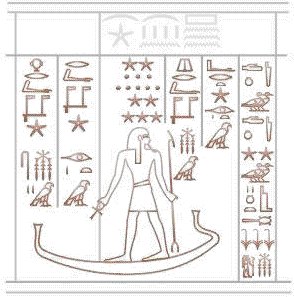 The Celestial Ferryman, Herf-haf: 'He whose face is turned backwards' HerfHaf on the Ramesseum.
Ken Bakeman comments, "Although the celestial ferryman looks backwards, his body fronts that of Sirius-Isis who not only represents the beginning of a new cycle of time but also the principles connected with birth, regeneration and renewal."
"In exploring the role that Herf-haf plays in the Sah-related group of decans, the symbolism associated with the star Sirius should be given consideration. The heliacal rising of the the bright star Sirius marked the beginning of the new cycle of time. In the divisions of the 'time stars' or decans this symbolism is associated with a concept of the juncture between old and new."
One note about the Denderah Zodiac is that there is seen at this point a huge gap associated with Grand Temple Decan 1 connected to Denderah Decan 20, which begins at the location of Sirius (Canis Major) and flows clockwise around to Grand Temple Decan 36 (Sah), which is associated with Denderah Decan 21.
SAH:
Ken Bakeman proposes that on Senenmut's Ceiling the name Sah is an approximate phonetic equivalent of  referring to celestial objects related to elements of the constellation Orion.
- Denderah Decan 21 which correlates to Grand Temple Decan 36, seen as
 and this Egyptian hieroglyph means [sah], Sah, and ends with a star ‘gate.’ Some sources claim it is called Shetu since it is in sequence before Sepdet, which is seen in Denderah Decan 37,
- As seen on "http://www.egyptologyonoline.com/astronomy.html" a claim is made that "The god Sah was the personification of the constellation later known as Orion. Sah was described as 'the glorious soul of Osiris' and formed a divine triad with the dog star Sopdet (Sepdet or Sirius on Denderah Decan 22 - Grand Temple Decan 35) and their son Soped (Soped, Sepd on Denderah Decan 37 - Grand Temple Decan 37), god of the 'eastern border'."
- As seen on "http://home.main.rr.com/imyunnut/Den.Round.html" by Joanne Conman, she refers to this decan as "Pehwey hery," and stated the meaning as "The End (or Northern End?) of the Upper?" "This is most probably a reference to the summer soltice, which marks the end of the sun's journey north for half the year." Pehwey means "The End or Latter Part," and "Hery" means "upper."
Denderah Decan 21 is seen below the temple axis or Lepus a hawk figure with the Double Crown (Pshent, unification of the white and red crown) or Horus crown of upper and lower Egypt and the curly object on its head, and it is perched upon an object that is either an Egyptian candleholder, axis, a mace or a roll of papyrus.
- Also of interest is the hieroglyphics in front of Denderah Decan 21 shows:
an apostrophe like character, Egypt. u, English o; next the lower arm sign, Egypt. a; and the mouth sign, Egypt. r; and ends with a star.
Thus we can see [u-a-r] or [o-a-r], which some sources claim the hieroglyphic characters under Orion read Oar, was anciently spelt Oarion.
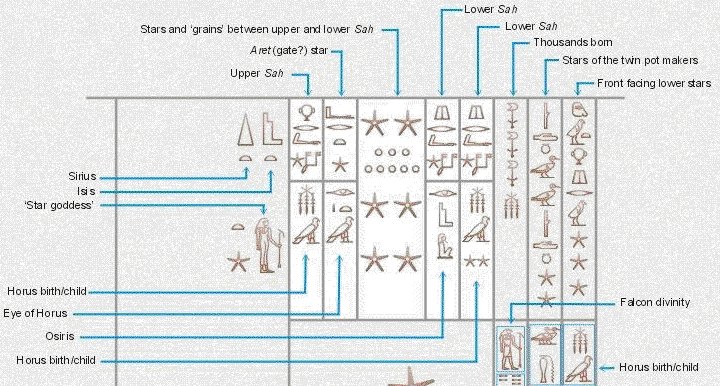 From the image above Ken Bakeman proposes that the Sah-related group or stars consists of divisions pertaining to the appearance of different parts of Orion as they came into view relative to the horizon with the passing of time during a sky watch. Therefore first we would see the upper or top part, then a 'gate' or 'lintel' star (aret), and last two lower parts. Also seen is a central array of stars and unspecified objects, indicated by the glyph for 'grains' or 'seeds.'
Ken Bakeman's Sah-related group of Senmut's tomb consists of four stars (Also see Orion's Star Names for details on Bellatrix, Betelgeuse, Rigel, and Saiph) as presented in the following divisions of decans.
- UPPER or TOP PART:
Ken Bakeman proposes that the upper part of Sah, 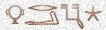 , which is seen as:
the face sign, Egypt. hr; then the mouth sign, Egypt. r; then a bent lower arm, Egypt. rm (if used as a determinative, indicates a 'concept of motion' or as a logogram, 'arm'); and the last is a phonetic equivalent of Egyptian sign for sah; and then ending with a star.
Thus it reads [hr-r (rm) sah], leading to mean "upper Sah," or the "Upper part of Sah," and the "Upper Motion of Sah," or the "Upper Arm of Sah."
It appears as Bellatrix (g Orionis marks the left shoulder) and its divinity is Horus child.
- Denderah Decan 25 which correlates to Grand Temple Decan 32, seen as
 is called Remen herou ioun sah, or Remen-heru-an-sah, where we see the:
bent lower arm, Egypt. rm; then the water sign, Egypt. n; then the face sign, Egypt. hr; then the quail chick sign, Egypt. w or u; then next has to be the sign for iwn; then we see the Egyptian sign for sah with a determinative |; and ends with a star, ‘gate.’
Thus we can see [rm-n hr-u iwn sah].
Remen would likely mean "forearm." Herou, Heru, hery is seen to mean "upper." Sah (Orion).
As seen on "http://www.egyptologyonoline.com/astronomy.html" a claim is made that "The god Sah (Orion) formed a divine triad with the dog star Sopdet (Sepdet, Sirius) and their son Soped (Soped, Sepd), god of the 'eastern border'."
As seen on "http://home.main.rr.com/imyunnut/Den.Round.html" by Joanne Conman, she calls this decan as "Remen-hery" thus meaning "The Upper Forearm" of Sah (Orion). See Denderah Decan 23 for information about the "The Lower Forearm."
- GATE or LINTEL STAR (ARET):
Ken Bakeman proposes that aret seb,  , also called the "Gate" or "lintel" star is seen hieroglyphically as:
the lower arm sign, Egypt. a; then the mouth sign, Egypt. r; and the bread loaf sign, Egypt. t; which is followed by one star.
This would be seen as [a-r-t], Aret.
It is claimed that it appears on the horizon as Betelgeuse (a Orionis in the right shoulder). Also its divinity is in reference to the Eye of Horus.
- Denderah Decan 27 which correlates to Grand Temple Decan 30, seen as
 and called by the name of Aret or Art, and is seen as:
the lower arm sign, Egypt. a; then the mouth sign, Egypt. r; and the bread loaf sign, Egypt. t; which is followed by two smaller stars.
This would be seen as [a-r-t] Aret, which seems to be out of sequence in relationship to the other Zodiac of Denderah Decans 21, 22, 23, 24, and 25 and Grand Temple Decans 32, 33, 34, 35, and 36 associated with the Sah name.
As seen on "http://home.main.rr.com/imyunnut/Den.Round.html" by Joanne Conman, "Aret" means "To Rise Up" or "Ascend" or possibly "Jaw." "It is connected to the Uraeus."
- Denderah Decan 24 which correlates to Grand Temple Decan 33, seen as
 and is called Mesdjer, Mestcher-Sah, and possibly Tjes areq, this first sign in the hieroglyphs is:
the Egypt. ms, child, eldest; next the folded cloth sign, Egypt. s’; next is an unknown sign, probably the Egypt. dj; followed by a donkey ear sign, Egypt. r; then the Egyptian sah sign; and ending with a star ‘gate.’
Therefore reading as [ms-s-dj-r sah].
As seen on "http://www.egyptologyonoline.com/astronomy.html" a claim is made that "The god Sah (Orion) formed a divine triad with the dog star Sopdet (Sepdet, Sirius) and their son Soped (Soped, Sepd), god of the 'eastern border'."
Therefore Mestcher-Sah may mean "Child of Sah."
As seen on "http://home.main.rr.com/imyunnut/Den.Round.html" by Joanne Conman, refers this decan as "Tjes areq" with the meaning "The Knot," but no reference of why.
Grand Temple Decan 33 does have association with Orion as Betelgeuse, Rigel, and Al Nilam.
- TWO LOWER PARTS:
Ken Bakeman proposes that Two Decans are assigned the title of "lower Sah" seen as 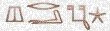 and it is seen in hieroglyph as:
an unknown sign possibly an altar, Egypt. kh; then the mouth sign, Egypt. r; then a bent lower arm, Egypt. rm (if used as a determinative, indicates a 'concept of motion' or as a logogram, 'arm'); and the last is a phonetic equivalent of Egyptian sign for sah; and then ending with a star.
Thus it reads [kh-r (rm) sah], leading to "lower Sah," or the "Lower parts of Sah," and the "Lower Motion of Sah," or the "Lower Arm of Sah."
In the succession of sky events these lower parts may be seen as corresponding to:
Rigel (b Orionis in the left knee or foot and associated with Osiris) and then
Saiph (k Orionis in the right knee or foot).
- Denderah Decan 23 which correlates to Grand Temple Decan 34, seen as
 and called Remen kher sah, Remen-Kher-Sah, and possibly Waret, and it is seen hieroglypically as:
a bent lower arm, Egypt. rm; then the water sign, Egypt. n; then an unknown sign possibly an altar, Egypt. kh; and the mouth sign, Egypt. r; and the last is the Egyptian sign for sah; ending with a star ‘gate.’
Thus it reads [rm-n kh-r sah].
Remen would likely mean "forearm." Kher is seen to mean "lower" or "under." Then Sah.
As seen on "http://home.main.rr.com/imyunnut/Den.Round.html" by Joanne Conman, she refers to this decan's possible name as "Waret," and stated the meaning as "District Under."
She also calls it "Remen khery" thus meaning "The Lower Forearm" of Sah (Orion). See Denderah Decan 25 for information about the "The Upper Forearm."
Grand Temple Decan 34 is associated with Orion and its star Saiph, located on Orion's back leg. Saiph's divinity is the Horus child.
- Denderah Decan 22 which correlates to Grand Temple Decan 35, seen as
 and called A sah, A-Sah, or Tepi-a Sepdet, as we also see on Grand Temple Decan 36, that sah is its own hieroglyph,
the lower arm sign, Egypt. a, which has a determinative sign | giving this its meaning, and then has the Egyptian sign for sah, and ends with a star.
Tepi-a Sepdet means "The One Who Precedes Sepdet."
The connection of the Grand Temple Decan 35 and Denderah Decan 22 with the star Rigel (located on Orion's front leg) is that both Decans are wearing the Atef crown (Osiris' crown made up of the white crown of Upper Egypt and the red feathers of Busiris). Rigel's divinity is Osiris.
GRAINS or SEEDS:
As promoted by Ken Bakeman, "Between the upper and lower Sah decans is a central group of untitled stars and 'pellets'. In looking for an explanation of this division of the Sah-related group it might be noted that other 'astronomical' ceilings have a similar arrangement but with some differences. The 'astronomical' ceiling from the Ramesseum has five lower star signs rather than the four found in the corresponding part of Senmut's ceiling."
"Pedamenope's tomb ceiling (from the 26th dynasty) shows ten 'grains' or 'seeds', each one represented by  , rather than eight, and these are arranged in a different pattern. In this case, the pellets, are in the shape of the sign for 'mouth',
  . This sign was also used to write numerical fractions and in this application may have been a clever shorthand method to convey the idea of an array of small parts. In a comparison to the pattern of the constellation Orion, these parts might have represented the stars that were located between Bellatrix and Betelgeuse on one side and Rigel and Saiph on the other."
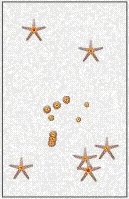 ,
,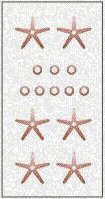 ,
,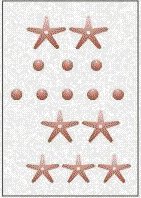 ,
,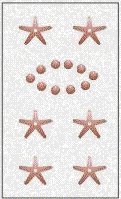 Orion Asterism Tomb of Senmut Ramesseum Tomb of Pedamenope
Comparison of the main objects of the Orion constellation to the central division of the Sah-related group from different sources.
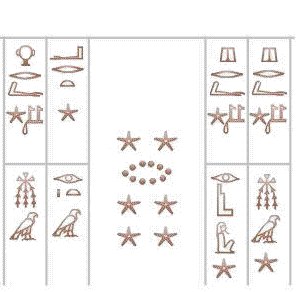 Left: The Sah-related group from the 'astronomical hall' of the Ramesseum. Right: Illustration of the Sah-related group from the 26th Dynasty tomb of Pedamenope.
The following are Ken Bakeman's three decans preceding the Sah-related group consisting of "front facing lower stars," "twin pot makers," and "thousands born."
- FRONT FACING STARS:
Ken Bakeman poses that the hieroglyphs for "front facing lower stars" is  .
.
- The first four glyphs represent the term "front facing,"
- The Egyptian sign for front (?); then the mouth sign, Egypt. r; next a quail chick sign, Egypt. a, ou; and last a face sign, Egypt. hr.
- This will read as [?-r-ou-hr], which I have not determined the meaning as "front facing."
- The next three glyphs represent the term "lower," as seen on Denderah Decan 30 (Grand Temple Decan 27) and named
 Khent kherou (Khent kh-r-ou):
- The first sign representing Khent (Egyptian sign for Khentet, possibly "Southern Traveler").
- The last three are kherou, which means "lower."
- The three stars are determinates, although given the name "stars."
- TWIN POT MAKERS:
Ken Bakeman poses that after the 'front facing' stars are followed by the hieroglyphs for the "twin pot makers"  and in sequence by the imagery of the pottery wheel of the Qed ('builder') twins. Perhaps this was envisioned as turning or revolving the attention of Herf-haf to the celestial events which took place before the Sah-related group of decans.
- Denderah Decan 29 which correlates to Grand Temple Decan 28, which is named
 Qed or Qet, and seen as
a stilt sign, Egypt. q; then a hand sign, Egypt. d; next a jar sign; Egypt. determinative; which ends with a star.
Thus reading [q-d] or Qed.
- Denderah Decan 28 which correlates to Grand Temple Decan 29, which is named
 Sasaqed, Sasaqet, Sasa qet, Sawy Qed, or Sawey Qed,
the first two are the duck sign, Egypt. s3, meaning SaSa
then the next three signs mean Qed
stilt sign, Egypt. q; then a hand sign, Egypt. d; next a jar sign, Egypt. determinative; which then ends with two stars,
then with three stars.
Therefore seen as [sa-sa-qd], and Sasa probably means "The Two Sons," and with Qed, "The Two Sons of Qed,"
- As seen on "http://home.main.rr.com/imyunnut/Den.Round.html" by Joanne Conman, "Sawey Qed" means "The Two Sons of Qed." She also claims that "Qed" means "to go around, like the potter's wheel."
- THOUSANDS BORN:
Ken Bakeman then poses that the next hieroglyph  represents "thousands born."
- The first three glyphs although different are very similar to Denderah Decan 26 which correlates to Grand Temple Decan 31 is named
 Khaou or Khau,
the first three signs represent the Egyptian h, with a u under it, and the vulture sign, 3, meaning a, since the h is the sieve sign kh,
Thus we see it as [Kh-a] Khau, and it is only used on this Decan.
As seen on "http://home.main.rr.com/imyunnut/Den.Round.html" by Joanne Conman, she claims "Khau" means "The Thousands" or "Three Thousand."
- Next we see the child sign, Egypt. ms, which means child, eldest, or possibly "born."
Go to the top of this page
This page updated on March 21, 2004.
To return to Volume II file ""The Birth of Moses through the Exodus"" or the Volume III - New Released Files.
Return to the Table of Contents or the Zodiac of Denderah