Taurus and its Decan Constellations.
Orion
On the Denderah Zodiac below the hind feet of Taurus, Orion is seen as a male figure wearing the (Hedjet) white crown of Upper Egypt. In his right hand is a flail, which is over his right shoulder, the flail and crook are a symbol of royalty, majesty and dominion. In his left hand he is holding a very large Egyptian waas scepter, a symbol of power and dominion. Some sources claim he is known as Ha-ga-t, which means this is He who triumphs. Note that some say he has an injury to his leg. It may be that the figure, which could be Monoceros by his hind foot, is the Egyptian Ba-Bird, Jabiru, Sumerian Habur, and Egyptian Sahu. |
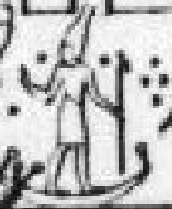
Orion is seen with only seven stars on the Grand Temple image above, which is located above Decan 34-35. Of interest is why here Orion is looking backwards, in relationship to what is seen on Senmut's Tomb in regard to Herf-haf. 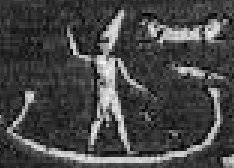 On the upper section of ESNE Plate 87 as seen above, we can see Orion standing on a serpent, which is located after Gemini and before Taurus.
|
Of interest is on the Grand Temple Decan 32 we see a figure, which is similar to Orion in the images below. 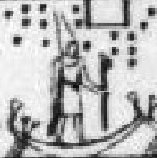
 See a title for Wesir, "He Who Dwells in Sah (Orion) with a Season in the Sky and a Season on Earth," placing him as an astral deity and the Underworld. |
One source claims, "There we will see a cocky man (Orion) with the flail and a scepter striding boldly in a wilderness above a serpent with an atef crown (Denderah Decan 22). This is an embellished crown of Osiris. It represents virtuous experience by rational means (white pin and feathers)." Note also to see information in Hydra. "This belief is the inspiration symbolized by the scepter in the left hand (Orion). The flail on the right shoulder (Orion) implies courageous action." "Now we ...see how the Cocky Man (Orion) became a Prince of Peace (Leo Minor) riding in the Kingdom of Heaven, with regal understanding of the meaning of the flail. Eventually the child will receive the scepter again, and when it is received the second time, it will be gripped by two hands extending from the gut. The power of the scepter is so great; that it must be held close to the bosom in both hands, for it is gut instincts in the form of mature intuition. Rational knowledge fails when we walk in the wilderness, which our paradigms do not comprehend. This is the journey of life as identified on the Denderah monument." The way of the Adept.
In "The Witness of the Stars," by E.W. Bullinger, page 125 "He (Orion) is so pictured in the ancient Denderah Zodiac, where we see a man coming forth pointing to three bright stars (Rigel, Bellatrix, and Betelgueze) as his. His name is given as Ha-ga-t, which means this is he who triumphs. The hieroglyphic characters below read Oar. Orion was anciently spelt Oarion, from the Hebrew root, which means light. So that Orion means coming forth as light. The ancient Akkadian for Orion was Ur-ana, the light of heaven."  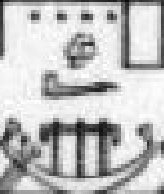
As seen on the Grand Temple Decan 12 in the images above it begins |