Other names for Orion: Al Babador (Arabic modern), Asu'gia, Elgeuze', Geuze, Geuzaz'guar, Jeuze', Al Ha'gue (Moorish), Al Jab'bar, Al Jau'zah (early Arab), Al Kunam, Rag'ulon, Al Shuja', Sugia', Egyptian Sahu.
- In mediaeval as well as in later astronomy, the original appears in degenerate forms, such as Elgeuze, Geuze, Jeuze, and the Geuzazguar of Grotius.
- Arabic Al Giauza, the Branch, Al Mirzam, the Ruler, Al Nagjed, the Prince.
- In "The Witness of the Stars," by E.W. Bullinger, page 127 "Other (Arabic) names ... Al Giauza, the branch; Al Gebor, the mighty; Al Mirzam, the ruler; Al Nagjed, the prince; Niphla (Chaldee), the mighty, Nux (Hebrew), the strong."
- Niphla, attributed to Chaldaea, has not been confirmed by modern scholars.
- Fakar al Jau'zah is Orion's belt, one claim that Fakar al Jauzah, means the Vertebrae in the Jauzah's back.
- Al Dhana'ib, the small stars of Orion.
- a, b, and g stars of Orion are called Al Najid the belt.
- Al Nasak, the Line; Al Alkat, the Golden Grains, Nuts, or Spangles; Niebuhr cited the modern Arabic Al Mizan al H'akk, the Accurate Scale-beam, so distinguishing them from the curved line of the fainter c, theta, iota, d, and kappa, Al Mizan al Batil, the False Scale-beam.
- The Rabbi Isaac Israel said that it was the Mazzaroth, Mazzaloth, or Mazlatha that most of his nation applied to the zodiac.
The following is more on the Shepherd relationship of Orion as may be seen in similar information about the Sumerian LI.DUR SIPA.ZI.AN.NA. Also see the Sumerian City of Larag (Larak) for a connection with the Sumerian name Ensipadzidana and a connection with the Bootes constellation.
Sumerian LI.DUR SIPA.ZI.AN.NA, "The Navel of the True Shepherd of Anu," which reads as (li, ?/ lí, true measure + dur, umbilical cord + sipa, shepherd + zi, breath, to undress + an-na, god of heaven), this does not translate well.
- One source claims this is probably the star a Betelgeuse, from the French Betelgeuse, probably from the Arabic bayt al-jauza for "house of the twins," in Orionis, seen as bayt, Arabic "house," and jauza, Arabic for "twins."
- House.
- Hebrew bayith, bah'-yith, probably from Heb. banah, baw-naw', a primary root to build, abbreviated, a house (in the greatest variation of applications, especially family, etc.).
- Hebrew Beyth-'El, bayth-ale', from Heb. bayith and Heb. 'el, ale, thus house of God, Beth-El, a place in Palestine, Bethel.
- Twins.
- Under Gemini constellation names we find the:
- Sumerian tab, "companion, pair, double. "
- Akkadian tu'amu, "twins."
- Babylonian-Assyrian Tuame, "twins."
- Hebrew Thaumin, "The United," and the Arabic Al Tauman, "The United," as related to the Hebrew word below:
- Hebrew ta'owm, taw-ome', or ta'om, from Heb. ta'am, taw-am', a primary root to be complete as denom. to be twinned, i.e. (fig.) duplicate or (arch.) jointed, coupled (together), bear twins, thus a twin (in plural only), lit. or fig., twins.
- Sumerian lí: true measure; fine oil.
- Sumerian ku-li: friend; a capacity measure ('solid base' + 'true measure').
- Sumerian nanam: n., true measure (na4, 'token, counter', + nam, 'destiny'); adj., reliable, true; honest, decent.
- True.
- Hebrew tseda' (Chald.), tsed-aw', from an unused root the Heb. tsadah, tsaw-daw', a primary root to chase, by implication to desolate, destroy, hunt, lie in wait, thus in the sense of intentness, a (sinister) design, true.
- Sumerian gín: hatchet, axe; shekel (of silver) (Akk. kînu 'true measure').
- Sumerian dur: bond; string, thread; strap, tie; amulet chain, necklace; umbilical cord.
- Sumerian dúr: (cf., duruna).
- Sumerian duruna, durun, dúru, dúr: n., buttocks; dwelling; v. plural, to sit; to be seated; to break wind; to dry out; to occupy, dwell; to set down (plural, cf., singular tuš) (dur, 'bond', + ùga/un, 'people').
- Sumerian anšedùr(ùr): he-ass; donkey foal.
- Sumerian dur5: (cf., duru5).
- Sumerian urah, dàra, dàr: mountain goat buck; ibex (dur, 'bond, tie', + áhi, 'arm').
- Sumerian dára, dár: n., belt, sash (compare dur, 'bond, tie'); v., to bind, pack.
- Sumerian sipad, sibad, sipa; šuba; sub2,3: n., shepherd; keeper; v., to pasture, tend (si, 'to keep in order', + bad, 'to let out', or pàd, 'to find').
- Sumerian sipad-ama-[ŠA.]GAN: shepherd of mother animals ('shepherd' + 'mother' + 'to bring forth').
- Sumerian sipad-amar-ru-ga: shepherd of brought back (?) ('shepherd' + 'young ones' + rúg, 'to restore' + genitive).
- Sumerian sipad-udu-siki-ka: shepherd of wool sheep ('shepherd' + 'sheep' + 'wool' + double genitive).
- Sumerian SUD-la: a quality of the ground ('shepherd' + 'sheep' + 'wool' + double genitive).
- Sumerian mùnsub: shepherd.
- Sumerian PA+USAN: a shepherd.
- Sumerian gába[KAB]-ra: shepherd boy/girl.
- Sumerian kabar: shepherd boy (ká, 'gate', + bar, 'to open').
- Sumerian zi: breathing; breath (of life); throat; soul (cf., zid, zìg).
- Sumerian zí: stench; bile; bitter.
- Sumerian zì: (cf., zíd).
- Sumerian zìg, zi: n., wall, partition; v., to stand up, rise; to rise up from (with -ta- or -ra-); to go out or make go out; to tear out, uproot; to take out, extract; to spend or credit; to approach (zi-zi in marû); adj., high.
- Sumerian zil; zi; zé: to undress; to peel off; to pare, cut; to shell.
- Sumerian an: n., sky, heaven; the god An; grain ear/date cluster; v., to be high; adj., high.
Sumerian SIPA.ZI.AN.NA, KK, Akkadian shidallu, "The True Shepherd of Anu," Orion, which connects to the Sumerian ruler was shepherd-king Dumuzi (Biblical Tammuz) who reigned in Erech ... early in the third millennium B.C.
- See translation notes above regarding SIPA.ZI.AN.NA (sipa, shepherd + zi, breath, to undress + an-na, god of heaven).
- From www.lexiline.com, "The Loyal Shepherd of Heaven (SIPA.ZI.AN.NA), d.Papsukkal (vizier of the great gods), the messenger of d.Anu and d.Ishtar. The constellation Orion, SIPA.ZI.AN.NA is equal to GilgaMESH, where d.MASH is a name of Gilgamesh-Mercury, also a name for Ninurta. MASH, "burn of" GILGA. GILGA may be the Seven Pleiades."
- KK (+ double genitive [a]k-a[k]).
Sumerian SIR.NAM SIPAD.INANNA.KA, which is found in the language of the Sumerian's as sir-namsipad-inanna-ka, meaning "hymns of shepherdship of (the goddess) Inanna," from (šìr, song + nam, destiny, or abstract prefix. sipad, shepherd + INANNA, a goddess + -ka, genitive).
- Sumerian šìr; šur: n., song; lament; v., to sing.
- Sumerian šir, sir4: testicles.
- Sumerian šér, šír: to shine brightly.
- Sumerian šèr: n., decision.
- Sumerian nam: (area of) responsibility; destiny, fate, lot, sign; office; governor; province; used as a prefix to form abstract nouns, such as nam-lugal, 'kingship' (abstract prefix + 'king'), nam-mah, 'greatness', or nam-lú-u18-lu7; nam-lú-ulu3: people (abstract prefix + 'human being' + 'huge').
- Sumerian nam-ti: life (abstract prefix + 'to live').
- Sumerian nam-úš: death (abstract prefix + 'to die').
- Sumerian nám: understanding.
- Sumerian sipad, sibad, sipa; šuba; sub2,3: n., shepherd; keeper; v., to pasture, tend (si, 'to keep in order', + bad, 'to let out', or pàd, 'to find').
- Sumerian INANNA - a goddess.
- As seen earlier in Ursa Major and Dumuzi / Ishtar, we find the Sumerian unug, unu6 [TEMEN-ÈŠ]: elevated shrine, temple. In the Early Dynastic-II period (2700-2500 B.C.), from archeological records the city walls were expanded in Uruk (Sumerian unug, or the Biblical Erech) near modern Warka (the same root consonants *'rk with a different vocalization), during this period. Enmerkar (Emmerkar??) king of Uruk, called en 'lord,' was the first to write on clay tablets and Kullub (Caleb?) has as epithet 'he who build Uruk' known from two epics, with no known inscription or archeological proof of his existence. The texts refer to commercial and military contacts with a city called Aratta (not yet localized, probably in Iran), where the Sumerian goddess Inanna (later Akkadian Ištar, Ishtar) and (supreme god An) Dumuzi were also worshipped. Gilgameš (Gilgamesh) is grandson of Enmerkar. The Assyrian version is in the library of Aššurbanipal (around 650 B.C.) dating to 1700 B.C., and Sumerian fragments dated around 2000 B.C. The royal dynasty name, Mesannepada, does date to 2600 B.C.
- Sumerian -ka: examples
- Sumerian sipad-udu-siki-ka: shepherd of wool sheep ('shepherd' + 'sheep' + 'wool' + double genitive).
- Sumerian lúé-níg-ka: manager of the treasure-house ('man' + 'house' + 'treasure' + double genitive [a]k-a[k]).
- Sumerian nag-énsi-ka: city ruler beverage ('drink' + 'city ruler' + genitive).
See Star Names for Orion.
This file was created on November 20, 2004 and updated on July 15, 2008, and March 30, 2010.
Return to the Table of Contents or the Zodiac of Denderah
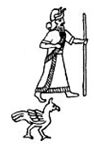 compared to the round Denderah Zodiac version
  and the Square version
 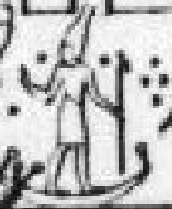 .
.