From The Alpha and the Omega - Volume III
by Jim A. Cornwell, Copyright © July 20, 2002, all rights reserved
"Volume III - The Sixth Month - Constellation Names for Bootes"
In the Sixth Month - Virgo.
Bootes, the Herdsman (Arcturus), the Plowman, the oxherd.
The constellation name for Bootes:
- Bootes, The Herdsman, [Latin Bootes, from Greek bootes, plowman, Boötes, from bootein, to plow, from bous, ox], which appears on the Meridian June 15.
- A wealth of history and mythology attaches to Bootes, especially to its brightest star, Arcturus, which is the fourth brightest star in the sky. In fact the entire constellation has been known as Arcturus.
- To the modern eye Bootes seems to have the shape of a kite or an ice-cream cone. Arcturus is at the bottom of the kite or cone, and is easily found by looking for the Big Dipper. Then follow the curving handle of the Dipper and "arc to Arcturus."
- The classical depiction of Bootes, the herdsman's body is the kitelike figure.
- The Quadrantid meteor shower radiates from the northern section of the constellation Bootes around January 4, at about 40 meteors per hour at its peak.
- Herdsman, Herdman.
- As also found in Taurus under Auriga, i.e. Shepherd is the mention of the domestication of sheep and goats in the Egyptian Naqada I, 3800-3600 B.C., Naqada II, 3400-3200 gives some relevance to the names of Auriga and its association with the Age of Taurus.
- Since Bootes which is under Virgo has such a title as the Herdsman (i.e. Arcturus) I have repeated those concepts here.
- Hebrew noqed, no-kade, act. part. from the same as the Heb. noqod, naw-kade', thus a spotter (of sheep or cattle), i.e. the owner or tender (who thus marks them), herdman, sheepmaster.
- Hebrew ra'ah, raw-aw', a primary root, to tend a flock, herdman, pastor, shepherd.
- Sumerian na-gada: herdsman ('human' + 'linen' ?).
- Sumerian na-kab-tum: cattle pen (Semitic loanword ?).
- Sumerian udul/utul(3,4,5,6,10): herdsman (udu, 'sheep', + lú, 'man').
- Sumerian gud-lah5[DU-DU]: ox driver ('bull, ox' + 'to drive').
- The Arabs believed that these circumpolar stars were a flock tended by Bootes, "ox-driver."
- Driver.
- Hebrew nagas, naw-gas', a primary root to drive (an animal, a workman, a debtor, an army), driver.
- An ancient Semitic name for the Herdsmen was Sa ina kakki makhtsu, "he who fights with weapons."
, ro'-makh, from an unused root meaning to hurl, a lance (as thrown), especially the iron point, buckler, javelin, lancet, spear.
Hebrew kiydown, kee-dohn.
Weapon.
- Hebrew keliy, kel-ee'.
- Hebrew nesheq, neh'-shek.
- Hebrew shelach, sheh'-lakh, missile of attack.
Sumerian SHU.PA, Boötes.
Sumerian šu, hand, portion, strength, to pour + (giš)pa, sprout, branch, wing.
This could have many meanings,"Hand of the Branch," "Strength of the Branch," "Portion [Plowing] for the Sprouts."
- From www.lexiline.com, "Bootes SHU.PA, means swing, teeter-totter."
- Under the Virgo constellation section from www.lexiline.com, "The Seed-Furrow (AB.SIN), d.Shala (with the) sheaf of grain." "AB.SIN rises 10 days after SHU.PA, which rises 60 days after KAK.SI.SA, thus it can only be the star SPICA (seed furrow, also refers to vulva.)."
- Also found in the Sagittarius Introduction as dShu and Pabilsag.
- Sumerian dShu (Divine hand, strength).
- Sumerian šu: n., hand; share, portion, bundle; strength; v., to pour.
- Sumerian šú: (cf., šuš(2)).
- Sumerian šu12: (cf., šùde).
- Sumerian šùde, šùdu, šùd, šu12: n., prayer, blessing; v., to pray, bless (šu, 'hand', + dé, 'to hail').
- Sumerian (giš)pa: leaf, bud, sprout; branch; wing; feather.
- Sumerian pana, pan, ban: bow (pa, 'branch', + na4, 'pebble, stone').
- Sumerian pa4,5,6: irrigation ditch, small canal.
- Sumerian pà: (cf., pàd).
- Sumerian pa...è; pa-è...ak: to show; to make appear; to make resplendent (often with -ni- or bi-) ('bud, sprout' + 'to send forth' + 'to make').
- One source claims an Egyptian-Sumerian connection: PA-RIN of the (Sun-)Hawk; Bah, Pah verses Bak, Pak, Rin (Sumerian ring, enclosure, dwelling place), the symbol looks like a square. Note: PA, (or XU) Hawk, The (Sun-)Hawk (line), of the (Sun-)Hawk race.
- In his work “BABYLONIAN STAR-LORE: An Illustrated Guide to the Star-lore and Constellations of Ancient Babylonia,” by Gavin White claims on page 44, "Watching over the agricultural preparations from on high is the figure known as SHU.PA who represents the high god Enlil. His celestial image seems to emphasize two facets of the god - as the principle god of farmers he holds the constellation of the Plough (Ursa Minor), and as the leader of the Babylonian pantheon he holds the 'rod and ring' symbol, which indicates his exalted rank."
White's image of the Babylonian version of SHU.PA is 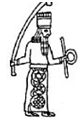 .
.
The following is more on the Shepherd relationship of Bootes as may be seen in similar information about the Sumerian LI.DUR SIPA.ZI.AN.NA. Also see the Sumerian City of Larag (Larak) for a connection with the Sumerian name Ensipadzidana and also a connection to the Orion constellation.
Shepherd.
- One source claims that Bootes is also called Shepherd, Ploughman, Pastor, Bearward (guardian of Ursa Major), Lance-holder, Shouter.
- One source claims that this is the Euphratean Sibzianna, "Shepherd-Spirit-of-Heaven."
- Under Taurus as to a connection with Orion who has Sumerian star names such as sipa-zi-an-na, "The True Shepherd of Anu," or Auriga who is sometimes called the Shepherd.
- One Babylonian cuneiform tablet calls Orion "The-Shepherd-Spirit-of-Heaven," which is also used for Bootes.
- Babylonian Ri-u-but-same, is Orion, "The shepherd."
- Richard H. Allen comments: Brown says that it was known in Assyria as Riu-but-same, "that reappears in Greek as Bootes"; and thus
"the idea of the ox-driving Ploughman or Herdsman, as applied to the constellation, is Euphratean in character."
- Sumerian LI.DUR SIPA.ZI.AN.NA, "The Navel of the True Shepherd of Anu," which reads as (li, ?/ lí, true measure + dur, umbilical cord + sipa, shepherd + zi, breath, to undress + an-na, god of heaven), this does not translate well.
- As also seen in Ursa Major Constellation Names.
- Sumerian PA+USAN: a shepherd.
- Sumerian gába[KAB]-ra: shepherd boy/girl.
- Sumerian kabar: shepherd boy (ká, 'gate', + bar, 'to open').
- Sumerian sipad, sibad, sipa; šuba; sub2,3: n., shepherd; keeper; v., to pasture, tend (si, 'to keep in order', + bad, 'to let out', or pàd, 'to find').
- Sumerian sipad-ama-[ŠA.]GAN: shepherd of mother animals ('shepherd' + 'mother' + 'to bring forth').
- Sumerian sipad-amar-ru-ga: shepherd of brought back (?) ('shepherd' + 'young ones' + rúg, 'to restore' + genitive).
- Sumerian sipad-udu-siki-ka: shepherd of wool sheep ('shepherd' + 'sheep' + 'wool' + double genitive).
- Sumerian SUD-la: a quality of the ground ('shepherd' + 'sheep' + 'wool' + double genitive).
- Sumerian mùnsub: shepherd.
- As found in Taurus under Auriga, i.e. Shepherd.
- The Shepherd connection:
- Auriga's group of stars has long been associated with goatherds, as Auriga as a Shepherd is usually portrayed with a goat over one shoulder, represented by the bright star Capella. In his lap or arms we find two, sometimes three kids (or new-born baby goats). He holds in his right hand a band.
- In "The Witness of the Stars," by E.W. Bullinger, page 134 "Auriga is from a Hebrew root which means a shepherd."
- Shepherd.
- Hebrew ro'iy, ro-ee', from act. part. of Heb. ra'ah, raw-aw', a primary root to tend a flock, i.e. pasture it, thus pastoral, as noun, a shepherd, shepherd.
- Hebrew tso'n, tsone, or tse'own (Psa. 144:13), tseh-one', from an unused root meaning to migrate, a collective name for a flock (of sheep or goats), also fig. (of men), (small) cattle, flock, lamb, sheep ([-cote, -fold, -shearer, -herd]).
- Greek poimen, poy-mane', of uncertain affin., a shepherd, (lit. or fig.), shepherd, pastor.
The Coming One
- Others call this constellation 'The Coming One,' as a picture of a man moving forward rapidly. In one hand he holds a spear; in the other hand, over his head, he holds a sickle.
- The name Bootes comes from the Hebrew root word "Bo" which means "To Come."
- Come.
- Hebrew bow', bo, a primary root to go or come.
- In "The Witness of the Stars," by E.W. Bullinger, page 42 "The Greeks called him Bo-o-tes, which is from the Hebrew root Bo, to come, meaning 'the coming' (Psalm 96:13 "For He cometh ...")."
- Rolleston "Hebrew Bootes, the coming."
- So Bootes is "The Coming One."
- One source claims that in Hebrew they called Bootes "Smat," which means "One Who Rules, Subdues, and Governs."
- In "The Witness of the Stars," by E.W. Bullinger, page 42 "Bootes was the Egyptian Smat, one who rules, subdues, and governs. Also called him Bau (like Hebrew Bo, to come), the coming one."
- Rule.
- Hebrew ma'tsar, mah-tsawr', from Heb. 'atsar, ... rule.
- Hebrew shalat, shaw-lat'.
- Hebrew shelet, shel-ate'.
- Although one source claims that some of the ancient Egyptians thought that the circumpolar stars, which never set, were evil, and saw the constellation we call Bootes as a hippopotamus -- a creature representing the incarnation of a benevolent goddess whose duty it was to keep the evil stars under control.
Plowman.
- Hebrew charash, khaw-rash', a primary root to scratch, to engrave, plough, and other words.
- The term was used with husbandmen synonymously in the Scriptures.
- A farmer in general.
- The plow was drawn by oxen, camels, cows, or heifers.
- Farming was practiced by Cain, Noah, Elisha, David, Uzziah, and Solomon.
- In Amos 9:11-15, used prophetically in verse 13 "Behold, the days come, saith the Lord, that the plowman shall overtake the reaper, ..."
Husbandman.
- Hebrew 'ikkar, ik-kawr' from an unused root to dig, farmer, husbandman, ploughman.
- Sumerian engar: irrigator, farmer (en, 'lord', + agar, 'field'; from the Akkadian 'ikkar from Semitic "to hoe, cultivate").
Under Pisces Introduction we see the following:
Sumerian MUL.APIN (see notes in Bootes and Andromeda), called "The Star of the Plow."
- In Virgo we find the constellation of Bootes is opposite of the stars that reflect Jesus' birth in Pisces. Is it possible that Jesus came in Bootes? The stars are not quite aligned. This was added here for your consideration.
- Sumerian MUL.
- Star.
- Sumerian mul: n., star; constellation; planet; meteor. v., to sparkle, shine, glow.
- Sumerian mùl: a destructive insect.
- Hebrew Kowkab, ko-kawb', probably from the same as Heb. Kabbown, kab-bone', from an unused root meaning to heap up, hilly, Cabbon, a place in Palestine, thus (in the sense of rolling) or Heb. kavah, kaw-raw', a primary root, properly to prick or penetrate, hence to blister, burn, thus (in the sense of blazing), a star (as round or as shining), fig. a prince, star.
- Sumerian APIN, Akkadian epinnu, "The Plow," referenced to Triangulum Boreale with g (gamma) (Almach or Almak) of Andromedae, Sumerian apin, plow.
- Plow.
- Sumerian (giš)apin: seeder plow (a, 'seed', + bun, 'to blow').
- From www.lexiline.com, "The Plow (GISH.APIN), d.Enlil, the lead star of the stars of d.Enlil."
- Parts of a plow.
- Sumerian (giš)á-apin: part of a seeder plow ('arm' + 'plow').
- Sumerian (giš)dam-apin: part of a seeder plow ('spouse' + 'plow').
- Sumerian (giš)PI-apin: a part of the seeder plow (barig, '36 liters in Old Sumerian period', + 'plow').
- Sumerian APIN-lal: cultivating leasehold land ('plow' + 'to pay').
- Sumerian apin-ús: plowman's helper ('plow' + 'to follow; to be next to').
- Sumerian gud-apin-níg-túg: blanket for a plow ox ('bull, ox' + 'plow' + 'thing' + 'cloth garment').
- Sumerian sag-apin(-na): plow guide ('head' + 'plow' + genitive).
- Hebrew charash, khaw-rash', a primary root to scratch, to engrave, plough, hence (from the use of tools) to fabricate, to devise, plow.
Yoke.
- As found in Taurus under Auriga, i.e. "Chariot-Yoke."
- In other sources it is also called Gar, meaning "Chariot" and Sugi, as meaning "Chariot-Yoke."
- Sumerian gúr, meaning "wheels."
- Yoke.
- Hebrew tsemed, tseh'-med, a yoke or team.
- Hebrew 'ol, ole or 'owl, from Heb. 'alal, (Chald.) al-al'.
- Other words in Hebrew 'alah; Heb. mowt, mote; Heb. mowtah, mo-taw'.
- Allen states: Brown also says that the Euphratean Sugi, the Chariot Yoke, which he identifies with alpha and beta of this constellation, remind us by sound and signification of the Zugon and Jugum of Greece and Rome respectively, and that astrology adds evidence in favor of a Chaldaean origin, for it has always claimed Libra — the Northern Scale at least — as a fruitful sign, taking this from the very foundations of astrology in the Chaldaean belief that "when the Sugi stars were clear the crops were good." In modern astrology, however, the reverse of this held in the case of the Southern Scale.
- Sumerian SHUDUN, Akkadian niru, "The Yoke," referenced as belonging to Boötes.
- Sumerian (giš)šudun(2,3,4,5), (giš)šudul(2,3,4,5): yoke, crosspiece (šúš/šú, 'to cover', + dun(4), 'warp yarns connecting opposite sides of a loom frame' and dul, 'to cover').
- Sumerian šu: n., hand; share, portion, bundle; strength. v., to pour.
- Sumerian (giš)dun-gi: a tool; a type of yoke (?) ('to scrape, dig' + 'reed' or 'firm, strong').
- Sumerian NITAH-dun-gi: a type of jackass ('male' + 'yoke' ?).
- Sumerian (giš)bìr-mar: wagon yoke ('team' + 'wagon').
- Sumerian gú giš... gál: to submit (to someone: dative) ('neck' + 'yoke' + 'to place').
- Allen states in his Capricornus section: Sayce, Bosanquet, and others think that they have without doubt identified it with the Assyrian Munakha, the Goat-Fish; and we see other probable names in Shah or Shahu, the Ibex, and in Niru, the Yoke, this last perhaps a popular one. Brown gives for it the Akkadian Su-tul of the same meaning; and another possible title, resembling the early Hindu, was Makhar, claimed also for Delphinus.
Egyptian/Coptic:
- On the Denderah Zodiac beneath the feet of Virgo, Bootes is seen as a male figure with a swine-like head and horn or crescent-shaped crown holding in both hands a great ploughshare or sickle.
- In his work “BABYLONIAN STAR-LORE: An Illustrated Guide to the Star-lore and Constellations of Ancient Babylonia,” by Gavin White he claims on page 44, "Over the preceding summer months fallow land had been prepared for the comming growing season by progressively clearing and leveling the fields, and then ploughing and harrowing to break down the soil to a workable state. What amounts to a rustic calendar can be seen among the autumnal stars where the constellation called the Harrow symbolizes the preparation of the fields and the Furrow represents their subsequent seeding."
Here is the round Denderah image  compared to White's image of Bootes
 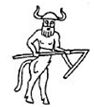 , in an attempt to promote that Babylonia influenced the Egyptian Denderah images.
White in his exerts comments, "Behind the goddess and child is the strange figure of a bull-headed man holding a hoe-like implement. He stands in front of a rectangle decorated with wavy lines – very similar to the rectangle located between the Piscean fish.
It is very likely that this figure is based on the Babylonian constellation known as the Harrow. It is described in star texts as ‘the weapon of the god Mar-biti’ and that within it is seen a representation of the Abyss – the reservoir of fresh-water found beneath the earth. We have already seen that the rectangle infilled with wavy lines symbolizes the watery Abyss in Mesopotamian art. Once again the Dendera imagery and Babylonian star-lore, even though difficult to understand in isolation, throw considerable light on each other when combined."
- In the "Gospel of the Stars," page 127 it is claimed that Lyra is "Fent-Har, the Serpent-Bruiser or horrifier in Denderah, a great female with the head of a swine, the enemy of the earth and holding in her hand a great ploughshare, symbol of tearing up, bruising, turning under."
- Of course that image is not seen in the Denderah for Lyra as specified above.
- As seen under Virgo in the Centaurus constellation is the words: From www.lexiline.com, "The wild boar (EN.TE.NA.BAR.CHUM), d.NIN.GIR.SU.
- Boar or Swine.
- Hebrew chaziyr, khaz-eer', from an unused root probably meaning to inclose, a hog (perhaps as penned), boar, swine.
- Greek choiros, khoy'-ros, of uncertain derivation, a hog, swine.
Sickle (i.e. ploughshare).
- Found in the Bible in Deut. 16:9; 23:25.
- Used mostly for cutting grain but on occasion they were used for pruning.
- Mark and John use the sickle in a figurative sense as the instrument of God's judgment (Mark 4:29; Rev. 14:14-20).
- Under the Leo constellation names for Hebrew/Greek words for Sickle we find:
- Hebrew chermesh, kher-mashe', or hermesh, from Heb. charam, khaw-ram', a primary root to seclude, to devote to religious uses, thus a sickle (as cutting), a reaping hook (Deut. 16:9; 23:25.)
- Hebrew maggal, mag-gawl', from an unused root meaning to reap, a sickle, a reaping hook (Jer. 50:16 and Joel 3:13).
- Greek drepanon, drep'-an-on, from drepo (to pluck), a gathering hook (for harvesting), a tool used for cutting grain.
- Under the Leo constellation names for Sumerian words for Sickle we find:
- The very early Sumerians saw in the curve of stars we call the Sickle an asterism (head of Leo) they knew as Gismes, the "curved weapon."
- I have not found this Sumerian word as of yet. A sickle is a curved weapon, and the following are examples of the Sumerian words:
- Sumerian giš, geš: tree; wood; wooden implement; scepter; tool; organ; plow; natural phenomenon.
- Sumerian gur10,14; ur4: n., sickle; v., to reap, harvest; to pluck; to shear (sheep); to gather in; to catch (in a net); to gather together; to join in assent (probably reduplication class).
- Sumerian še-gur10-ku5: harvest ('grain' + 'sickle' + 'to cut').
- Sumerian zubu, zubi: sickle (zú, 'flint; tooth', + bu[r], 'to pull, draw, cut off').
- Sumerian gàm: n., sickle; handle; v., to shine, glitter.
- Under the Auriga constellation in Taurus is this name the Sumerian GÀM, Akkadian gamlu, "The Crook," one source claims that it is associated with Auriga, but it seems to fit better with Leo, and the Sumerian words for the "curved weapon."
- Sumerian gam: n., decline, incline (cf., gúr); v., to bow down, kneel (for someone: dative; direction: terminative); to bend, curve; to shrivel.
- From www.lexiline.com, "The Crook Staff (GAM), god of the crook staff (d.Gamlum), one source claims this is the staff in the hand of Orion (note that it is an Egyptian waas scepter on the Denderah Zodiac)."
- The Sickle was also recognized as a backwards question mark or fishhook opposite of the Aquarius lucky stars.
- The esoteric meaning of Aquarius's Hebrew letter Tzaddi, was a fishing hook, and is seen in Matthew 17:21 where the Lord told him to cast a hook (KJV).
Harvest
- First mentioned in Gen. 8:22; 30:14; 45:6, is:
- Hebrew qatsiyr, kaw-tseer', or qatsir, from Heb. qatsar, kaw-tsar', to dock off, thus severed, i.e. harvest (as reaped), the crop, the time, the reaper, or fig.
- Greek therismos, ther-is-mos', from Gr. therizo, ther-id'-zo, from Gr. theros, ther'-os, heat, summer, thus to harvest, reap, reaping, i.e. the crop.
- April-May was barley reaping and Passover; six weeks later in June-July came the wheat harvest and the Feast of Pentecost; then in September-October was the ingathering of the fruit of tree and vine and as the seventh month the Feast of Tabernacles.
- In the NT, most of the time the term "harvest" is used figuratively for the gathering in of the redeemed saints at the end of the age (Matt. 13:39).
- As in Zech. 7:10, thus "The Pierced (One) is coming to be the judge and the conqueror and harvester of the earth, with as in Rev. 14:15 in his right hand a sharp-edged sickle.
- Rolleston claims that "Nekkar, the Pierced (Zech. 12:10)."
Other names for Bootes: Al Ka'meluz, Al 'Awwa' (11th manzil), Azimeth' Colan'za, Al Bakkar, Al Nakkar, Incalu'rus (Alfonsine), Al Khetu'rus, Kolan'za, Al Ramih, Aulad al Dhi'bah (stars), Aulad al Nadhlat (other stars), Al Hamil Luzz.
- Richard H. Allen states the following:
Among its Arabian derivatives are Nekkar, often considered as Al Nakkar, the Digger, or Tearer, analogous to the classic Trencher in the vineyard; but Ideler showed this to be an erroneous form of Al Bakkar, the Herdsman, found with Ibn Yunus.
Alkalurops, which appeared for Bootes in the Alfonsine Tables as Incalurus, is from Kalaurops, a herdsman's Crook or Staff, with the Arabic article prefixed; this now is our title for the star mu (Alkalurops). The staff, ultimately figured as a Lance, gave rise to the name Al Ramih, which came into general use among the Arabians, but subsequently degenerated in early European astronomical works into Aramech, Ariamech, and like words for the constellation as well as for its great star.
Al Haris al Sama’ of Arabic literature originally was for Arcturus, although eventually applied to the constellation. But long before these ideas were current in Arabia, that people are supposed to have had an enormous Lion, their early Asad, extending over a third of the heavens, of which the stars Arcturus and Spica were the shin-bones; Regulus, the forehead; the heads of Gemini, one of the fore paws; Canis Minor, the other; and Corvus, the hind quarters.
See Star Names of Bootes.
This file was created on November 20, 2004, and updated on July 15, 2008, and March 30, 2010.
Return to the Table of Contents or the Zodiac of Denderah