From The Alpha and the Omega - Volume III
by Jim A. Cornwell, Copyright © July 20, 2002, all rights reserved
"Volume III - Virgo and its Decan Constellations"

Virgo and its Decan Constellations.

Bootes

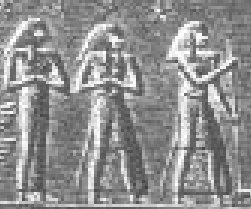
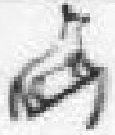
    On the Denderah Zodiac beneath the feet of Virgo, Bootes is seen as a male figure with a swine-like head and horn or crescent-shaped crown holding in both hands a great ploughshare or sickle.
    Since Bootes is seen as a netjeru in human form, therefore it represents a spiritual understanding.

    Other sources claim that Bootes is a bull-headed human holding a hoe (see Montu), and accepted as the star Arcturus.


    In "The Witness of the Stars," by E.W. Bullinger, page 42 "Bootes was the Egyptian Smat, one who rules, subdues, and governs.    Also called him Bau (like Hebrew Bo, to come), the coming one."


     On the Denderah Zodiac and the Grand Temple, Ursa Minor is seen as a wolf, or jackal.    Ursa Minor seems to be standing on a ploughshare or sickle.

    On ESNE Plate 79 the figure to the right may correlate to a woman, but she is holding a staff with a small Bull-like animal.    Since this sequences between what may be Gemini and Taurus it is uncertain if this is Bootes.
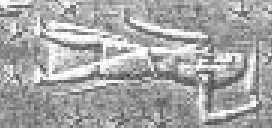
    As this is also seen between Gemini and Taurus on the ESNE Plate 79, and located between Gemini and Orion on the ESNE Plate 87 upper section.
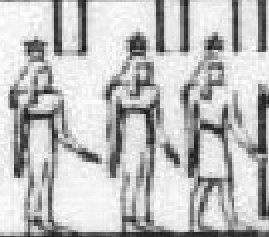
    Also note the figure located above and between the Grand Temple Decan 31-32 seen in the next column, where the individual to the right with the staff could be either Jupiter or Auriga.

    ESNE Plate 79 above shows this Virgo like figure which is probably Bootes and not Virgo, and seen as a male figure with a club or bone in his lowered right hand, and has a knife in the hand of his raised left arm.    It is located directly above Leo and Coma.
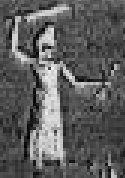
    On the upper section of ESNE Plate 87 shows the figure above as between Leo and Cancer, but seen with a knife in the raised right arm, and a bow and arrow in the left hand.    It is very similar to the previous image above, and is probably also Bootes a constellation that I propose is in Virgo.    Also see the goddess Neith for a comparison.

    Cyril Fagan comments on the above image, "But in the Egyptian zodiac they were known as the 'Bow Stars' and were included in the constellation Cancer.    Both the 'Bow' and 'Arrow' (Sirius) rose simulataneously in Egypt during the dynastic period.    The Bow Stars were the goddess Satis, who holds a bow and arrow [See Argo Navis or Canis Major Star Names], beneath the lion.    In the Esne zodiac she walks before the lion holding in her right hand a reed sickle above her head while carrying her bow and arrows in her other hand.

    On the Grand Temple as seen below these first two deities are seen between Ophiuchus (in Scorpius) and Gemini located above Decan 32.
 

    In the "Gospel of the Stars, by Joseph Seiss, page 127 it is claimed that Lyra is "Fent-Har, the Serpent-Bruiser or horrifier in Denderah, a great female with the head of a swine, the enemy of the earth and holding in her hand a great ploughshare, symbol of tearing up, bruising, turning under."

    Of course that image is not seen in the Denderah for Lyra as specified above.    See note in Bootes.


    From www.siloam.net/denderah it states Bootes is holding or reaching out to the plow or Big Dipper (i.e. Ursa Major) and entitles it as "Cultivating the Field."    Siloam promotes that "the ox leg does not signify the Big Dipper," justifying this with the ancients belief that it was known as "the Heavenly Plow."
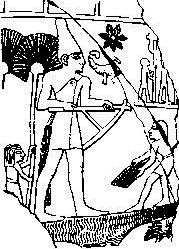
    "On the Denderah zodiac, it is clear that the labor of providing for the cosmos is signified by the male bovine (Bootes) with the plow," standing after Lupus, and "This bovine man is none other than Atlas."     Siloam shows "further proof that the bovine man holding the plow represents Bootes and the Big Dipper," by presenting Egyptian artifacts, which was assumed to be "the Narmer palette" seen below on the right "Scorpion King holding a plow walking upon tilled soil with a scorpion and a flower before his face, and a subject placing a mat before his feet.    The flower has seven petals, and is probably an early reference to the goddess of conception, Seshat (See Denderah Decan 26 and Argo Navis), the creative consort of Thoth."    Thus to scorpion and plow "this man sees the desire for the top of the world before him, which is the flower of heaven on the axis of the galaxy."

25a 25b
    From "EGYPT'S MAKING The Origins of Ancient Egypt 5000-2000 B.C." by Michael Rice copyright 1990.
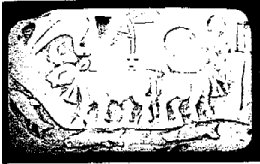
    25a. This unusal object, a two-sided plaque carved in shell, is of Egyptian provenace, though it is very un-Egyptian in character.    The reverse shows two bulls surmounted by a hieroglyphic or representation of a hoe, beneath their hooves runs a stream in which fish are swimming.    From Staatliche Museen Berlin DDR.
    25b. The hoe is identical to that carried by the dominant figure on the ceremonial mace head attributed to the late predynastic King Scorpion.    (The hieroglyph represents the phoneme 'mr'.)    From Ashmolean Museum Oxford.
    The designs on the plaque are much more typical of Elamite or Sumerian art than of Egyptian and the material shell is relatively common in western Asia, but hardly ever used in Egypt.    Likewise the fish are similar to those found on western Asiatic seals.


Select one of the following to open it.
Each of these are connected to the constellation Virgo,
Bootes, Coma Berenices, Centaurus.
Decan 14, Decan 15.

    This file last updated on February 21, 2004, and also on June 18, 2005.

Return to the Table of Contents or the Zodiac of Denderah