From The Alpha and the Omega - Volume III
by Jim A. Cornwell, Copyright © July 20, 2002, all rights reserved
"Volume III - The Third Month - Star Names for Canis Major"
In the Third Month of Gemini
Star Names of Canis Major
a Sirius, "The Dog Star," is the brightest star in the sky, which rises and sets so that its rays pass through a long path of turbulent air, so that it often flashes prismatic colors.
- The ancients sources of 1000 B.C. claim that Sirius was "red," "fiery," and "coppery," whereas from A.D. 1000 to today it is very white, with a tinge of blue. A puzzle that no one has solved. It is probably an atmospheric pollution issue, since stellar evolution does not change that rapid.
- Others claim that Sirius means "Prince," from the Hebrew Sar or Seir, as in the prince of all earth, as the root sarar implies "To make oneself a Prince."
- Prince.
- Hebrew sar, sar, from Heb. sarar, saw-rar', a primary root to have (trans. exercise, reflex get) dominion, altogether, make self a prince, (bear) rule; thus a head person (of any rank or class), captain (that had rule), chief (captain), general, governor, keeper, lord, master, prince, ruler, steward.
- In "The Witness of the Stars," by E.W. Bullinger, page 143 "the brightest star in the whole heavens! It is called Sirius, the Prince (Heb. Sar)."
- Hebrew nasiy', naw-see', or nasi, from Heb. nasa', naw-saw', or nacah, a primary root to lift, thus properly an exalted one, i.e. a king or sheik, also a rising mist, captain, chief, cloud, governor, prince, ruler, vapour.
- Prince or Ruler:
- Messiah as seen in Isaiah 9:6 - "Prince of Peace."
- Acts 5:31 - Greek archegos, ar-khay-gos, a chief leader, prince.
- Sumerian nim: n., prince; flying insect; highland; east; morning; v., to be high; to multiply in arithmetic; adj., high; early; adv., above.
- Sumerian nun: n., prince, noble, master. adj., great, noble, fine.
- Seir.
- Hebrew Se'iyr, say-eer', formed like Heb. sa'iyr, saw-eer', or sa'ir, from Heb. sa'ar, saw-ar', a primary root to storm, shiver, fear, thus shaggy, as noun, a he-goat, by analogy a faun, devil, goat, hairy, kid, rough, satyr, thus rough, Seir, a mountain of Greek word Idumea and its aboriginal occupants, also one in Palestine, Seir. Seir is the location of the descendants of Edom or Esau (Elam).
- One-source claims that Saru (Semitic) a temple or palace sign, which is the source of the Egyptian name serekh.
- Sumerian sar, šar: n., a surface measure of one square ninda = 36 meters2. v., to insert, enter; to begin; to write; to pay, deliver punctually; to disturb someone; to drive (with -ni-); to drive, chase away (with -ta-); to run. adj., driven out, pursued.
- Sumerian sár: (cf., šár).
- Sumerian šar: (cf., sar).
- Sumerian šár, sár: n., totality; world; horizon. v., to be many; to multiply or mix (with -da-); to slaughter; to request, implore. adj., numerous.
- Sumerian lúšár: a military officer.
- Sumerian šar8 (NI): to interpret, explain.
- Sirius was represented in ancient Egypt as a five-pointed star, an icon, which is seen on the walls of the Temple of Hathor at Denderah.
- Sirius is called the "Divine Sothis," which is 1461 years.
- Greek Egyptians claim Sirius comes from the Greek seirios, meaning "scorcher," which may be derived from an even more ancient Egyptian word.
- Some claim it also means "Glittering", "The Burning One" and "Lamp."
- The name of the constellation, Naz (hawk "Sent" or "Caused to Come Swiftly") and the star Seir (means "Prince.").
- Other information states the word Naz means "Caused to Come Forth," "Coming Swiftly Down," on its head is a pestle and mortar.
- Hawk.
- Hebrew nets, nayts, from Heb. natsats, naw-tsats, a primary root to glare, i.e. be bright-colored, sparkle, thus a flower (from its brilliancy), also a hawk (from its flashing speed), blossom, hawk.
- Hebrew nasiy', naw-see', or nasi, from Heb. nasa', naw-saw', or nacah, a primary root to lift, thus properly an exalted one, i.e. a king or sheik, also a rising mist, captain, chief, cloud, governor, prince, ruler, vapour.
- Some believe that the word Nazarene from Nazareth, stems from the combination of Naz-Seir-ene meaning "the sent Prince."
- One star in this constellation is called Kasista, which is Akkadian for "the leader," also called by Plutarch.
- In "The Witness of the Stars," by E.W. Bullinger, page 143 "In the ancient Akkadian it is called Kasista, which means the Leader and Prince of the heavenly host." "While (as Mr. Robert Brown, Junior, points out) the Sacred Books of Persia contain many praises of the star Tistrya or Tistar (Sirius), 'the chieftain of the East.'" Euphratean Stellar Researches.
- From www.louisville.edu, "from Robert Burnham Jr., in Burnham's Celestial Handbook, Vol. I. Sirius is a star known as:"
- Old Akkadian Mul-lik-ud, "the Dog Star of the Sun."
- Babylonia Kakkab-lik-ku, "Star of the Dog."
- Babylonians Kak-si-di, "shinning like copper," in the Bronze Age, is mentioned "In the Iliad, Homer refers to Sirius gleaming like Achilles' copper shield. This metaphor of copper usage is part of the Mystery of the red Sirius 2000 years ago."
- In "Hamlet's Mill" by Giorgio de Santillana and Hertha von Dechend, Gambit Inc. 1969 it states on page 216-217, "... the ritual text of the Babylonian New year addresses Sirius as 'mulKAK.SI.DI, who measures the depth of the Sea'. mul is the prefix announcing the star, KAK.SI.DI means 'arrow.' The bow from which it is sent on its way is a constellation, built from stars of Argo and Canis Major."
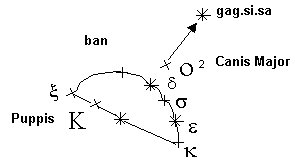
"The Mesopotamian constellation of Bow and Arrow (mulBAN and mulKAK.SI.DI, or gag.si.sa) as reconstructed on the evidence of astronomical cuneiform texts; gag.si.sa/KAK.SI.DI is Sirius, the 'Arrow Star'."
"In the so-called 'Round Zodiac' of Dendera (Roman Egypt), the goddess Satit (see Argo Navis - Sextant) is aiming her arrow from the same bow at the star on the head of the Sothiscow-Sirius again."

- In his work “BABYLONIAN STAR-LORE: An Illustrated Guide to the Star-lore and Constellations of Ancient Babylonia,” by Gavin White in his exerts claims, "On the Babylonian star-map the stars of Canis Major, which include Sirius, are referred to as the Bow and Arrow. We can be quite certain that the Babylonian star figure was depicted as a female archer, modeled on the warrior goddess Inanna. The Arrow was treated as a separate constellation associated with the god Ninurta, who combined the roles of warrior and farmer; one of his symbols from entitlement stones is known to be a perched bird. Once again a close correspondence can be seen between the Dendera images and what we know of the Babylonian constellations."
White's image of female archer is seen on page 41 shown here 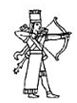 , where he claims "Inanna herself is portrayed among the stars in the form of the Bow-constellation. Together with her sacred Lion, she marks the summer as the season of war, when campaigns commenced in the spring finally come to fruition. She grants glory and victory to her royal favorites who are respresented in the heavens by the King Star, which stands at the Lion's breast."
My comment: Of course the round Denderah image for Argo Navis (Sextant) seen here  in no way resembles White's version above.
- Chaldean Kak-shisha, "the Dog Star that Leads."
- Sumerian KAK.SI.SÁ, Akkadian Shukudu, "The Arrow," these names complies to Sagitta but are related more to the star a Sirius in Canis Maioris, this will derive as the Sumerian (kak, peg, spike, nail + si, put, place, to do + sá, advice, approach, compete), and possibly "To approach and place a peg/spike."
- [See notes under Capricornus in Sagitta for more on the Sumerian KAK.SI.SA the "Arrow"].
- Assyrian Kal-bu-sa mas, "the Dog of the Sun."
- Chaldean Du-shisha, "the Director."
- Later Persians called it Tir, "the Arrow," note to see Sumerian TIR.AN.NA seen in the Gemini constellation names.
- One sources claims that this is "Mazzaroth."
- Semitic Hasil.
- Hebrew Sihor, which is an Egyptian name learned by the Hebrews during their time in the Land of the Pharaohs.
- Phoenician Hannabeah, "the Barker," also used in Canaan. One of the manzil stars.
- Dogon, North African province Mali, south of Sahara, west of Egypt (Nubia or Kush).
- Euphratean Sirius, in some epithets is called Ban, "Star of the Bow" (similar syllables for "bow" and "dog" in Assyrian, the name is not absolutely certain), but is also called "Star of Stars," and "The Propitious Star of Heaven."
- As the "Bow Star" it has a remarkable connection with the Chinese version of the figure: just SE of Sirius was the Chinese Hou-Chi, the Bow and Arrow, aimed at Sirius, the "Celestial Jackal."
- Other names for Sirius: Canicula, Dog Star, Aschere, Alsere' (Grotius), Elscheere', Scera', Al Shi'ra, Al Si'ra, Al Suhail' (modern), Shu'ra al Shamiy'yah, Shi'ra al 'Abur al Yamaniy'yah, G'abbar', and the Egyptian Sothis.
- In "The Witness of the Stars," by E.W. Bullinger, page 144 "Other stars, not identified ... are - Aschere (Hebrew), who shall come; Al Shira Al Temeniya (Arabic), the Prince or chief of the right hand."
b Mizram, which in Arabic means, "herald," which is what it does in the case of Sirius.
- Herald.
- Hebrew karowz (Chald.), kaw-roze', from Heb. keraz (Chald.), ker-az', probably of Greek origin, Greek kerusso, kay-roos'-so, of uncertain affinity, to herald (as a public crier), especially divine truth (the gospel), preach, proclaim, publish, thus to proclaim, make a proclamation, thus a herald.
- One source calls it Murzim, Mur'zim, or Murzam, with a meaning of "the roarer," as in to announce Sirius.
- Also seen as Al-Mur'zim, "the roarer."
- In the "Gospel of the Stars," by Joseph Seiss, page 117, "Mirzam, the Ruler."
- In "The Witness of the Stars," by E.W. Bullinger, page 144 "b (in left forefoot) ... Mirzam, the prince or ruler."
- Other names for Mizram: Mir'zam, Mir'za, Al Kalb, Mirzama' al Shi'rayain, Al Mirzaman'.
g Muliphein', "star to swear by."
- Also see g Centauri (Muliphain).
- Muhlifan, means "star sworn by."
- In the "Gospel of the Stars," by Joseph Seiss, page 117, "Muliphen, the Leader, the Chieftain."
- In "The Witness of the Stars," by E.W. Bullinger, page 144 "Muliphen, (Arabic), the leader, the chief."
- Other names for Muliphein': Muliphen, Isis, Mir'za.
d Wesen, Wez'en, which is East of Sirius, and possibly, means "weight."
- Arabic Al-Wazn, means "the weight."
- In "Hamlet's Mill" by Giorgio de Santillana and Hertha von Dechend, Gambit Inc. 1969 it states on page 271-272, "... one stumbles over the strange name given to Canopus by the Arabs; they call it 'the wieght,' and the Tables of Alphonsus of Castle spell it 'Suhel ponderous,' the heavy-weighing Canopus." Which appears to be a reference to "Suhail al wazn," seen on Argo Navis Star Names
- Also see the modern constellation Columba (Dove).
- The constellation's name was a genuine attempt to immortalize biblical events and was originally Columba Noae, which by literal interpretation means "The Dove of Noah."
- Columba's two stars of interest are: a Phakt (Phact or Al-Fakhitah) meaning "The dove" and b Wezn (Wazn or Al-Wazn) meaning "the weight." Columbia is a constellation seen below Canis Major, Lepus and Eridanus. Also of interest is see the notes on Phakt under the information on Lepus Decan.
- In the "Gospel of the Stars," by Joseph Seiss, page 117, "Wesen, Shining, Illustrious, Scarlet."
- In "The Witness of the Stars," by E.W. Bullinger, page 144 "d (in the body) ... Wesen, the bright, the shining."
- Other names for Wesen: Alwazn, Wesen, Al Wazor, Al Wazn, Muhlitain'.
e Adhara, "maidens" is southwest of Wesen and an Arabic word meaning "the virgins."
- Arabic Al-'Adhara, means "The maidens."
- The name's connection with Canis Major is unknown. Although I did find the following:
- Sumerian BAN (GISH.BAN), Akkadian Qashtu, "The Bow," which is derived from the Sumerian (ban, bow [gish, wood + ban, bow]), thus a "Bow, made from wood." This name also claims that the three stars t (tau), d (delta), s (sigma), and the star e (epsilon) the Arabic Adhara, form what is called "the virgins," in the constellation Canis Maioris seen above on Sirius regarding KAK.SI.DI which mentions a "BOW".
- See note in Sagittarius as to an incomplete Babylonian fragment is thought to read Kakkab Kastu, Akkadian Ban, "The Constellation of the Bow," which seems to be reversed from the Sumerian as seen below.
- [See Sumerian giš, geš, tree, wood, plow, under Cancer for the subject of the Ploughing of Ursa Major].
- Sumerian ban, pana, pan: bow (pa, 'branch', + na4, 'pebble, stone').
- Bow.
- Hebrew qesheth, keh'-sheth; from Heb. qashah, kaw-shaw', root to be dense, in the original sense of Heb. qowsh, koshe, root to bend, of bending; a bow, for shooting.
- Also the word Kish.
- Hebrew Qiysh, keesh, from the Heb. qowsh, a bow, Kish.
- From www.lexiline.com, "The Bow (BAN), the Elamite d.Ishtar, the daughter of d.Enlil," same as Sumerian BAN, "bow."
- Virgins, Daughters of Men.
- Sumerian ki-sikil: young girl; virgin ('place' + 'pure').
- Sumerian sikil: v., to be/make clean, pure (siki, 'hair' ?, + ul, 'to shine'; cf., suku5, 'to shine brightly', sig7, 'to create; to make beautiful'); adj., clean, fresh, pure, virgin.
- Hebrew ben, bane, a son, although in Gen. 6:4 "daughters" is actually written Tau (Vau vowel) Nun Beth, or B(uh)N(oh)Th, probably in Heb. benoth, banowth.
- Some sources call this star "The Glorious."
- In the "Gospel of the Stars," by Joseph Seiss, page 117, "Adhara, the Glorious."
- In "The Witness of the Stars," by E.W. Bullinger, page 144 "e (in the right hind leg) ... Adhara, the glorious."
- Other names for Adhara: Adara', Adhara', Al Zara', Udara', Udra'.
z Furud, is called "apes," in one source, but is the Arabic word meaning "solitary."
- Arabic Al-Furud, means "individual" stars.
- In "The Witness of the Stars," by E.W. Bullinger, page 142 "In the Denderah Zodiac he (Canis Major - Sirius) is called Apes, which means the head."
- Other names for Furud: Phurud, Al Furud.
h Aludra, Aludra', "maidenhead," another Arabic word with the same root as Adhara, meaning "virginity" the reason is unclear.
- Arabic Al-'Udhrah, means "The maidenhead."
- Other names for Aludra: 'Adhra.
In "The Witness of the Stars," by E.W. Bullinger, page 144 "Other stars, not identified ... are - Abur (Hebrew), the mighty; Al Habor (Arabic), the mighty."
Other stars not shown here are e, q1, q2, i, k, o2, p, and w to round out the 14 stars of Canis Major.
Return to Constellation Names for Canis Major.
This file updated on March 14, 2005, December 31, 2006, and March 30, 2010.
Return to the Table of Contents or the Zodiac of Denderah