Cancer and its Decan Constellations.
Ursa Major
On the Denderah Zodiac, Ursa Major is seen as a large thigh and leg of some kind of hoofed animal in the very middle of the Denderah Zodiac circle.
Of interest is one of its stars |
Seen above is Draco with a crocodile on its back with a folded feather on its wrist, while holding a chain attached (or mooring post) to the leg of an animal (Ursa Major) as seen on the lower section of ESNE Plate 87 (Also see Tauret). |
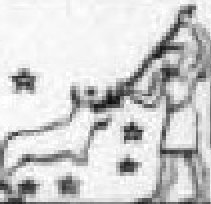
Sagitta may be the arrow in the hands of a deity on the Grand Temple located above Decan 16-17, between Capricornus and Sagittarius. This seems to be out of sequence for the traditional position with Cancer, but then Cancer also has a dual position in the heaveanly scheme. 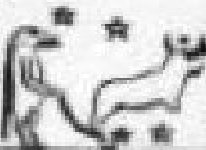 |
In "Hamlet's Mill" by Giorgio de Santillana and Hertha von Dechend, Gambit Inc. 1969 it states on the Appendices page 414 "This mnj.t wr.t - Mercer writes it min.t - the 'great landing stick,' is said 'to mourn for the soul of the dead in the Pyramid Texts ... The constellation transcribed menat by Brugsch, mnit by Neugebauer - occurs in two categories of astronomical monuments, namely (1) in the Ramesside Star Clocks (Theban hour tables), and (2) in the ceiling pictures of royal tombs in the zodiacs of Dendera, etc. In every case the peg or post rests in the hands of Isis disguised as a hippopotamus; fastened to the mooring-post is a rope or chain, the other end of which is tied Maskheti, the bull's thigh, i.e. the Big Dipper, and in one of the texts it is stated (Brugsch, Thesaurus, p. 122) that 'it is the office of Isis-Hippopotamus to guard this chain'." From Massey’s ANCIENT EGYPT Vol. 1 (T. Fisher Unwin, London, 1907) pp. 310-312: "Massey has a picture from the ‘rectangular zodiac’; it shows a hippopotamus on the left with a chain running to the one and only leg of a cow. He calls the leg the haunch or thigh of the milch (kept for milking) cow Nut (he also says it is of Hathor, the great mother as a cow). It is in the constellation Meskhen meaning ‘womb,’ the birth of the celestial waters and ‘the place of rebirth for the souls in the heaven of eternity." "The Haunch (an animal’s loin and leg together) is a pole of heaven around which the stars revolve. In the center of the circular zodiac there is an animal leg, much like that of a cow. It is the center around which the whole representation revolves." Ad de Vries in his Dictionary of Symbols and Imagery says the thigh stood for strength and support in Egypt.
In "The Witness of the Stars," by E.W. Bullinger, page 154-157 he reports nothing as to Ursa Major on the Denderah Zodiac, as if it is being ignored.
From www.siloam.net/denderah it states Bootes is holding or reaching out to the plow or Big Dipper (i.e. Ursa Major) and entitles it as "Cultivating the Field." Siloam promotes that "the ox leg does not signify the Big Dipper," justifying this with the ancients believed it was known as "the Heavenly Plow." |