From The Alpha and the Omega - Volume III
by Jim A. Cornwell, Copyright © July 20, 2002, all rights reserved
"Volume III - The Fourth Month - Constellation Names for Ursa Major"
In the Fourth Month of Cancer
Ursa Major, Great Bear, The Greater Sheepfold, Big Dipper
The constellation name for Ursa Major:
It was also known as "The Plough, the Wain, or Wagon."
- Sumerian MAR.GÍD.DA, Akkadian Eriqqu, "The Wagon," Ursa Major.
This would read as Sumerian (mar, wagon, chariot + gíd, long + da, nominative), thus "The Long Wagon."
- Sumerian mar: wagon whip (?) ('whip' + 'wagon').
- Sumerian (giš/urudu)mar, gar7: n., spade; earthworm; wagon (Akk. marru "hoe, spade" from Semitic root "to hoe, farm"); v., to sow, scatter; to coat, apply; to don; to immerse; to enclose, lock up.
- Sumerian anše-mar: chariot or wagon ass ('equid' + 'wagon').
- Sumerian (giš)bìr-mar: wagon yoke ('team' + 'wagon').
- Sumerian lúMAR-TU[-KI]: Amorite - Semitic nomad of the western desert ('wagon' + 'to be born').
- Egyptian Mar is a pictograph of a drill or borer, as if derived from the Sumerian Mar sign for a drill.
- Egyptian MAR, MER, to pierce, or drill.
The Egyptian Mar means "hero," pictured as the hieroglyph, sign of a drill.
-
 .
.
- Sumerian MAR, pierce, twist, turn, is also pictured as a drill.
Thus the same sign in Sumerian means, "pierce, throw down, destroy," like a Wild Bull.
-
 .
.
- Wagon.
- Hebrew 'agalah, ag-aw-law', from the same as Heb. 'agol, aw-gole', or 'agowl, aw-gole', from an unused root meaning to revolve, circular, round, thus something revolving, i.e. a wheeled vehicle, cart, chariot, wagon.
- Arabic Ogilah, means going around, as wheels.
- Sumerian gíd: long.
- Sumerian giš-gíd-da: long wood; punting pole; javelin, spear ('wood' + 'long' + nominative).
- Sumerian (giš)gú-gíd-gíd: an agricultural tool ('neck' + reduplicated 'long').
- Sumerian im-gíd-da: small, one column tablet ('clay tablet' + 'long' + 'side').
- Sumerian ú-gíd-da: long grasses ('grasses' + 'long' + nominative).
- Sumerian da: n., arm, side; v., to hold; to be near; to protect; prep., comitative suffix - with.
- Sumerian da5: to surround, beset, besiege (cf., dab); (with, or with someone -da-).
- Sumerian (giš)bar-bé-da: a tool.
- Richard H. Allen comments: The Goths similarly called the seven stars Karl Wagen, which has descended to modern Germans as Wagen and Himmel Wagen, the last with the story that it represents the Chariot in which Elijah journeyed to heaven. But in the heathen times of the northern nations it was the Wagon of Odin, Woden, or Wuotan, the father of Thor, and the Irmines Wagen of the Saxons. Grimm cites Herwagen, probably the Horwagen of Bayer and the Hurwagen of Caesius; while a common English name now is the Waggon. The Poles call it Woz Niebeski, the Heavenly Wain. In all these similes the three tail stars of our Bear were the three draught-horses in line.
- In his work “BABYLONIAN STAR-LORE: An Illustrated Guide to the Star-lore and Constellations of Ancient Babylonia,” by Gavin White gives this image of Ursa Major which is seen on page 49 shown here as
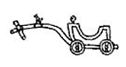 and comments, "The image most characteristic of the circumpolar regions is of course the wagon, which is repeated twice over. The associated lore of the Wagon constellation clearly indicates that it was thought to rule over life and death - one medical text even states that a mortally ill man cannot die without the permission of the Wagon star. It is thus very likely that the celestial Wagons are in fact funerary biers that carried the corpse of the dead man to the burial ground, and thus by extension they could also be thought of as transporting the deceased to the realm of shades.
Throughout ancient Eurasia and the Near East wagons and chariots have been found in the burials of the most affluent members of society. We may be justified to infer that the circumpolar stars close to the celestial Wagons may be specifically reserved for the dead nobility - a point worth noting as a very similar conception is found in the funerary lore of ancient Egypt where the souls of departed pharaohs were thought to dwell in the circumpolar regions."
As you can see for yourself the image for Ursa Major above has no correlation with the Round Denderah image  and the Esne temple image
 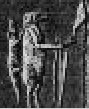 and the Square Denderah images
 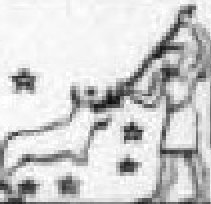 and
and 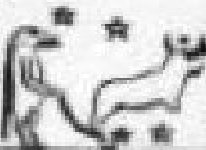 , but see the Denderah Decan information for more detail.
In "Hamlet's Mill" by Giorgio de Santillana and Hertha von Dechend, Gambit Inc. 1969 it states in regard to a chariot on page 266, "... four-wheeled truck the Big Dipper, Greek hamaxa, Latin plaustrum and Sumerian MAR.GID.DA equal to Charles' Wain."
One source claims that the Sumero-Akkadian word Mar-gidda, shown above means "The-Long-Chariot" and "Lord-of-the-Ghost-World."
- Connected with Mul-lil, Lord of the Underworld and the Night-world.
- Sumerian mul: n., star; constellation; planet; meteor; v., to sparkle.
- and in this aspect was called Wul-mo-sarra, "The-Lord-the-Voice-of-the-Firmament."
In Job 38:32 ".. or canst thou guide (make them appear) Arcturus with his sons?" Here Arcturus (a star in Bootes, which means "the guardian of the bear" or "the north") may refer to Ursa Major, and his sons are the three stars in his tail. The great and less Bear are also called by the Arabs "Daughter of the Bier," whereas the quadrangle being the bier, the three others the mourners.
Al Naish, or Annaish is the Arabic name of the constellation of Ursa Major, which means "The Assembled Together," as in a fold. Note Na -ish.
- In the "Gospel of the Stars, by Joseph Seiss, page 127, "the ordered, or assembled together, as sheep in a fold."
- Rolleston claims that the Hebrew Ash means, the assembled, (Arcturus) Job 9:9, Biblical assemble - Joel 3:11.
- One source calls it 'Ash and her offspring for Job 9:9 and Job 38:31-32. Basically "Canst thou guide Ash and her offspring."
- Authorized Version - "Arcturus and her sons."
- In "The Witness of the Stars," by E.W. Bullinger, page 154, "Arcturus and his sons."
- Revised Version - "Bear and his train (margin, sons)."
- In "The Witness of the Stars," by E.W. Bullinger, page 154, "The Bear with her train."
- One source claims that the Book of Job shows Ash or Ayish, as to the Hyades (in Taurus), as to the Vulgate and Septuagint this is "Arcturus," and "Hesperus."
- Ash resembles the Arabic na'ash, "a bier," the four stars of the Wain, the three in front as mourners under the title of Benat na 'ash, "daughters of the bier." Job speaks of "children of Ayish," or Arcturus' sons. Bible denotes Ash as "moth." Ayish as seen in Syrian Peshitta, is Iyutha (signifying Aldebaran, the great red star in Taurus), whereas the rainy Hyades are "the children."
- Sumerian asa, as, az: cage; fetter; bear; myrtle.
- Mezarim, the Bears (Great and Little), see notes in Canis Major in Gemini.
- Also see star name Mesarthim (Metsarim or Metharim) under Aries, Hebrew mazowr. g Mesarthim, which is, considered a mistranslation of ancient Hebrew texts.
- Mesarthrim' which is specified as meaning "the fat ram."
- Fat.
- Hebrew cheleb, kheh'-leb or cheleb, khay'-leb, from an unused root meaning to be fat, grease or marrow.
- Hebrew dashen, daw-shane', a prim. root to be fat, rich, fertile;
- Other words are Hebrew bariy, baw-ree'; Heb. shamen, shaw-mane'; Heb. marbeq, mar-bake'; Heb. meriy', mer-ee'; Heb. yaqosh, yaw-koshe'.
- Other words in Hebrew Merathayim, mer-aw-thah'-yim, dual of Heb. mar, mar, bitter, thus double bitterness, Merathajim, an epithet of Babylon.
- In "The Witness of the Stars," by E.W. Bullinger, page 105 "g Mesartim (Hebrew), the bound." (Near to b). Thus it would have to be the Hebrew Mesartim, "the bound."
- Bound.
- Hebrew mazowr, maw-zore', or mazor, maw-zore', from Heb. zuwr, zoor, a primary root to press together, tighten, in the sense of binding up, a bandage, i.e. remedy, hence a sore (as needing a compress), bound up, wound.
- Hebrew maçoreth, maw-so'-reth, from Heb. 'açar, aw-sar, a primary root, to yoke or hitch, to fasten, join, a band, bond.
- Hebrew mowçer, mo-sare', also (in plural) fem. mowçerah, mo-say-raw', or moçerah, mo-ser-aw', band, bond.
- Other words for Bound: Hebrew 'aqad, aw-kad'; Heb. qashar, kaw-shar'; Heb. ta'avah, tah-av-aw'; Heb. tsarar, tsaw-rar'; Heb. pathiyl, paw-theel'; Heb. gebuwl, gheb-ool' or ge-bul.
- Sumerian sur: n., rushes; v., to delimit, bound, divide; to press (out); to brew (beer); to submerge (reduplication class ?).
- Sumerian šita(4); šid3,4,5: n., band; bond, tie; v., to bind; to be together; to join, link with; to couple; adj., bound, intact.
- Rolleston claims "Mesarthim', Mesartim', was 'First Star in Aries."
- Mezarim to some was Arcturus (Ursa Major) in mistake, for Arctos as seen in the Vulgate and Septuagint.
- Job opposes to the "chamber of the south," as the source of cold, an asterism named Mezarim (Job 37:9).
- Job 9:5 "Pleiades and the chambers of the south."
- Job 37:9 "Out of the south, cometh ... whirlwind."
- Hadre Theman ("Chambers of the South") may be Canopus or the "Ship" of Argo Navis in Cancer, the Southern Cross or Crux in Libra and Centaurus in Virgo.
- Chamber.
- Hebrew cheder, kheh'-der, from Heb. chadar, khaw-dar', a prim. root, properly to inclose (as a room), i.e. (by analogy) to beset (as in a siege), enter a privy chamber, thus an apartment, chamber.
- South.
- Hebrew teyman, tay-mawn', or teman, tay-mawn', denom. from Heb. yamiyn, yaw-meen', the right hand or side, locally, the south, thus the south (as being on the right hand of a person facing east, south).
- Other names for Mesarthim: Scartai'.
- Rolleston and "The Witness of the Stars," by E.W. Bullinger, page 153-154, "While Arcas, or Arctos (Artic Regions) a traveling company or the stronghold of the saved." Gen 37:25.
Babyonian:
- Richard H. Allen states: And Achilles Tatios distinctly asserted that it was from Chaldaea. But Brown thinks, in regard to the identity of the archaic and modern constellations of this name in that country, that at present there is no real evidence to connect the Kakkabu Dabi (or Dabu, the Babylonian Bear) with the Plough or Wain, still less with Ursa Major; and identifies the latter with the Euphratean Bel-me-Khi-ra, the Confronter of Bel, — Berlin, with Bel himself. A group of seven stars is often shown on the cylinders from Babylonia, Lajard's Culte de Mithra giving many instances of this, although the reference may have been to the Pleiades; while it is Sayce's suggestion that perhaps "the god seven," so frequently mentioned in the inscriptions, is connected with Ursa Major.
Egyptian/Coptic:
- To the Egyptians the stars of the dipper are the thigh of a bull (the seven stars).
- On the Denderah Zodiac, Ursa Major is seen as a large thigh and leg of some kind of hoofed animal in the very middle of the Denderah Zodiac circle.
- Of interest is the star g Phad or Phecda was the Arabic Al-Fakhidh meaning "the thigh."
- In "Hamlet's Mill" by Giorgio de Santillana and Hertha von Dechend, Gambit Inc. 1969 it states on page 301, "... the Babylonians called the Big Dipper 'bond of heaven,' 'mother bond of heaven,' the Greeks spelled it 'Omphaloessa'."
On the Apendices page 405 "Taurus is the head and first third of a bull, his 'thigh' turning around in the circumpolar region. Thus, it might be something to think about that in the Round Zodiac of Dendera (Roman period), the circumpolar 'thigh' shows a ram sitting on it, looking back, moreover, as benefits the zodiacal Aries (See F.S. Lauth, Zodiaques de Denderah [1865], p. 44). G.A. Wainwright, in 'A Pair of Constellations,' Studies presented to F.L. Griffith (1932), p. 373, with reference to Benedite, mentions a thigh with the head of a ram from Edfu, called the 'Foreleg of Khnum' (cf. Monuments dell' Egitto e della Nubia, Ippolite Rosellini ed. [1844], vol. 3, plate 24)."
On the Appendices page 412 "The object that Irragal (Nergal) is tearing out is called tarkulla, Sumerian DIM.GAL, which has been translated into '(Anchor-) post,' 'ship's mast,' 'mooring-post' (Heidel), also 'anchor' itself, and even 'steering-oar'."
On the Appendices page 414 "This mnj.t wr.t - Mercer writes it min.t - the 'great landing stick,' is said 'to mourn for the soul of the dead in the Pyramid Texts ... The constellation transcribed menat by Brugsch, mnit by Neugebauer - occurs in two categories of astronomical monuments, namely (1) in the Ramesside Star Clocks (Theban hour tables), and (2) in the ceiling pictures of royal tombs in the zodiacs of Dendera, etc. In every case the peg or post rests in the hands of Isis disguised as a hippopotamus; fastened to the mooring-post is a rope or chain, the other end of which is tied Maskheti, the bull's thigh, i.e. the Big Dipper, and in one of the texts it is stated (Brugsch, Thesaurus, p. 122) that 'it is the office of Isis-Hippopotamus to guard this chain'."
On the Appendices page 416 "mnj.t (menat) as Menouthis, the wife of Canopus, steersman of Menelaus (Greek Eumenouthis)."
- Sumerian DIM.GAL as mentioned in the above texts, this could mean a "Great or Enormous Mast, Rope or Post."
- Sumerian dimgul: mast (dim, 'to bond, tie', + gul, 'enormous').
- Sumerian dim: n., bond, tie; rope; v., to make fast.
- Sumerian dím: to make, build, fashion, create.
- Sumerian (giš)dím: post.
- Sumerian gal: n., a large cup; adj., big, large, great.
- Sumerian ulul(2): binding; harness; leash, chain (u, 'ten, many', + lal, 'to strap, harness').
Latin, Ursa, the bear, the strong (Rolleston claims as Biblical mighty - Job 6:23).
- In "The Witness of the Stars," by E.W. Bullinger, page 155, "The ancient Jewish commentators interpreted Ash as the seven stars of this constellation. They are called by others Septentriones, which became the Latin word for North."
Other names associated to the constellation Ursa Major:
- Dob, Dobh (Hebrew), Dub (Phoenician), Dub'be, Dub'he, Dub'on.
- Al Dubb al Ak'bar, Dub Alac'ber, Dubhelac'bar, Dubheh Lachur (mentioned in the "Gospel of the Stars, by Joseph Seiss, page 127, "the latter herd or flock.").
- Arabian, Al Dubb al Akbar, the Greater Bear, — Dubhelacbar with Bayer and Dub Alacber with Chilmead, — all of these perhaps adopted from Greece. Caesius cited the "Mohammedans'" Dubbe, Dubhe, and Dubon; and Robert Browning, in his Jochanan Hakkadosh, repeated these as Dob.
- Al Haud: But very differently in early Arabia it was Al Haud, the Pond, into which the Gazelle, our Leo Minor, sprang when frightened at the lashing of the Lion's tail; although some of the Desert observers claimed that this Pond lay among the stars of the neck, breast, and knees of the Greater Bear (Ursa Major);
- Kaf'zah al Thiba'.
- Na'ash Laa'zar (the Square): Riccioli, quoting Kircher, said that the Arabian Christians with more definiteness termed it Na’ash Laazar, the Bier of Lazarus.
- Banat Na'ash al Kubra: The Hebrew 'Ash, or 'Ayish, is reproduced by, or was derived from, the Arabic Banat Naash al Kubra, the Daughters of the Great Bier, i.e. the Mourners.
- It was the Grande Ourse of the French, the Orsa Maggiore of the Italians, and the Grosse Bar of the Germans.
- Richard H. Allen states: ... our North American Indians show evidence of a common origin in the far antiquity of Asia, as they called the seven stars Okuari and Paukunawa, words for a "bear," which in no way resembles the animal, this was before they were visited by the white men, as is attested by Le Clercq in 1691, by the Reverend Cotton Mather in 1712, by the Jesuit missionary La Fitau in 1724, and by the French traveler Charlevoix in 1744.
He also comments: Among the adjacent Syrians it was a Wild Boar, and in the stars of the feet of our Bear (now Leo Minor) the early nomads saw the tracks of their Ghazal (gazelle). Similarly, in the far North, it has been the Sarw of the Lapps, their familiar Reindeer, the Los of the Ostiaks, and the Tukto of the Greenlanders.
Continue to see more on the Constellation Names for Ursa Major or to see Star names for Ursa Major.
This file last updated on March 14, 2005, July 15, 2008, and March 30, 2010.
Return to the Table of Contents or the Zodiac of Denderah