|
Decan 20-21

|
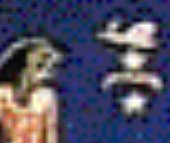
Decan 20 below the front feet of Canis Major is seen as a male figure with a hawk head, and no crown with two stars aligned vertically under his left hand. There is no major connection noticeable with Grand Temple Decan 1.
Since Decan 20 is seen as a netjeru in a male human form, therefore it represents a spiritual understanding.
The hieroglyphics below may start with
either
a mousetrap, Egypt. Peh,
or lion sign, Egypt. r, l, rw mouth sign,
next is either
the Egyptian sign for ta
or a face sign, Egypt. hr,
next is
the Egypt sign for pt, Pet depicts the sky as a ceiling, which drops at the ends, as do the horizons, it symbolizes the heavens.
or a bird with wings in flight, maybe Egypt. t, or possibly Nekhbet a goddess portrayed as a vulture, protectress of Upper Egypt.
and ends with a star.
Thus [Peh-ta-t or Peh-hr-pt]
or we may read [l/rw-hr-pt].
Note that on the Denderah Zodiac, Eridanus is known as Peh-ta-t, the mouth of the river, seen in Aries.
|
If compared to Denderah Decan 20, there is no noticeable connections.
 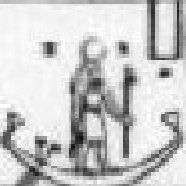
Grand Temple Decan 1 is a male figure with a sun disk crown with three stars above him. He also is holding a shepherd’s crooked end scepter, but also seen as the Egyptian waas-scepter in his left hand. The crooked end scepter is also seen on Grand Temple Decan 1 and 11.
On Grand Temple Decan 1, 10, and 15 we find a male figure with a sun disk crown on their heads. Where 10 and 15 are hawk heads.
Decan 1 is called  Tepi en ken Mout, Tepa-kenmut or Tepi ken mout, from Tepi en ken Mout, Tepa-kenmut or Tepi ken mout, from
the Egyptian head sign for Tep,
then a lower arm, Egypt. a,
then the basket sign, Egypt. k,
next a water sign, Egypt. n,
and then what looks like the vulture sign is presented as the owl sign, Egypt. m,
and the bread loaf sign, Egypt. t,
and ending with the star ‘gate.’
So we have [Tep-i k-n m-t].
Tepi is also seen on Grand Temple Decan 10, 19 and 24. Tepi usually means "Precedes."
Ken Mout is also seen on Grand Temple Decan 1, 2 and 3.
As seen on "http://home.main.rr.com/
imyunnut/Den.Round.html" by Joanne Conman, "Knumet," possibly means "Ape." One source claims that Lepus and optionally Canis Major - Sirius, "may be called Apes, which means the head." This may refer to the word "Precedes" as in "head of." As seen previously on Grand Temple Decan 3, she states that "Khery-kheped-Knumet," means "The One Who is Under the Thigh or Buttocks of Knumet."
This adds to the confusion of who knumet is.
Therefore Tepi ken mout must mean "The One Who Precedes Knumet."
Cyril Fagan claims, "... the constellation Knm.t as the Vulture (Altair) and Stwy (Shetyu) as the Tortoise (Lyra)."
Its deity is named  Geb (Seb), ou Hapi-Asmat, ou Hapi-Mestha, and also see Hor-behedet, god of the earth, son of Shu and Tefnet, brother/husband of Nuit, father of Osiris, Set, Isis and Nephthys. His sacred animal was the goose. Seen as a man with green or black skin. He imprisoned the souls of the wicked not to ascend to heaven. Geb (Seb), ou Hapi-Asmat, ou Hapi-Mestha, and also see Hor-behedet, god of the earth, son of Shu and Tefnet, brother/husband of Nuit, father of Osiris, Set, Isis and Nephthys. His sacred animal was the goose. Seen as a man with green or black skin. He imprisoned the souls of the wicked not to ascend to heaven.
Associated with CANCER,
but it has stars
in Leo as [6] Regulus
and Canis Major as Adhara.
One note about the Denderah Zodiac is that there is seen at this point a huge gap associated with Grand Temple Decan 1 (connected to Denderah Decan 20) through Grand Temple Decan 37 to Decan 36 (which is associated with Denderah Decan 21).
|