From The Alpha and the Omega - Volume III
by Jim A. Cornwell, Copyright © July 20, 2002, all rights reserved
"Volume III - Gods/Goddesses of Ancient Egypt"
GEB
(Keb, Seb)


    To return to the
Saturn Decan (similarity of Egyptian Seb to Hebrew Sabbatei (Sabbath)),
Denderah Decan 20-Grand Temple Decan 1 (Deity),
Neheb-khau (son of Geb and Renenutet),
Nut (Geb's twin sister),
Shu (holds aloft the sky, and keeps separate his two children Geb and Nut),
or List of Netjeru.
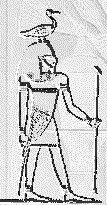
    Geb a universal or cosmic deity, god of the earth, a malevolent being as well as beneficial deity, who imprisoned the dead in his body.    As god of the earth and fertility, he was green in color, as with the ithphallyic form and "eldest of Shu," as called in the Pyramid Text.    He is described as holding "one arm to the sky and the other to the earth."    He was also sometimes shown wearing the crown of Lower Egypt or the atef crown.
    He divided the earth into two parts, giving Lower Egypt to Heru the Elder and upper Egypt to Set.
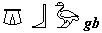
    The hieroglyph for his name, a white fronted goose, on top of his head.
    The hieroglyph for a goose is .
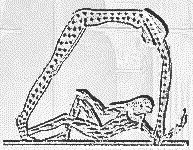
    Known as "The Great Cackler," Geb sometimes took on the form of a goose, but was usually shown as a man.    Sometimes he was depicted wearing the headdress of a goose, but more often he was shown as a reclining man - sometimes ithphallyic - laying far underneath his sister-wife, the goddess Nut.     Originally he was a local god, worshiped as a goose, though the specific city where he was first worshiped is unknown, it seems to have been around the Iunu (On, Heliopolis) region, thus Iuna/Heliopolis/Cairo.
    With his twin sister Nut, who arches over the fallen body of Geb, who sprawls with limbs awry and phallus erect, both produced the deities of Aset, Wesir, Set, and Nephythys.
    Geb identifies with the Greek Chronos (Roman Saturn).    Seb is identified with the third plaque of Egypt regarding Lice (gnats) all over the land.    Seb was the Egyptian Goose-God. like Saturn, is referred to as "The Father of Gods," a symbol of Time and God of the Earth.
    As can be seen on Denderah Decan 20-Grand Temple Decan 1 its deity is named     Geb (Seb), ou Hapi-Asmat, ou Hapi-Mestha, and also see Hor-behedet, god of the earth, son of Shu and Tefnet, brother/husband of Nuit, father of Osiris, Set, Isis and Nephthys.    His sacred animal was the goose.    Seen as a man with green or black skin.    He imprisoned the souls of the wicked not to ascend to heaven.

    Other sources claim that Geb as an earth god, the earthquakes were thought to be his laughter.    It was believed that he supplied the minerals and precious stones, and so was also a god of the mines.    The earth itself was referred to as "The House of Geb."    As the god of the surface of the earth from which spring up trees, and plants, and herbs and grain he played a very prominent part in the mythology of the underworld, and as the god of the earth beneath the surface of the ground he had authority over the tombs wherein the dead were laid.    In hymns and other compositions he is often styled the rpat ie. the hereditary, tribal chief of the gods, and he plays a very important part in The Book of the Dead ... and on his brow rested the secret gates which were close by the Balance of Ra, and which were guarded by the god himself.
-- The Gods of the Egyptians, E. A. Wallis Budge
    Yet he wasn't just a god of the surface of the earth, but a god of everything in and underneath the earth.    It is in this that Geb was related to the deceased - as the dead were buried in underground tombs, they were buried inside Geb himself.    He was thought to watch the weighing of the heart in the Halls of Ma'ati.    As Nut was often represented on the cover of the sarcophagus, Geb was represented by the base, so the deceased was enclosed in the twin deities - Nut above and Geb below.    Geb, though, had a darker aspect in relation with the dead.    He was thought to hold the souls of the damned, keeping them prisoner in the earth.
    In the tale of Geb and Nut, the twins angered the sun god Ra, their grandfather, by being so close together in a permanent embrace, making love.    He called on their father, Shu, to rip the twins apart.    Shu parted them, stamping on Geb while raising Nut high up above him.    It turned out, though, that the sky goddess was pregnant, and she eventually gave birth to Geb's children - Osiris, Horus the Elder, Set, Isis and Nephthys.
    Another tradition believed that Geb and Nut produced the World Egg from which the sun was born in the form of a bnw-bird - a phoenix.    Isis is referred to as "The Egg of the Goose," referring to this.    One text tells us how Geb caused the golden box in which Ra's uraeus was kept to be opened in his presence.    Ra had disposed of the box, together with his cane and a lock of his hair, in a fortress on the eastern frontier of his empire as a potent and dangerous talisman.    When opened, the breath of the divine serpent within killed all of Geb's companions then and there, and gravely burned Geb himself.    Only the lock of Ra's hair, applied to the wound, could heal Geb.    So great, indeed, was the virtue of this divine lock of hair that years later when it was plunged for purification into the lake of At Nub it immediately turned into a crocodile.    When he was restored to health Geb administered his kingdom wisely and drew up a careful report on the condition of every province and town in Egypt.
-- Egyptian Mythology, Veronica Ions
    The Egyptians believed that Geb was the third divine pharaoh, Shu before him and Osiris after, and the one who supported Horus' right to the throne.    Thus Geb was known for his protective qualities.    One spell in The Book of the Dead refers to this, stating "I am decreed to be the Heir, the Lord of the Earth of Geb.    I have union with women.    Geb hath refreshed me, and he hath caused me to ascend his throne."    Since the Egyptians believed that the pharaoh was the living image of Horus, the pharaoh was known as the "Heir of Geb."
    He was adored in Iunu, Djeba (Utes-Hor, Behde, Edfu) and Kom Ombo, though no temple to him has been found.    He was, though, seen as a previous ruler of Egypt and the personification of the earth itself.    He was a god of the earth who provided the Egyptians with everything from precious stones to the food that they ate, and the plants that grew along the Nile.    He was a god of everything on the earth, with powers reaching below the earth and to the land of the dead, imprisoning those evil souls who deserved eternal imprisonment, and watching over the justified dead.    From a local god to a great deity of Egypt, Geb was a fertility god who personified the earth itself.


    This file was created on June 18, 2005.

Return to the Table of Contents or the Zodiac of Denderah