From The Alpha and the Omega - Volume III
by Jim A. Cornwell, Copyright © July 20, 2002, all rights reserved
"Volume III - Gods/Goddesses of Ancient Egypt"
NUT
(Newet, Nuit)


    To return to the
Geb (Nut's twin brother),
Khepri (born out of the womb of his mother Nut),
or List of Netjeru.
    Nut, belonging to the Heliopolitan Ennead was the mistress of all heavenly bodies and was thought to be reaching across the sky from horizon to horizon, touching them with her hands and feet.    She was seen as the mother of Re, who swallowed up every evening and gave birth to him again every morning between her thighs.
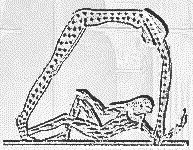
    She was seen in Egyptian artwork as a dark slim-limbed star-covered naked woman, supported only on the tips of her fingers and toes, facing downwards, she arches over the fallen body of Geb, , sometimes ithphallyic, looking up at his sister-wife and sprawls with limbs awry and phallus erect.    Her arms and legs were imagined to be the pillars of the sky, and hands and feet were thought to touch the four cardinal points at the horizon.    Nut is supported by the god Shu and her belly forms a canopy for the earth.
    She was thus connected to resurrection and the tomb.    The coffin, decorated with stars, was seen as the heavens, i.e. Nut herself in whose body the deceased rested until he awoke to new life.    There were many festivals to Nut through the year, including the "Festival of Nut and Ra" and the "Feast of Nut."    Nut was one of the cosmic deities and as such was never worshipped in a personified form, despite being a protector of the dead, no temples or specific cult centres are linked to her.
    She was believed to be the daughter of the gods Shu and Tefnut, the granddaughter of the sun god Ra.    Her husband was also her brother, Geb.     It is said that Thoth made the five new days in a year so that Nut and Geb could bear children: Osiris who was born on the first day (an unlucky day), Horus the Elder on the second (neither lucky nor unlucky), Set on the third (an unlucky day), Isis on the fourth (a lucky day, "A Beautiful Festival of Heaven and Earth"), and Nephythys the last born on the fifth day (an unlucky day).    The days on which these deities were born were known as the "five epagomenal days of the year," and they were celebrated all over Egypt.

    Nut identifies with the Greek Rhea, daughter of Uranus as was Geb the Greek Cronos (Roman Saturn).

    What other sources state about Nut.
    She was also described as a cow goddess, taking on some of the attributes of Hathor.    Geb was described as the "Bull of Nut" in the Pyramid Texts.    As a great, solar cow, she was thought to have carried Ra up into the heavens on her back, after he retired from his rule on the earth.    She was even been depicted as sow, or with the teats of a sow, ready for her children to suckle.    At other times, she was just portrayed as a woman wearing her sign, the particular design of an Egyptian pot on her head.    In one myth Nut gives birth to the Sun-god daily and he passes over her body until he reaches her mouth at sunset.    He then passed into her mouth and through her body and is reborn the next morning.    Another myth described the sun as sailing up her legs and back in the Atet (Matet) boat until noon, when he entered the Sektet boat and continued his travels until sunset.
    As a goddess who gave birth to the son each day, she became connected with the underworld, resurrection and the tomb.    She was seen as a friend to the dead, as a mother-like protector to those who journeyed through the land of the dead.    She was often painted on the inside lid of the sarcophagus, protecting the dead until he or she, like Ra, could be reborn in their new life.
    In The Book of the Dead, Nut was seen as a mother-figure to the sun god Ra, who at sunrise was known as Khepera and took the form of a scarab beetle (at noon he was Ra at his full strength, and at sunset he was known as Atem (Tem, Temu, Atum) who was old and weakening):
    "Homage to thee, O thou who hast come as Khepera, Khepera the creator of the gods, Thou art seated on thy throne, thou risest up in the sky, illumining thy mother [Nut], thou art seated on thy throne as the king of the gods.    [Thy] mother Nut stretcheth out her hands, and performeth an act of homage to thee.
...
    The Company of the Gods rejoice at thy rising, the earth is glad when it beholdeth thy rays; the people who have been long dead come forth with cries of joy to behold thy beauties every day.    Thou goest forth each day over heaven and earth, and thou art made strong each day by thy mother Nut.
...
    Homage to thee, O thou who art Ra when thou risest, and who art Atem when thou settest in beauty.    Thou risest and thou shinest on the back of thy mother [Nut], O thou who art crowned the king of the gods!    Nut welcometh thee, and payeth homage unto thee, and Ma'at, the everlasting and never-changing goddess, embraceth thee at noon and at eve.
...
    The gods rejoice greatly when they see my beautiful appearances from the body of the goddess Nut, and when the goddess Nut bringeth me forth
."

    She was also called on to help the deceased in one of the spells of The Book of the Dead: THE CHAPTER OF SNUFFING THE AIR, AND OF HAVING POWER OVER THE WATER IN KHERT-NETER.    The Osiris Ani saith:- "Hail, thou Sycamore tree of the goddess Nut!    Give me of the [water and of the] air which is in thee.    I embrace that throne which is in Unu, and I keep guard over the Egg of Nekek-ur.    It flourisheth, and I flourish; it liveth, and I live; it snuffeth the air, and I snuff the air, I the Osiris Ani, whose word is truth, in [peace]."


    This file was created on June 18, 2005.

Return to the Table of Contents or the Zodiac of Denderah