From The Alpha and the Omega - Volume III
by Jim A. Cornwell, Copyright © July 20, 2002, all rights reserved
"Volume III - Gods/Goddesses of Ancient Egypt"
NEBT-HET
(Nebet-Hewet, Neb-hwt, Neb-hut,
Nebt-hut, Nebthet,
Gr. Nephtys, Nephthys
)

Nebt-Het           Nephthys


    To return to the
Denderah Decan 7 - Grand Temple Decan 14 (mentioned as Ast Nebt-Het),
Denderah Decan 16 - Grand Temple Decan 5 (sister and wife of Set,
sister of Isis and Osiris, mother of Anubis, who protected Hapi
),
Amset (mention of protecting Hapi),
Heru (Hapy was protected by the goddess Nephthys),
or List of Netjeru.
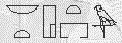
    Nebt-Het means "Mistress of the House," which is a title and the same word as her hieroglyph sign on her head as a crown, but by the word "house" or "het" is that portion of the sky which forms the abode of the Sun-god Horus in the same sense as the name "Het-Hert," or Hathor, i.e., the "House of Horus."
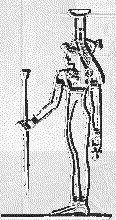
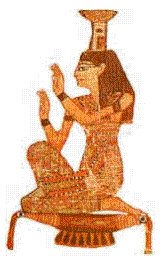
    She was depicted as a woman with the hieroglyph of her name (a basket and a house on top of each other) on her head, though she was also sometimes given wings or the form of a bird (the kite), making her a solar deity, as well as a deity of the dead.    She holds a scepter with a cup-like (papyrus plant) shape on it.
    Among her titles, Nephthys was known as the "Lady of the Body" (of the Gods), the "Dweller within Senu," "Lady of Heaven," "Mistress of the Gods," "the Great Goddess and Lady of Life."
    Her major centres of worships were Senu, Hebet, (Behbit), Per-mert, Re-nefert, Het-sekhem, Het-Khas, Ta-kehset, and Diospolites.    Her principal sanctuary was at Iunu (On, Heliopolis).    Nephthys seemed to have been ignored and did not become a major cult figure, like her sister Isis.
    Daughter to Geb and Nut of the Heliopolitan Ennead (Iuna/Heliopolis/Cairo), sister to Aset (Gr. Isis), Wesir (Gr. Osiris) and sister spouse to Set.
    In later times said to be the mother of Inpew (Anubis the god of the dead), supposedly fathered by Osiris.
    She was the darkness to Isis' light, the bareness to contrast her sister's fertility.    Although linked with death and decay, she was also a bringer of life into the world, and rebirth into the land of the dead.    Leaving her husband Set, she became a follower of Osiris and a supporter of her sister.    In Egyptian art, the twin sisters were almost always shown together.    Great of magic, Nephthys was seen as a good goddess who would give them rebirth in the land of the dead, just as she had helped Osiris to be reborn.
    Eventhough she was the wife of Set, she was seen as a loyal sister to her other siblings, helping Isis to gather Osiris' scattered limbs (after Set cut him into pieces), and helped her revive the dead god.    She thus became associated with the dead, becoming a "Friend of the Dead."    She offered guidance to the newly dead, and comfort to the family of the one who died.
    She also protects and takes care of the young Heru child, son of Aset.


    As seen on Denderah Decan 7 - Grand Temple Decan 14 the deity is called     Aset, nebhet, also Ast Nebt-Het note that Nephthys (Nebt-het) is the sister and wife of Set, sister of Isis and Osiris, mother of Anubis, who protected Hapi.    Along with Hapy - the baboon headed Son of Horus - she guarded the lungs in their canopic jar on the north cardinal point.

    On Denderah Decan 16 - Grand Temple Decan 5 its deity is   Nebet tep Ahet, Nebt-tep-ahet (the children of Horus, ou les enfants d'Horus) of interest is Greek Nephthys (Nebt-het) who is the sister and wife of Set, sister of Isis and Osiris, mother of Anubis, who protected Hapi.

    Other sources claim Nephthys saith unto the Osiris Ani, whose word is truth:- "I go round about thee to protect thee, O brother Osiris.    I have come to be a protector unto thee.    [My strength shall be near thee, my strength shall be near thee, for ever.    Ra hath heard thy cry, and the gods have made thy word to be truth.    Thou art raised up.    Thy word is truth in respect of what hath been done unto thee.    Ptah hath overthrown thy foes, and thou art Horus, the son of Hathor.]"
-- Speech of Nephthys, The Book of the Dead
    As comforter, she stood at the birth-bed to offer comfort and help with the birth of new born children - Isis was seen as the midwife.    The two sisters were often together, only being able to be told apart by the hieroglyph on their heads.    Also, like her sister, she was thought to have great magical powers - she was the Mighty One of Words of Power.
    Yet, originally, where Isis was visible, birth, growth, development and vigour, Nephthys was invisible, death, decay, diminution and immobility.    She was the darkness to Isis' light.    Isis was the day, her twin sister the night.    The goddesses were personified by two priestesses who were virgins and who were ceremonially pure; the hair of their limbs was to be shaved off, they were to wear ram's wool garlands upon their heads, and to hold tambourines in their hands; on the arm of one of them was to be a fillet inscribed "To Isis," and on the arm of the other was to be a fillet inscribed "To Nephthys."    On five days during the month of December these women took their places in the temple of Abtu (Abydos) and, assisted by the Kher Heb, or precentor, they sang a series of groups of verses to the god.
    Here is an except from the "Songs of Isis and Nephthys," sung to Osiris by the two priestesses: Hail, thou lord of the underworld, thou Bull of those who are therein, thou Image of Ra-Harmachis, thou Babe of beautiful appearance, come thou to us in peace.    Thou didst repel thy disasters, thou didst drive away evil hap; Lord, come to us in peace.

    O Un-nefer, lord of food, thou chief, thou who art of terrible majesty, thou God, president of the gods, when thou dost inundate the land [all] things are engendered.    Thou art gentler than the gods.    The emanation of thy body make the dead and the living to live, O thou lord of food, thou prince of green herbs, thou mighty lord, thou staff of life, thou giver of offerings to the gods, and of sepulchral meals to the blessed dead.    Thy souls flieth after Ra, thou shinest at dawn, thou settest at twilight, thou riseth every day; thou shalt rise on the left hand of Atmu for ever and ever.    Thou art the glorious one, the vicar of Ra; the company of the gods cometh to thee invoking thy face, the flame whereof reacheth unto thine enemies.    We rejoice when thou gatherest together thy bones, and when thou hast made whole thy body daily.    Anubis cometh to thee, and the two sisters (i.e., Isis and Nephthys) come to thee.    They have obtained beautiful things for thee, and they gather together thy limbs for thee, and they seek to put together the mutilated members of thy body.    Wipe thou the impurities which are on them upon our hair and come thou to us having no recollection of that which hath caused thee sorrow.
    Come thou in thy attribute of "Prince of the Earth," lay aside thy trepidation and be at peace with us, O Lord.    Thou shalt be proclaimed heir of the world, and the One god, and the fulfiller of the designs of the gods.    All the gods invoke thee, come therefore to thy temple and be not afraid.    O Ra (i.e., Osiris), thou art beloved of Isis and Nephthys; rest thou in thy habitation for ever.
    One of the reasons, during the later period of Egyptian history, given as to why Set and Osiris hate each other was because of Nephthys, Set's sister-wife.    She was barren (she represented the desert, as did Set, and she hit on the plan of disguising herself as Isis and seducing Osiris.    Getting Osiris drunk, Nephthys took Osiris to her bed, and the two had drunken sex together.    Osiris dropped his garland of melilot flowers in the act of passion.    Set found the adulterous goddess and the flowers, and knowing who the flowers belonged to, he began to plan Osiris' death.    The child of this union was thought to be Anubis, god of mummification.    Now as the overflowings of the Nile are sometimes very great, and extend to the boundaries of the land, this gave rise to the story of the secret intercourse between Osiris and Nephthys, as the natural consequence of so great an inundation would be the springing up of plants in those parts of the country which were formerly barren.
-- Nephthys, TourEgypt


    This file was created on June 18, 2005.

Return to the Table of Contents or the Zodiac of Denderah