From The Alpha and the Omega - Volume III
by Jim A. Cornwell, Copyright © July 20, 2002, all rights reserved
"Volume III - Gods/Goddesses of Ancient Egypt"
HERU
(Hor, Horus,
Heru-Khuiti
)


    To return to the
Cancer Decan (Heru-Khuiti netjer of the twelfth month Cancer named Mesori),
Taurus Decan (Heru (Horus) netjer of the tenth month Taurus named Payni),
Lepus Decan (hawk figure with the Double Crown),
Eye Decan (Ra-Heru-Khuti),
Corvus Decan (Isis, the rising star-goddess nursing Horus, the rising sun-god),
Denderah Decan 8 - Grand Temple Decan 13 (Deity),
Denderah Decan 23 - Grand Temple Decan 34 (Deity),
Denderah Decan 24 - Grand Temple Decan 33 (two of deity sons of Horus),
Denderah Decan 10 - Grand Temple Decan 11 (Deity),
Denderah Decan 12 - Grand Temple Decan 9 (Double Crown of Horus),
Denderah Decan 13 - Grand Temple Decan 8 (one of the deity sons of Horus),
Denderah Decan 29 - Grand Temple Decan 28 (Deity Hor-pa-kraat - Horus Child),
Denderah Decan 30 - Grand Temple Decan 27 (Deity),
Denderah Decan 14 - Grand Temple Decan 7 (one of the deity sons of Horus),
Denderah Decan 15 - Grand Temple Decan 6 (one of the deity sons of Horus),
Denderah Decan 31 - Grand Temple Decan 26 (Deity),
Denderah Decan 33 - Grand Temple Decan 24 (one of the deity sons of Horus),
Denderah Decan 16 - Grand Temple Decan 5 (Horus connection),
Denderah Decan 18 - Grand Temple Decan 3 (Horus connection),
Denderah Decan 35 - Grand Temple Decan 22 (one of the deity sons of Horus),
Denderah Decan 36 - Grand Temple Decan 21 (one of the deity sons of Horus),
Mihos (war-god associated with Horus and Nefertem),
Horus' four sons (Imsety (Amset), Hapy, Duamutef and Qebehsenuef),
Nefertum (dwelled with Re through his connection to the sun and Horus so they became as one),
Pakhet (associated with Heru),
or List of Netjeru.
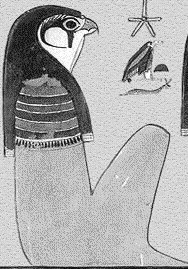
    Horus the ancient Egyptian god of the sun (solar god of Memphis), the son of Osiris and Isis, was represented as having the head of a hawk or falcon, which was synonymous with the sky, and was secretly brought up in the Delta swamps about Buto till he could challenge Set his uncle and father's murderer.    After Osiris was done in by Set, Isis changed into a hawk and revived Osiris long enough for him to impregnate her.    The child was Horus.
    The hieroglyph for a hawk or falcon is .
    His main center of worship was in Iuna/Heliopolis/Cairo.    Other temple sites were in Nebet/Ombi/Kom Ombo, Djeba/Apollinopolis Magna/Edfu, Nekhen/Hierakonpolis, Gesy/Apollinopolis Parva/Qus, Iunet/Tentyris/Dendera, Men'at-khufu/el-Minya.

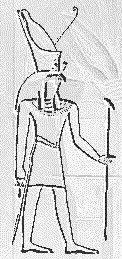
    Heru or Horus is usually depicted as wearing the Double Crown (Pshent, the unified white and red crown) or combination of the upper and lower crown headdress with the little curly item coming from it.    He is also hawk-headed and carries a spear or waas scepter in his left hand.
 
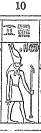
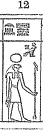
    Grand Temple Decan 9 and 31 seen above is a male figure with a hawk head with scepter.    The Double Crown (Pshent, the unified white and red crown) or Horus combo crown can also be found on Grand Temple Decan 3, 9, and 31.

    As seen on Grand Temple Decan 11, Grand Temple Decan 13, Grand Temple Decan 26, Grand Temple Decan 27 and Grand Temple Decan 34
its deity is called     Hor (Heru, Maat Heru), as we see in Denderah Decan 8 has 3 stars in front of it as seen above.
    The hieroglyph for Hawk or Falcon is .


    All of the names of Horus come from the following three names:

Horus had four sons: Duamutef, Qebehsenuef, Imsety (Amset) and Hapy

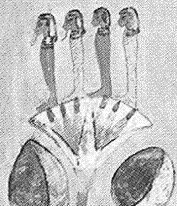
four sons rising out of a lotus.

    The four mummiform Sons of Horus were believed to be the sons of Horus, either Horus of Khem (Letopolis), Horus the Son of Isis or Horus the Elder), deities who protected the canopic jars that held internal organs of the deceased.    From the First Intermediate Period until the end of the 18th Dynasty, the stoppers of the canopic jars were shaped like the face of the deceased.    After this time, the stoppers started to be depicted as the four Sons of Horus.    These four gods, Friends of the King - Imsety, Hapy, Duamutef, and Qebehsenuef, the children of Horus of Khem - they tie the rope-ladder for this King, they make firm the wooden ladder for this King, they cause the King to mount up to Khepera when he comes into being in the eastern side of the sky. -- Pyramid Text 2078
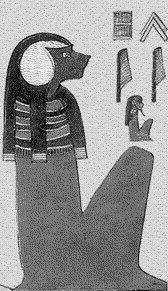
    As seen on Denderah Decan 18 - Grand Temple Decan 3 its deity is called     Khenet Khaset ou Isis, ou les 4 fils d’Horus, also Khentet-Khast, or Isis or the Children of Horus (ou les enfants d'Horus).
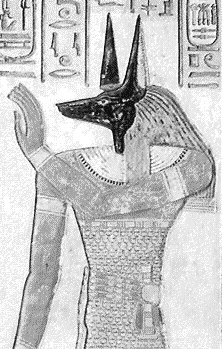
    The four deities - Imsety, human headed protector of the liver, Hapy, baboon headed protector of the lungs, Duamutef, jackal headed protector of the stomach and Qebehsenuef, falcon headed protector of the intestines - were thought to have come out of a water lily that rose from the waters of Nun.    The four mummiform gods were rescued by the crocodile god Sobek, by the orders of Ra, and Anubis gave them funerary duties.    They also attend the judgement of the deceased in the Halls of Ma'ati where they stand before Osiris on a half opened blue water lily.
    Originally it was believed that the Canopic jars were found only in Canopus (known as Pikuat to the ancient Egyptians), and were attributed to a Greek hero, Canopus (Kanopos), who was thought to have been buried there.    Jean-François Champollion's experimented on one of the jars and found that one held an internal organ; probably a heart, liver or spleen.    This proved that the jars were linked to the funerary cult of ancient Egypt, and not to worship of a god-hero, personified as these jars.    Champollion was the first to conclude that the four heads on the Canopic jars were four symbolic spirits.    He believed the stoppers to be the heads of a woman, a baboon, a hawk and a jackal.    He was very close to the truth, despite not being able to read the hieroglyphs on the jars.    The very earliest canopic equipment consisted of simple chests, or even a specially built cavity in the wall, where wrapped visceral bundles were placed.    We find the first possible canopic installations at Saqqara in tombs of the 2nd Dynasty, but proven canopic burials date from the 4th dynasty reign of Senfru.    By the end of the 4th Dynasty, organs were sometimes placed inside simple stone or pottery jars, with flat or domed lids.    The earliest examples of canopic jars come from the 4th dynasty tomb of Queen Meresankh III at Giza, from the reign of Menkaura.    While the First Intermediate Period was a time of Chaos in Egyptian history, it was during this time that the lid of canopic jars started to take on the form of a human head instead of a flat or domed shape.    Also, the wrapped bundles of viscera placed in the jars were now sometimes adorned with cartonnage masks with human faces.
    The four gods were also related to the sky, they were "behind the Constellation of the Thigh (the Great Bear), in the northern sky."    The Children of Horus were related to the Decans, which were Kher-Khept-Kenmut (Grand Temple Decan 3), Ha-tchat (Grand Temple Decan 4) and Pehui-Tchat (Grand Temple Decan 5).    It was also noted that the constellations of the Great and Little Bears resembled the "adzes" used in portrayals of the ceremony of the "Opening of the Mouth," performed on the mummy of the dead king to give it life.    The Great Bear (Egyptian constellation of the "Thigh") was associated with the Four Sons of Horus and each was place at one of the cardinal points, and seems in some way to have generated the force that turned the sky.
    They were part of the Seven Spirits (the other three being Maa-atef, Kheribeqef, and Heru-khenti-en-ariti) who made up a group appointed by Anubis.    These Seven Spirits (or Seven Shining Ones) were believed to have protected the dead body of Osiris.    The positioning for protection of the deceased (emulating the protection of the dead Osiris) was already well established by the Middle Kingdom.

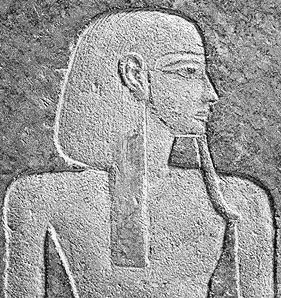
    As seen on Senmut's Tomb the hieroglyph for Horus Birth Child is .


    This file was created on June 18, 2005, and updated on May 30, 2006.

Return to the Table of Contents or the Zodiac of Denderah