|
Decan 35-36

|
Decan 35 is seen below Venus as a normal size ram with horns curving along its jaw, but on its head is a set of wavy horns and on top of them is a sun disk crown, with one star located above the body. This ram is identical to Denderah's Aries image except for the crown and also that it is standing. There does not seem to be any connection with Grand Temple Decan 22.
Since Decan 35 is seen as a netjeru in a animal form, it represents a pure force of nature.
Of note is the deity Amen (Amun) is sometimes depicted in the form of the Nile Goose or a ram with curved horns.
The hieroglyphs below
begin with either
a mouse sign, Egypt. peh,
or the Egypt sign for q,
then either
the sandy slope sign, Egypt. k,
or the jar stand sign, Egypt. g,
next the mouth sign, Egypt. r,
and the lower arm sign, Egypt. a,
followed by a star.
This would read [peh-k-r-a] or [peh-g-r-a]
or [q-k-r-a] or [q-g-r-a].
I am unsure if the above has any connection to Pegasus as some sources claim it to be known as Pe-Ka, Peka or Pega.
From www.siloam.net/denderah it states "The twelve stars under the feet of Aquarius identify the restored awareness of cosmic human experience, which is Osiris, hidden in the path of the precession." Siloam claims that Denderah Decan 35 is Aries 'the great rational being, signified by the large strutting ram the Great Shepherd" and Denderah Decan 36 is Cygnus, the swan or goose, and both are entitled together as "Rational Satisfaction."
|
Compared to Denderah Decan 35, there is no noticeable connection although the Ram figure applies to the name of Grand Temple Decan 22.
 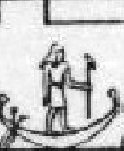
Grand Temple Decan 22 is a male figure with no crown and no stars.
Thus Decan 22 is called by  Kher khepet seret, Kher-khept-sert, Kher khepet seret, Kher-khept-sert,
or Khery-kheped-Seret,
which begins with the Egyptian sign for kh,
next the mouth sign, r,
then a fish with head cut off, Egypt. Khepet,
next the door bolt sign, Egypt. s,
the mouth sign, Egypt. r,
and the bread loaf sign, t,
followed by a star.
This reads [Kh-r Khepet s-r-t].
Kher is seen on Grand Temple Decan 3, 22, 27 and 34. Kher is seen to mean "lower" or "under." Also see the ram god Kherty meaning the "Lower One."
Khepet is seen on the Grand Temple Decan 3 and 22. As seen on Denderah Decan 18 (Grand Temple Decan 3) for Khery-khepedt must mean "The One Who is Under the Thigh (or Buttocks)" as mentioned on "http://home.main.rr.com/
imyunnut/Den.Round.html" by Joanne Conman, that "Khery-kheped-Knumet," means "The One Who is Under the Thigh (or Buttocks) of Knumet."
The word Seret is seen on Grand Temple Decan 20, 21 and 22. Seret means "Sheep" or "Ewe" (sr.t), whereas (sr "Ram"). Therefore it would make sense to state that "Kher khepet seret," would mean "The One Who is Under the Thigh (or Buttocks) of Seret (Sheep)."
See Denderah Decan 1 and Grand Temple Decan 20 for more information.
This deity is called  Qebehsenouef or Qebhsennuf a son of Horus. Qebehsenouef or Qebhsennuf a son of Horus.
Associated with AQUARIUS
and PISCIS AUSTRINUS,
but it has stars
in Andromeda as Mirach,
and Piscis Austrinus as Fomalhaut.
|