From The Alpha and the Omega - Volume III
by Jim A. Cornwell, Copyright © July 20, 2002, all rights reserved
"Volume III - Gods/Goddesses of Ancient Egypt"
AMEN
(Amon, Amun, Amon-Ra,
Ammon, Amoun, Imen
)


    To return to the
Aries Decan (Ammon),
Aquarius Decan (Amon-Ra),
Aquila Decan (goose),
Jupiter Decan (Ammon),
Ophiuchus Decan (Amun),
Auriga Decan (Light of Amun),
Lupus Decan (as a lion),
Coma Decan (Amun),
Cygnus Decan (Nile Goose),
Denderah Decan Zero Or 37 - Grand Temple Decan 37
(One of the eight primordial deities - Ogdoad),
Denderah Decan 23 - Grand Temple Decan 34 (Amen),
Denderah Decan 17 - Grand Temple Decan 4 (Amen),
Denderah Decan 35 - Grand Temple Decan 22 (as a ram),
Denderah Decan 36 - Grand Temple Decan 21 (Nile Goose),
or List of Netjeru.
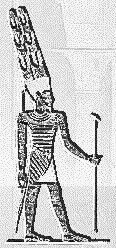
    Amen in one image is shown in human form, with two tall plumes on his crown on top of his head, seated on a throne.    His skin is blue like lapislazol, semi-precious stone, and he is wearing a short kilt.    On top of his crown are two tall plumes, signifying him as a sky deity, and it is said that he was as invisible as the wind.
    In the creation myth Amun (see Ophiuchus) is in the form of a snake (Amun Kem-Atef," He Who has Completed His Moment") as a forerunner of the eight deities of the Ogdoad (see Grand Temple Decan 37).    As a primeval creator god mentioned in the Pyramid Texts (5th Dynasty) as a primeval deity whose shadow protects the other gods.

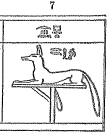
    The netjer of the seventh month of Aquarius is Amon-Ra, at Ramesseum: Jackal (rekh-netches), at Edfu: Hippopotamus (rekh-netches), note that REKEH (nezes)) or Nasie as if the 13th month of the year.
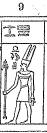
    It is noted here that the Month-Table at the Ramesseum shows the ninth month (Aries) which is called Pachons, Pachon, Pakhons, Chonsu, Christian coptes Bashans, and claims the netjer of the month was Khonsu, at Ramesseum and Edfu: Kensu, note Chonsu mentioned above.
    As seen in the image below it looks as if the figure resembles Amon-Ra more than Khonsu.
    Amen (Amun) is sometimes depicted in the form of the Nile Goose or a ram with curved horns.
    The goose might come from the creation myth about the "Gengen Wer," Great Honker or Great Cackler, the goose which carried the egg from which life came forth, and indicated Amun as a creator god.
    One source claims that the Egyptian Ammon, means "true."

    Amen (Amon, Amun, Ammon, Amoun) means "The Hidden One," which shows his association with invisibility, and was a deity of the city of Thebes/Waset.    The ancients regarded him as being behind and in all things, as too complex to describe in one name or depict his true form.    Therefore he was called "He who abides in all things," or "Hidden of aspect, mysterious of form" or the ba of all things are his epiteths.    They also called him "asha renu" which means "rich in names."    His consort was Amenet (Amaunet) also see Mut (Auramooth), mother of Khonsu was one of the four pairs of the Ogdoad.    He seems to be wearing a similar crown as in Decan 4 and 6.
    Amen was seen as
1) a man enthroned,
2) frog-headed man,
3) cobra-headed man,
4) ape,
5) lion.
    As Amun-Min he was shown in a black ityphallic form.
    As Amun-Re in the 11th Dynasty, he was merged into the sun-cult of Re in Heliopolis.
    At Thebes he ousted Mont the god of war, and became Amun-Re, the Sun-god, or the "King of the Gods," in Dynasty 12.    Around 2100 B.C., Ethiopia (Libya) was a vassal state of Thebes, where eventually he was called Jupiter Ammon (identified with Zeus) and even Alexander the Great consulted the oracle of Amun.
    His main festival the Opet which was celebrated when the yearly rising of the Nile was halfway through, where his statue was carried on a boat from his temple at Karnak ("Ipet-Isut" meaning "The Most Selected of Places") to the great temple of Luxor ("Amun em Ipet Resyt" meaning "Amun Who Is In His Southern Sanctuary").    His statue depicts him wearing the headdress of a cylindrical cap surmounted by two feathers.

    From www.siloam.net/denderah it states that Auriga is entitled as the "Light of Amun."


    This file was created on June 18, 2005 and updated on May 30, 2006.

Return to the Table of Contents or the Zodiac of Denderah