From The Alpha and the Omega - Volume III
by Jim A. Cornwell, Copyright © July 20, 2002, all rights reserved
"Volume III - Gods/Goddesses of Ancient Egypt"
AMAUNET
(Amen-t, Ament, Amenet,
Amenti, Amentet, Amentit,
Imentet, Imentit
)


    To return to the
Lepus Decan (star Phact),
Coma Decan (ESNE Plate 79),
Corvus Decan (various goddesses),
Denderah Decan Zero Or 37 - Grand Temple Decan 37
(One of the eight primordial deities - Ogdoad),
Denderah Decan 17 and Grand Temple Decan 4 (consort of Amen),
or List of Netjeru.
    Amaunet the name means "hidden one," and she is seen as a woman with a vulture skin and the crown of Upper Egypt on her head.    She is one of the eight primeval gods in the Ogdoad, forming the female counterpart of Amun.    The Ogdoad Creation myth which was originated in Khemmu/Hermopolis - el Ashmunein, conceived of four female and four male deities, forming four couples (the number four being the number of totality and completeness).    Of these eight deities, only Amun developed into a remarkable status and moved to Thebes/Waset/Karnak with his female counterpart Amaunet.    At Karnak she remains the consort of Amun though less important than Mut.    The names of Amun and Amaunet are mentioned as early as the Pyramid Texts (Dyn. 5).
    In "The Dawn of Astronomy" by J. Norman Lockyer, New York, The McMillian Company 1897, as seen on page 363, "I will deal with Amen-t first.    No doubt it will have been already asked how it came that such an unfamiliar star as Phact had been selected.
    Here the answer is overwhelming.    This star, although so little familiar to us northerners, is one of the most conspicuous of the stars in the southern portion of the heavens, and its helical rising heralded the solstice and the rise of the Nile before the helical rising of Sirius was useful for that purpose!
    Under Phact we have the star symbolised by the ancient Egyptians under the name of the goddess Amen-t
(wife of sun-god Ra) or Teki, whose figure in the month table at the Ramesseum leads the procession of the months.."
    The hieroglyph for a frog is .
    On ESNE Plate 79 to the left of the figure of Saturn it seems to be a Virgo like figure holding the long tail of the Sphinx in her hands similar to Coma Berenices.    The image above could also be Amaunet or even Mut.

    Other sources claim Amentet, 'She of the West' was the Egyptian goddess and friend of the dead, and the personification of the Land of the West, Amenty - imnty.    The word Amenti or Amentet, as used by the Egyptians was originally the place where the sun set, and applied to the west bank of the Nile - Egyptian cemeteries and funerary places were all on the west.    To the Egyptians, west was a direction linked to death.    Amentet was also the name of the underworld - the place where Ra travelled during the night.    The place where the sun set was also called by this name, being the entrance to the land of the dead according to Egyptian belief.    It was she who welcomed the deceased to their new dwelling place in the netherworld, offering food and drink to regenerate them.    She was also a goddess who helped with the rebirthing process, and thus a goddess of fertility and rebirth, the rebirth of the souls in the afterlife.    Thus she is also a fertility goddess, who was often represented by other fertility-related goddesses such as Hathor, Isis and Nit, Mut, and Nut.
    She was depicted as a beautiful woman as wearing the hieroglyph of the west (amn) on her head, carrying a sceptre and the ankh of life in her hands.    She is occasionally seen as a winged goddess, when linked to the goddesses Isis and Nephthys.    The standard of the west is usually a half circle sitting on top of two poles of uneven length, the longer of which is tied to her head by a headband.    Often a hawk or an ostrich feather is seen sitting on top of the standard.    This hieroglyph was used in words such as 'west' and words relating to the west such as, 'western' as well as 'right' and 'right hand'.
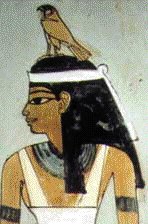
    Occasionally, she is shown wearing just the hawk on her head as seen in the image at the top of this page.    She was believed to live in a tree at the edge of the desert, a place where she could watch the gates to the underworld.    She was often shown not only in tombs, but on coffins, being a goddess of the dead.
    This feather, the normal ornament of Libyans, who wore it fixed in their hair, was also the sign for the word 'Western' and was naturally suitable to Amentet, who was originally the goddess of the Libyan province to the west of Lower Egypt.
    The Christian Egyptians or Copts used the word Amend to translate the Greek word Hades, to which they attributed all the ideas which their heathen ancestors had associated with the Amenti of The Book of the Dead.
    She was also connected with Nephthys and Ma'at.    As the goddess Hathor-Amentet, she was a solar goddess of the west, paired with Ra-Horakhty, who was believed to regenerate and welcome the newly deceased.    She was sometimes depicted with Iabet, the goddess of the east.
    There may have been a male version of Amentet.    In The Book of the Earth, there are two male deities who are shown to welcome the sun - iabtht and amntht.    Amenteth may have been the male personification of the west, and maybe a husband or companion of Amentet.


    This file was created on June 18, 2005.

Return to the Table of Contents or the Zodiac of Denderah