From The Alpha and the Omega - Volume III
by Jim A. Cornwell, Copyright © July 20, 2002, all rights reserved
"Volume III - Gods/Goddesses of Ancient Egypt"
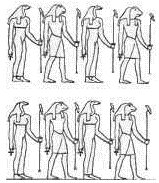
OGDOAD


    To return to the
Denderah Decan Zero Or 37 - Grand Temple Decan 37
(The eight primordial deities - Ogdoad) or the (Circle of Eight),
Thoth (Theban tradition has Thoth creating the eight primordial deities),
or List of Netjeru.
Amen (Amun)                                       Amenet (Amaunet)
Heq (Heka, Heh)                                    Heqet (Heket, Hehet, Hauhet)
Nun (Pesdjet, Nu, Nux)                          Naunet (Nunet)
Kau (Keh, Nehebkhau, Nehebkau)           Kauket (Keket)

    Ogdoad a creation myth which was originated in Khemmu/Hermopolis - el Ashmunein, conceived of four female and four male deities, forming four couples (the number four being the number of totality and completeness).
    The Egyptians believed that before the world was formed, there was a watery mass of dark, directionless chaos.    In this chaos lived the Ogdoad of Khmunu (Hermopolis), four frog gods and four snake goddesses of chaos.    The name of the water of chaos was Nun.    These eight deities were Nun and Naunet (water), Amen and Amaunet (invisibility), Heh and Hauhet (infinity) and Kek and Kauket (darkness).    The water stretched infinitely off in all directions, as ever lasting as time itself.
    The chaos existed without the light, and thus Kek and Kauket came to represent this darkness.    They also symbolised obscurity, the kind of obscurity that went with darkness, and night.
    The Ogdoad were the original great gods of Iunu (On, Heliopolis) where they were thought to have helped with creation, then died and retired to the land of the dead where they continued to make the Nile flow and the sun rise every day.    Iunu was thought to have been the site of the primeval mound by the priests of the city, and they had a sacred lake known as "The Sea of Two Knives" and an island known as "The Isle of Flames."    The lake, attached to a temple, represented Nun's waters, and the island was believed to be the primeval mound itself.    Ra was thought to have come into the world out of the giant water lily which grew on the mound:
    "Out of the water lily, created by the Eight, came forth Ra, who created all things, divine and human."
    As seen in the Coffin Text, Spell 76, "O you eight chaos gods, keepers of the chambers of the sky... The bnbn [phoenix] of Ra was that from which Atum came to be as ... Kek, darkness... I am the one who begot the chaos gods again, as Heh, Nun, Amun, Kek.    I am Shu who begot the gods."

    It was from Nun (Nu) that Ra (or Amen, another of the Ogdoad who became prominent Middle Kingdom onward, and joined with the sun god as Amen-Ra) created himself, rising up on the first piece of land, the primeval mound (Benben) out of the water lily (lotus) blossom, born from the world egg, or as a bnw-bird who then found and landed on the mound.
    The priests of Waset (Thebes), on the other hand, declared that Waset was the site of the Nun's water, and the rising of the primeval mound.    Amen, the creator god of Waset, was originally one of the Ogdoad and became the most powerful god of the area.    They believed that Amen changed from the invisible chaos deity into the primeval mound.    In this form, he created the other gods.    He created the water lily, which opened to reveal the child form of Amen-Ra, who then finished the creation of the world.    Nun, although he was a powerful force, was thought to have been inert until Amen awoke him from torpor, and used his chaotic waters to create the universe.
    In another story, it was Thoth who awoke from Nun and sang the unnamed four frog gods and snake goddesses who then continued Thoth's song to keep the sun travelling through the sky.

    This file was created on June 18, 2005.

Return to the Table of Contents or the Zodiac of Denderah