From The Alpha and the Omega - Volume III
by Jim A. Cornwell, Copyright © July 20, 2002, all rights reserved
"Volume III - Gods/Goddesses of Ancient Egypt"
NIT
(Neith, Neit, Net)

or


    To return to the
Luna Decan (Is Luna same as Neith, sent forth, or caused to come),
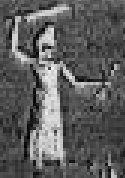
Bootes Decan (upper section of Esne Plate 87 a figure with a knife in the raised right arm, a bow and arrow in the left hand),
Denderah Decan 13 - Grand Temple Decan 8 (Neith was protector of Duamutef),
Denderah Decan Zero Or 37 - Grand Temple Decan 37
(One of the eight primordial deities - Ogdoad),
Heru (Duamutef was protected by the goddess Neith),
Apep (created by Nit),
Banebdjedet (mediated to the opinion of Neith),
Ogdoad (eight primordial deities),
Naunet (Nit as on of the eight primordial deities),
or List of Netjeru.
    Nit (Gr. Neith) was a local patron goddess of Zau (Gr. Sau, Sai, Sais), known early as the Predynastic and Early Dynastic Period when her influence was at its height as goddess of war and weaving, and the Red Crown of Lower Egypt.
    Earliest traces show her hieroglyph as crossed arrows on a shield as seen on a pole in front of reed shrines and on pottery from Dynasty I in Abydos.
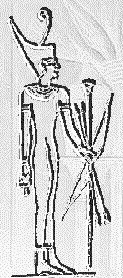
    Nit is seen as a woman wearing her emblem, either a shield crossed with two arrows, or a weaving shuttle or the Red Crown of Lower Egypt, made of reed and called nt.    The later form of the Emblem is what some people believe to be a weaving shuttle, linked to the root of the word for "weave," ntt (which is also the root for the word "being").    The Egyptians may have confused the symbols, and so she became a goddess of weaving and other domestic arts.    It was claimed, in one version of her tale, that she created the world by weaving it with her shuttle.
    One source claims she is called "the Terrifying One."     Nit is sometimes a goddess of war, or the patroness of weaving, a mortuary goddess and in later times an androgynous Creator goddess, who had both male and female attributes.    The Egyptians believed her to be an ancient and wise goddess, to whom the other gods came if they could not resolve their own disputes.
    Her function as a deity of war is probably the earliest one, mainly shown by her attributes the bow, shield and arrows, which she was also often shown carrying, linking her to hunting and warfare, or a sceptre and the ankh sign of life.
    The Emblem of Nit, originally a shield and two crossed arrows was her symbol from the earliest times, making her a goddess of hunting and war since predynastic times.    The earliest use of this Emblem was used in the name of queen Nithotep, "Nit is Pleased," who seems to have been the wife of Aha "Fighter" Menes of the 1st Dynasty.    Another early dynastic queen, Merytnit, "Beloved of Nit," served as regent around the time of king Den.
    She was also shown in the form of a cow, though this was very rare.    As a cow, she was linked to both Nut and Hathor.    In late dynastic times there is no doubt that Nit was regarded as nothing but a form of Hathor.    She was called "Nit, the Cow Who Gave Birth to Ra" as one of her titles.
    At an earlier period she was certainly a personification of a form of the great, inert, primeval watery mass out of which sprang the sun god Ra.
    In the Late period her cult was at Zau, she was regarded as mother from early times of Sobek, the crocodile god.    The two were mentioned as mother and son in the pyramid of Unas - and one of her titles was "Nurse of Crocodiles."     She is also the mother of the sun god Re and called the "Mother of Gods."

    On the upper section of ESNE Plate 87 shows the figure above as between Leo and Cancer, but seen with a knife in the raised right arm, and a bow and arrow in the left hand.    It is very similar to the previous image above, and is probably also Bootes a constellation that I propose is in Virgo.

    Cyril Fagan comments on the above image, "But in the Egyptian zodiac they were known as the 'Bow Stars' and were included in the constellation Cancer.    Both the 'Bow' and 'Arrow' (Sirius) rose simulataneously in Egypt during the dynastic period.    The Bow Stars were the goddess Satis, who holds a bow and arrow [See Argo Navis Decan or Canis Major Star Names], beneath the lion.    In the Esne zodiac she walks before the lion holding in her right hand a reed sickle above her head while carrying her bow and arrows in her other hand."
    Nit's most ancient symbol is the shield with crossed arrows, which occurs in the early dynastic period.    This warlike emblem is reflected in her titles "Mistress of the Bow... Ruler of Arrows."

    She was linked with a number of goddesses including Isis, Bast, Wadjet, Nekhbet, Mut and Sekhmet.
    By Greek times there was a great annual festival in honour of Isis-Nit.    Part of the festival, recorded by Herodotus, said that the people lit their houses with lamps and torches that were fueled by oil mixed with salt.    The lamps and torches were kept burning until the morning, while the people themselves feasted.    Nun is compared to the Greek Athena, Roman Diana, the moon goddesses.

    What other sources claim about Nit:
    She was also linked to Tatet, the goddess who dressed the dead, and was thus linked to preservation of the dead.    This was probably due to being a weaver goddess - she was believed to make the bandages for the deceased.    With Serqet, she was a watcher of the sky who, in one story, was thought to stop Amen and his wife from being disturbed while they were together, making her a goddess of marriages.
    She might have also been linked to Anubis and Wepwawet (Upuaut), because one of her earliest titles was also "Opener of the Ways."    She was also one of the four goddesses - herself, Isis, Nephthys and Serqet - who watched over the deceased as well as each goddess protecting one of the four Sons of Horus.    Nit, along with the jackal-headed Son of Horus, Duamutef, watched over the east cardinal point of the sarcophagus where the canopic jar containing the stomach was placed.    Also, during the earliest times, weapons were placed around the grave to protect the dead, and so her nature of a warrior-goddess might have been a direct link to her becoming a mortuary goddess.
    She was also regarded, during the Old Kingdom, as the wife of Set, though by later times this relationship was dropped and she became the wife of Sobek instead.    In Upper Egypt she was married to the inundation god, Khnum, instead.    "Give the office of Osiris to his son Horus!    Do not go on committing these great wrongs, which are not in place, or I will get angry and the sky will topple to the ground.    But also tell the Lord of All, the Bull who lives in Iunu (On, Heliopolis), to double Set's property.    Give him Anat and Astarte, your two daughters, and put Horus in the place of his father."
-- Nit Addressing the Gods, Myth and Symbol in Ancient Egypt, RT Rundle Clark
    A protectress of Osiris, the pharaoh and the dead, she guarded the coffin and one of the canopic jars along with a Son of Horus.    She wove the linen bandages for the dead, protecting the body from decomposition.    Linked to royalty since the 1st Dynasty, she was a guardian of the Red Crown of Lower Egypt itself.    She used her arrows to put evil spirits to sleep, and thus was a goddess of the chase and of warfare.    She was thought to be the water from which Ra was born, becoming the mother of Ra and thus of the gods themselves.    Eventually she became the creatrix, the great creator, who was neither male nor female, but a combination of both.    Despite the attempt at Iunyt to give her northern origins, where she was the wife of Khnum, she was a goddess of the delta and of Upper Egypt itself.    She was "Everything that has been, that which is, and everything that will be," the female creator god of Egypt.


    Because Nit's name was linked to a word for water, nt, the Egyptians believed her to be connected with the god of the watery primeval void, Nun.    Since the sun god arose from the primeval waters, and with Nit being these waters, she was thought to be the mother of the sun, Ra, and mother of the gods.    The evil serpent Apep, enemy of Ra, was believed to have been created when Nit spat into the waters of Nun, her spittle turning into the giant water snake.
    As a creatrix, though, her name was written using the hieroglyph of an ejaculating phallus, a strong link to the male creative force a hint as to her part in the creation of the universe.    According to the Iunyt (Esna) cosmology the goddess emerged from the primeval waters to create the world.    She then followed the flow of the Nile northward to found Zau in company with the subsequently venerated lates-fish.    There are much earlier references to Nit's association with the primordial flood-waters and to her demiurge: Amenhotep II (18th Dynasty) in one inscription is the pharaoh "whose being Nit moulded"; the papyrus (20th Dynasty) giving the account of the struggle between Horus and Set mentions Nit "who illuminated the first face" and in the sixth century B.C. the goddess is said to have invented birth.
    This give Nit an association with water and with Nunet, a frog-goddess, the hieroglyph for a frog is and also see notes in Ptah), and in later times she was regarded as a primeval deity with both male and female properties.

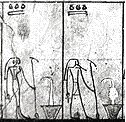
    One source claims the image below is Nun and Naunet at Amduat.    The hieroglyphs for Naunet is .

Naunet, see Ogdoad, as one of the eight primordial deities).

    Naunet (Nunet), on the other hand, is more obscure than her husband.    She was thought to be a snake-headed woman who presided over the watery chaos with Nun.    Her name was exactly the same as Nun's, in hieroglyphs, but with the feminine ending for a goddess.
    In Hikuptah, she was imagined to be the mother of the sun god, as Nun was the father, combined with Ptah, creator god of the city: The gods who came into being in Ptah:
Ptah-on-the-great-throne --------.
Ptah-Nun, the father who [made] Atem.
Ptah-Naunet, the mother who bore Atem.
Ptah-the-Great is heart and tongue of the Nine [Gods].
-- Shabaka Stone

    The Egyptians of Khmunu believed that the world was surrounded by mountains that helped support the sky, but at their feet was Naunet.    They imagined that Ra appeared from these mountains, being reborn daily from the watery abyss.
    Naunet was the feminine to Nun's masculine, more of a representation of duality than an actual goddess, so she was even less of a deity than Nun, and more of an abstract.
    One day, it was believed that the waters of Nun would eventually inundate the whole world, and once again the universe would become the primordial waste of Nun's chaotic waters.


    This file was created on June 18, 2005.

Return to the Table of Contents or the Zodiac of Denderah