From The Alpha and the Omega - Volume III
by Jim A. Cornwell, Copyright © July 20, 2002, all rights reserved
"Volume III - Gods/Goddesses of Ancient Egypt"
SOBEK
(Sebek, Sobeq, Sobk, Sochet, Gr. Suchos)


    To return to the
Draco Decan (Sebek was a Crocodile god of Fayum),
or List of Netjeru.
    Sobek (Sebek) or Greek Suchos, means "Watching over you," was an ancient god of crocodiles, first mentioned in the Pyramid Texts and worshipped till Roman times.    Egypt worshipped him to gain his protection and strength, or reviling him and killing the crocodiles of the area because of the evil that they could do.    To his worshipers, he was a god who created the Nile, a god of fertility and rebirth, and the symbolic strength of the ruler of Egypt.
    During the 12th and 13th Dynasties, the cult of Sobek became prominent and such rulers as Sobekhotep and Sobekneferu or Sobeqneferu (1799-1795 B.C.) was the sister (and maybe the wife) of Amenemnhat IV (1808-1799 B.C.), was the last ruler of the 12th Dynasty as the first attested or definite female pharaoh of Egypt, called "The Beauties of Sobeq."    There were eight rulers of the 13th Dynasty with the birth name of Sobekhotep, including Sobekhotep II Amenemhat (c. 1750 B.C.), Sobekhotep III Sekhemrasewadjtawy (c. 1745 B.C.) and Sobekhotep IV Khaneferra (c. 1730-1720 B.C.).
    Sobeq first known in the Old Kingdom as "Rager," called the son of Nit (Neith), and in some myths Set is said to be his father.    The two were mentioned as mother and son in the pyramid of Unas.
    The hieroglyph for a crocodile is .    Set may be called msha [crocodile].    On the other hand, msha, the crocodile, is sometimes called the son of Set.    It would be a mistake to deduce from this that Set is the father of a particular mythical son, in the way Osiris is the father of Horus.    The intention is merely to express that a dangerous crocodile is a Setian product.
ahy {Snarer};    yty {Seizer}; ...    away {Robber}.
-- Set, God of Confusion: A Study of his Role in Egyptian Mythology and Religion, H. te Velde
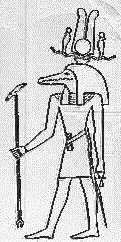
    He is depicted as a crocodile, wearing the sun disc on his head, a connection to Re.    In this form he is often perched on a shrine or an altar.    More seldom he is depicted as a human-headed crocodile, crocodile-headed man or as a full crocodile wearing an Atef crown or plumed headdress with a horned sun disk and carrying a Waas sceptre and a wax ankh sign of life.    His sacred animal, the crocodile, was both revered and reviled by the people of Egypt, even a tamed crocodile was worshiped as the god Sobek himself, while in other places the reptiles were killed.    The Egyptians seemed to both respect and fear the power of the crocodile, and as the result of this, Sobek was seen as an ambivalent creature.
    He is also depicted in crocodile form with a falcon's head which shows a relationship with Heru.    In this connection Sobeq is a protector, a healer and one who avenges wrongdoers.
    Sobek was a god of the Nile (which was believed to have come from his sweat) who gave life to vegetation and fertility to the land.    Sobeq is called "Lord of stretches of water and of fishes" or "Lord of the Waters" and was believed to have risen from the primeval waters of Nun to create the world.    One tale says that Sobek laid his eggs on the bank of the waters, starting the creation process.    With the Nile issuing from his sweat, "he (who) made the herbage green."    This explains his link to the rebirth of the deceased into the after life.     According to some myths Sobeq belongs in the underworld from where he could be called upon to get rid of bothers and troubles of different kinds, by using the phrase "to Sobek with it."
    Sobek's temples were found scattered throughout the land of Egypt, but there were two main cult centers in ancient Egypt for Sobeq:     Another title is "Lord of Bakhu", where he was said to have a temple made of carnelian at Bakhu, mountain of the horizon.    "I am Sobek, who dwelleth amid his terrors.    I am Sobek, and I seize [my prey] like a ravening beast.    I am the great Fish which is in Kamui.    I am the Lord to whom bowings and prostrations are made in Sekhem.    And the Osiris Ani is the lord to whom bowings and prostrations are made in Sekhem." -- The Book of the Dead, The Chapter of Making the Transformation into the Crocodile God (Sobek)

    What other sources state about Sobek.
    The crocodile's power to snatch and destroy it's prey was thought to be symbolic of the might of the pharaoh - the strength and energy of the reptile was a manifestation of the pharaoh's own power.    The word "sovereign" was written as yt.    This way, the crocodile - and thus Sobek - was linked to the pharaoh, the sovereign of Egypt.
    In times of need, he gives the pharaoh strength and fortitude so that he may overcome all obstacles.    He also protects the pharaoh from all harm, especially evil magic.
-- Sobek, TourEgypt
    Originally, Sobek was probably a dark god who had to be appeased to give the people his protection against crocodiles.    Sobek had a dark streak that stayed with him for the time he was worshiped.    In The Book of the Dead, he was showed as four crocodiles who were believed to attack the deceased in the underworld.    This dark side sometimes put him in the camp of Set.    In one version of the tale of Osiris, Isis had to place Horus into a little boat of papyrus reeds to protect him from a menacing Sobek.    His form of a crocodile - one of Set's creatures - linked him closely to the enemy of Horus.    It was believed that Set turned himself into a crocodile to escape from Horus, and Sobek was punished for allowing this.    Several bynames of Set have the determinative of the crocodile.    Although crocodiles may be the bas of Sobek, they may also be regarded as the messengers of Set.
    Sobek, as with many of the other protective gods, also had a benign side.    In a different version of the tale of Osiris, it was Sobek who carried the dead body of Osiris to the bank of the Nile on his back.    The four mummiform Sons of Horus - Imsety, human headed protector of the liver, Hapy, baboon headed protector of the lungs, Duamutef, jackal headed protector of the stomach and Qebehsenuef, falcon headed protector of the intestines - were believed to have come out of a water lily that rose from the waters of Nun.    Under the orders of Ra, the four gods were rescued by Sobek in a net, and brought them to land.    The Book of the Dead suggests that Sobek's closeness to Horus can be traced back to his participation in the birth of this god.    Sobek was responsible for calling Isis and Nephthys to aid in the protection of the dead.
-- The Crocodile God, Sobek, Catherine C. Harris
    Despite the different attitudes of people to the god, he was venerated as one who restored sight to the dead, who revived their senses and who protected them from Set who attacked those souls who travelled through the land of the dead.
    On the western border of the Fayum... on the lake of Moeris was the temple of Sobek of the Island, Soknopaios as it is called by the Greeks.    It had a high-priest who received a small stipend of 344 drachmę, and all the other priests together received daily about one bushel of wheat as remuneration for their trouble.    They were not even immune from the statutory labour on the embankments, and if this was lessened for them, it was owing to the good offices of their fellow citizens.
-- Egypt, Myths and Legends, Lewis Spence
    Some tales suggested that Set was his father.    He was given different wives in different areas - Hathor, Renenutet, Heqet to name a few.    He was also thought to be husband of the goddess Taweret, who was somtimes depicted with a crocodile on her back.    He was, likewise, given different children - Khonsu, Horus and Khnum were sometimes called his sons, again in different areas.    Those who do away utterly sins and offences, and who are in the following of the goddess Hetepsekhus, are the god Sobek and his associates who dwell in the water.    The goddess Hetepsekhus is the Eye of Ra.
-- The Book of the Dead, Texts Relating to the Weighing of the Heart of Ani
    During the Middle Kingdom, Sobek was linked to the god Amen, who seemed to have assimilated him to some degree.    He was also connected to the sun god Ra, giving the form Sobek-Ra, who was worshipped as another omnipotent manifestation of the sun deity.    Thus Sobek could be shown wearing either the headdress of Amen or the sun disk of Ra.


    This file was created on June 18, 2005.

Return to the Table of Contents or the Zodiac of Denderah