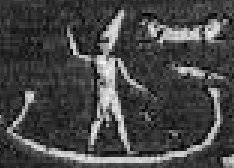
Denderah Zodiac Decan 0 or 37.

On the Denderah Zodiac we see eight captives in the circle are bound on their knees but they are not headless.
Hieroglyphs of Denderah Zodiac for Decan 0 or 37 seen under Piscis Austrinus and on top of the circle begin with
the fish sign, Egypt. Kha,
then the mouth sign, Egypt. r,
and next has the lower arm sign, Egypt. a,
then either
the quail chick, Egypt. w, ou,
or the duck sign, Egypt. s3, sa,
and ends with a star.
This reads as [Kha-r-a-ou] or [Kha-r-a-sa].
The eight captives inside the large disk represent eight (actually 9 but traditionally seen as being 8) that could form the left-hand half of Capricornus. These figures do stand for the glyphic symbol of enemies or wickedness. These are Decan stars and to one source the glyphs say Sa-r-a or a-r-sa, the figure to the right is also named sa-r-a (possible an indicator of epithet, title or a piece of time).

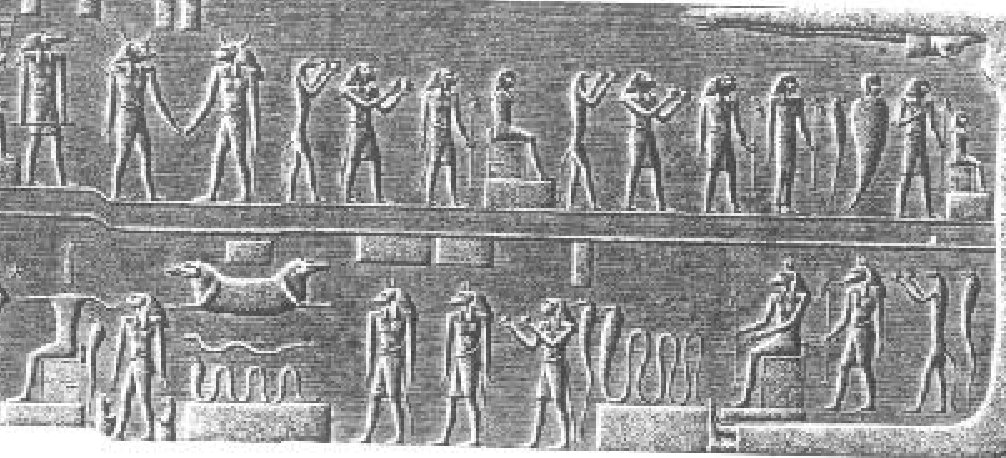
If comparing to the Grand Temple Decan 37, the nine headless captives as seen below on the lower section of ESNE Plate 87, is located between Aquarius and Capricornus.
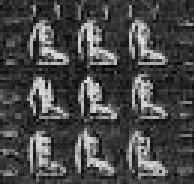
In the book by Denon "Descriptions de l’Egypte", it states that the symbol and line drawing show that in the circle are eight men on their knees, with their heads chopped off, and their arms tied behind their backs, possibly representing the world of the enemies (as the classic image of foreign enemies) to the Egyptians. The image above is found on the temple north of Esneh, Descriptions de l’Egypte," vol. I, pl. 87. It appears to be different from the eight characters in the large disk of the Zodiac of Denderah.
Some believe Thoth (Theban tradition) created the 8 primordial deities, which are known as the Ogdoad the Creation myth which was originated in Khemmu/Hermopolis - el Ashmunein, conceived of four female and four male deities, forming four couples (the number four being the number of totality and completeness).
Amen (Amun) Amenet (Amaunet)
Heq (Heka, Heh) Heqet (Heket, Hehet, Hauhet)
Nun (Pesdjet, Nu, Nux)
Naunet (Nunet)
Kau (Keh, Nehebkhau, Nehebkau) Kauket (Keket)
This object is located on the perimeter between Capricornus and Aquarius. Some sources call them "eight bound images." It concludes with "This leads to the eighth of seven kings." These kings are referred to as "intuitive consciousness."
This same source claims that at some future moment the "eight bound kings are released from habit, as implied by the circle within the wheel of the Denderah monument." As in some goal or journey "after breaking the bondage to salvation in Aquarius, the individual is confronted by Thoth."
Another source see these as "... are eight figures bound within a circle. This is a circle within a circle. It defines the habitual nature, which is rational behavior. Habitual nature serves the Great Shepherd, but it is a Land Bondage to the eight spirits within the small circle. These eight spirits are the kings of the apocalypse."
From Alan Pert, University of Sydney, "Some ideas came to me about the 8 bound figures between decan 36 and 1, Ad de Vries in his "Dictionary of Symbols and Imagery" is helpful here: 8 is a new beginning. God made the world in 6 days, rested on the seventh, so 8 is the start of a new cycle. In music, it is the octave, the return of the same note.
The eight figures are thus between the end of one cycle and the beginning of another. The plausible explanation is we have 8 men bound in a wheel of fate, fortune, destiny, or the zodiac (Mazzaroth).
In "The Dawn of Astronomy" a study of the temple-worship and mythology of the Ancient Egyptians by J. Norman Lockyer, New York, The McMillian Company 1897, as seen on page 276, he shows the following image:
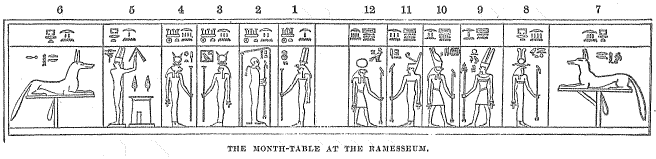 This represents the Month-Table at the Ramesseum, with the hieroglyphic names and image of the Nerteru for each Egyptian month. It should also be noted that each of the neteru seem to be facing each other in pairs of six, which may have been done for asthetics, instead of the usual facing one direction to determine the read on the hieroglyphs. I found it interesting that it starts from left to right beginning with Capricornus and ending with Aquarius. Another interesting point is the gap or spaced area centered between month 1 and 12, which turns out to be the area that represents the epo gomena, is left blank with no hieroglyphs or images. This area should be exactly opposite of Denderah Decan 0 or 37, the circle of eight bound.
|
Lets compare the following to the Denderah Circle with Eight Figures.

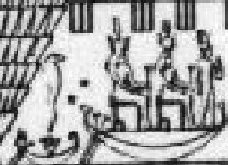
As to Grand Temple Decan 37 seen above:
We first see a cobra like serpent (seen on some ESNE plates on images at the bottom of this section) arising up from a lotus flower on his own separate small boat, with two stars in front of it.
On the second larger boat there are three figures.
First: a female figure seated on a throne with a scepter, with a cup-like (papyrus-shaped) object on it like the one seen in Grand Temple Decan 33. On her head are Hathor horns with a sun disk and one feather (ostrich) on top of it.
Second: a female figure seated on a throne with a scepter, with a cup-like (papyrus-shaped) object on it like the one seen in Grand Temple Decan 33. On her head are Hathor horns with a sun disk and two plumes on top of it.
Third: in front of both figures is standing a young male wearing the Double Crown (Pshent, unification of the white and red crown) or Horus upper and lower crown of Egypt, with his left hand finger up to his mouth, just like the figures seen in Grand Temple Decan 27 and 28, which also has a lotus flower.
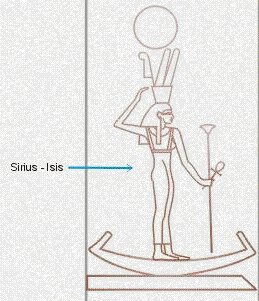
As we can see in the above image found on Senmut's Tomb is this representation of Sirius or Isis, as compared to the female images above.
The hieroglyphs for Sirius is  and for Isis and for Isis  . .
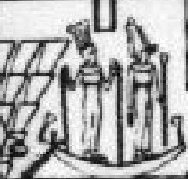
Above the Grand Temple Decan 37 is a boat with two figures, which may be Argo Navis (Sextant). The first figure is holding up two vials and pouring water out as seen with Aquarius, but wearing a plumed headdress. The next figure has a Atef Crown (Osiris' white crown of Upper Egypt and red feathers of Busiris) with a cup-like (papyrus-shaped) scepter. These could be the deities Jupiter and Mercury.
This 37th decan could be the 5 epa gomenes’ days (Osiris, Horus, Seth, Isis, Nephthys), which bear the name of Soped, in fact our Sirius, for more see Calendar Dates, where we see the month of Thuti (Leo) as the opposite of this decan, which is between Capricornus and Aquarius.
As seen that Decan 37 is called  Soped or known as the child of Sirius, (Egyptian Sepdet or Septet) we see Soped or known as the child of Sirius, (Egyptian Sepdet or Septet) we see
a tall triangular figure or sign, which is unknown to me. Although here it is represented as Sepd,
and since next is the bread loaf, Egypt. t,
and then it ends in a star, ‘gate.’
We therefore see [Sepd-t], possibly the stars Sirius and Mirzam in Canis Major.
As seen on "http://www.egyptologyonoline.com/
astronomy.html" a claim is made that "The god Sah (Orion on Denderah Decan 21 - Grand Temple Decan 36) was the personification of the constellation later known as Orion. Sah was described as 'the glorious soul of Osiris' and formed a divine triad with the dog star Sopdet (Sepdet or Sirius on Denderah Decan 22 - Grand Temple Decan 35) and their son Soped (Soped, Sepd on Denderah Decan 37 - Grand Temple Decan 37), god of the 'eastern border'."
 Seen above is an image proposed for Denderah Decan 7 as a possible connection with the hieroglyphs from
the triangle or pyramid shaped sign, Egypt. Sepd,
and the other signs are too small to read,
but followed by a star.
It’s deity is named Hor Ast or Maat-Heru Ast = Horus, Isis.
Note that in front of them is the cow (Canis Major) lying on a boat with the star (Sirius) above the horns. This is located on the Denderah Zodiac directly opposite of the Circle of Eight figures, with Denderah Decan 18 at the halfway point.
|