From The Alpha and the Omega - Volume III
by Jim A. Cornwell, Copyright © July 20, 2002, all rights reserved
"Volume III - Gods/Goddesses of Ancient Egypt"
NEHEB-KHAU
(Nehebkhau, Nehebkau,
Nehebu-Kau, Nehebkhau,
Kau, Keh
)


    To return to the
Ophiuchus Decan (Nehebkhau as the lord of the decans),
Serpens Decan (Nehebkhau as the lord of the decans),
Denderah Decan Zero Or 37 - Grand Temple Decan 37
(One of the eight primordial deities - Ogdoad),
Ogdoad (eight primordial deities),
or List of Netjeru.
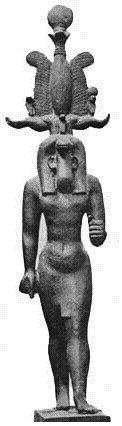
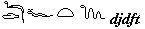
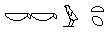
    Neheb-khau according to George Hart, "Dictionary of Egyptian Gods and Goddesses," this was a benevolent snake-god, "He Who Harnesses the Spirits, or "He Who Unites the Kas."     Nehebkau's name is from the ancient Egyptian word for "yoke together" or "unite," nhb, with the word for the plural of a part of the spirit, the ka, which implies he is the one that unites the ka the double with the physical body that it would reside in, be it an animate or inanimate object.
    Nehebkau was one of the original primeval gods, swimming around in the primeval waters of Nun before creation in the form of a snake, then bound to the sun god when time began.     Nehebkau was invisible and a source of protection and magic for both in Egypt and the Underworld (afterlife).
    As seen in the Pyramid Text of Unas, "Homage to thee, Netethib, daughter of these four gods who are in the Great House.    Even when the command of Unas goes not forth, uncover yourselves in order that Unas may see you as Horus seeth Isis, as Nehebkau seeth Serqet, as Sobek seeth Nit, and as Set seeth Netethib."
    One source claims that Nehebkau was a serpent or snake with human arms and legs, occasionally with wings.    Less often, he is shown as a two headed snake, with a head at each end of the reptilian body.
    The hieroglyph for a snake is .
    As a subject of Ra and Serpent god of the Underworld, he was a menace to gods and men, but sometimes shown holding contaniers of food in his hands, in offering to the deceased.    After death, it was Nehebkau who protected and fed the pharaoh, offering food and water to the other justified dead.    The drink was known as the "Milk of Light," magical liquid that would heal the deceased had they been bitten by a poisonous animal.    He was one of the fourty two gods in the Halls of Ma'at, who helped to judge over the deceased.    As seen in The Negative Confessions, The Book of the Dead, "O Nehebkau who comes from the city: I have not sought to make myself unduly distinguished."
    He was mentioned in the Pyramid Texts as the son of the scorpion goddess Serket and therefore associated with the spells against venomous bites and another tradition says that he is the son of the earth god Geb and Renenutet, the goddess who gave the rn - the true name - to each child at birth.
    One source claims Neheb-Kau was also called "He Who keeps the energies together," by which is meant that in him was assembled the totality of the energies in the universe.    He was a primeval being, and such, an indestructible and invulnerable reptile.
    In the Old Kingdom, Atum (Atem) controlled the rather fierce and aggressive power of Neheb-Kau by pressing his nail into the snake-god's spine, which can be seen also for the serpent god Apep (Apophis).    He could not be overcome with magic, fire or water.
    As seen on "http://home.main.rr.com/imyunnut/Den.Round.html" by Joanne Conman, who claims "Just above the Scorpion is a falcon-headed figure seated on a boat.    Above his head is a sun disk and uraeus, and he holds a wAs scepter.    I believe this figure represents the god Nehebkau, who was the lord of the decans."

    Nehebkau did not have a priesthood, but did have a festival in honour of him celebrated on Tybi [the fifth month], nine days after the "Festival of Ploughing the Earth."    Although he did not have a cult following of his own, he was a god who they invoked in magical spells to gain his protection and cures against snakebites, both in life and in the land of the dead.    The Egyptians believed that he swallowed seven (a magical number) cobras, using them for his magical power.    It was thought that he was one of the gods who announced the new pharaoh to the gods, at the begining of his rule.
    "Homage to you, O ye gods, who are masters of [your] beards, and who are holy by reason of your sceptres.    Speak ye for me words of good import to Ra, and make ye me to have favour in the sight of Nehebkau." -- The Chapter of Not Letting the Heart of Nun, Whose Word is Truth, be Driven Away from Him in Khert-Neter, The Book of the Dead


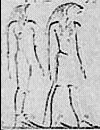
    I have conceived that maybe Neheb-Kau is part of the 8 primordial deities, which are known as the Ogdoad, and may represent the male Kau (Keh, Nehebkhau, Nehebkau) and his female consort Kauket (Keket).
    Both of these are identified below as:
Kek and Kauket

and


    Kek and Kauket, as deities of darkness, obscurity and night, their aspects connected them to the eight gods of the Ogdoad.    Budge believe that Kek and Kauket were once deities linked to Khnum and Satet, to Hapi - Nile gods of Abu (Elephantine).    He also believed that Kek may have also been linked to Sobek.
    The characteristics of the third pair of gods, Keku and Kauket, is that they represent the male and female powers of the darkness which was supposed to cover over the primeval abyss of water; they have been compared by Dr. Brugsch with the Erebos of the Greeks.

Kek

    Kek (Kuk, Keku) means darkness, thus he was the god of the darkness of chaos, the darkness before time began.    He was the god of obscurity, hidden in the darkness.    The Egyptians saw the night time, the time without the light of the sun, as a reflection of this chaotic darkness.
    As a god of the night, Kek was also related to the day and was called the "bringer-in of the light," and responsible for the time of night that came just before sunrise.    The god of the hours before day dawned over the land of Egypt.    This was the twilight which gave birth to the sun.

Kauket

    Kauket was the feminine to Kek's masculine, more of a representation of duality than an actual goddess, so she was even less of a deity than Kek, and much more of an abstract.    She was a snake-headed woman who ruled over the darkness with her husband.    Her name also meant darkness, as did her husband's name, but with a feminine ending.
    She was, though, also related to the day being called "bringer-in of the night, showing her to be the goddess of the night, just after sunset.    The goddess of the the hours of the evening, as night covered Egypt, and the sun had disappeared.    This was the twilight which turned into the darkness of night.


    This file was created on June 18, 2005.

Return to the Table of Contents or the Zodiac of Denderah