From The Alpha and the Omega - Volume III
by Jim A. Cornwell, Copyright © July 20, 2002, all rights reserved
"Volume III - Gods/Goddesses of Ancient Egypt"
SELKET
(Selqet, Selquet, Selkit, Selchis, Selkis,
Serqet, Serket, Satet, Satis, Satit, Setet,
Sathit, Sati, Setis
)

   Selket                                       Satis


    To return to the
Virgo Decan (Satis who holds a bow and arrow),
Leo Decan (Satis who holds a bow and arrow),
Argo Navis Decan (Sextant is shown as the maiden Selket or Satet holding a bow and arrow in her hands),
Bootes Decan (Satis who holds a bow and arrow),
Scorpius Decan (Selket and Serket a scorpion-goddess as a beautiful woman with a scorpion on her head),
Corvus Decan (Some goddesses are portrayed such as Renen-t, Serk-t, Ra-t, Amen-t as Isis nursing Horus ),
Crater Decan (The two goddesses associated with the flood are Anuket and Satet),
Aquarius Decan (Anqet and Satis, a comment on who the figures on the boat are),
Denderah Decan 14 - Grand Temple Decan 7 (Serket protector of Horus' son Qebehsenouef),
Denderah Decan 17 - Grand Temple Decan 4 (Satis depicted in female form, wearing the White Crown of Upper Egypt, with two curved antelope horns on the side),
Apep (Serqet used her magic to protect the barque),
Aset (Aset is sometimes Serqet),
Heru (Qebehsenuef was protected by Serket),
Khnum (consort of Satis),
Neheb-khau (son of Serket),
or List of Netjeru.
Serqet                                         Satet


    Selket, her names mean "She who causes to breathe" and refers to her power of protecting from, or curing poisonous stings of scorpions and serpents.    She could also punish those with the poison of a scorpion or snake, causing breathlessness and death.
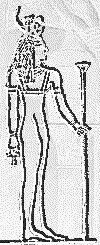
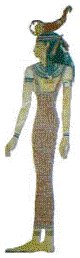
    She is depicted with a scorpion ready to strike above her head or as a woman with a scorpion's head, and in her hand a payrus plant scepter.
    First seen as a serpent in ancient Egypt, and became a scorpion by the Ptolemaic period.    The Scorpion was associated with the Egyptian scorpion goddess Selket, a goddess of magic, medicine and the afterlife.    She was a pyschopomp, or guide of souls into afterlife.
    On the Denderah Zodiac, Argo Navis (Sextant) is also known as Selket.
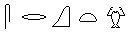
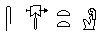
    The hieroglyph for a scorpion is .


    The goddess Serket (Serqet, Selket) is an ancient Egyptian scorpion-goddess of magic and also a protective goddess, who punished the wrong doers with her burning wrath.    Yet just as she could kill, she was thought to give breath to the justified dead, helping them be reborn in the afterlife.
    Serqet was often shown as a beautiful woman with a scorpion on her head, and occasionally as a scorpion with the head of a woman, though this was rare.    She was sometimes shown wearing the headdress of Hathor, a solar disk with cow horns, but this was after Isis started to be shown wearing it.    Serqet was closely connected with Isis and her twin sister Nephthys.    By the XXI Dynasty, she was sometimes shown with the head of a lioness, with a protective crocodile at the back of her neck.    She could also be depicted as a lioness or as a serpent.
    In the underworld, she helped in the process of rebirth of the newly deceased, and oriented them as they came to her, giving them the breath of life.    She was given the title "Mistress of the Beautiful House," associating her with the Divine Booth where mummification took place.    She was the protector of the canopic jar that held the intestines, along with Qebehsenuef, a falcon headed Son of Horus.    She was associated with the western cardinal point.
    One source shows that Srkt Ii tw means "she-who-relieves-the-windpipe," as the word windpipe (See Scorpius Decan), may have some connection in the opposite sign of Taurus.
    In The Animals of Creation, by Patrick C. Ryan, he claims that the Egyptian scorpion-goddess is srq.(j)t ... A fuller form, srq.(j)t-Ht.w exists, translated as "She Who Lets Throats Breathe," and believes that srq is cognate with Indo-European streng/k-; and that it means "to tighten, stiffen" so that srq.(j)t-Ht.w is translated as "She Who Stiffens (Paralyzes) the Throats," resulting in the anticipated effects of a scorpion's bite.
    Serqet also used her magic to protect the barque from Apep, as she had power over snakes, reptiles and poisonous animals.    She also joined Ra's solar journeys through the underworld each night, and helped to protect the barque from the attack of the water snake-demon Apep.    She was also thought to be able to hold Apep's tail.
    Originally she was worshiped in the Delta, but her cult spread throughout the land of Egypt, with cult centres at Djeba and Per-Serqet (Pselkis, el Dakka).    The priests of Serqet were doctors and magicians - in ancient Egypt, medicine was a mixture of folklore, magic and science - who dedicated themselves to healing venomous bites from poisonous creatures.    She was given the titles of kherep Serqet, "Sceptre of Serqet," and sa Serqet, "Protection of Serqet," in this role of patroness of the healing arts.    The goddess herself was invoked by the people to both prevent and heal poisonous animal bites.    Although she had a priesthood, there have been no temples to this goddess found as yet.

    What other sources state about Serqet.
    Sometimes, in her capacity as a guardian of the innards of the dead with Isis, Nephthys and Nit, she is given wings with which to protect the deceased.     As a protective goddess, she was called on by the people to protect and heal them from snake bites and scorpion stings.    She was thought to be the one who helped Isis protect Horus from scorpions, either by providing the goddess with seven scorpions to protect her, or by calling to Isis for the royal barque of Ra to stop, forcing the other gods to help bring Horus back to life.    She was thought to especially protect children and pregnant women from these creatures.    "Rejoice, most fortunate of women, for you shall bear a daughter who shall be the child of Amen-Ra, who shall reign over the Two Lands of Egypt and be sovereign of the whole world."
    The monument in the temple shows their bodies interlocked, the god offering her the ankh to breath life, and throwing some rituals on her foot.    Nit, the goddess of life, and Serqet the protectoress of the living were holding the god and queen's feet. -- Hatshepsut, The Queens of Egypt, Dr. Sameh Arab
    "(I am) Serqet, mistress of heaven and lady of all the gods.    I have come before you (Oh) King's Great Wife, Mistress of the Two Lands, Lady of Upper and Lower Egypt, Nefertari, Beloved of Mut, Justified Before Osiris Who Resides in Abtu (Abydos), and I have accorded you a place in the sacred land, so that you may appear gloriously in heaven like Ra. -- Inscription in the Tomb of Nefetari, Serqet speaking to Nefertari
    She was believed to be either the mother or daughter of the sun god Ra, and thus her wrath was thought to be like the burning, noonday sun.    It was probably because of her very close connection with Isis and her twin sister Nephthys that in Djeba (Utes-Hor, Behde, Edfu), she was believed to be the wife of Horus and the mother of Harakhety (Horus of the Horizon).    The Pyramid Texts claims that she was the mother of Nehebkau, a snake god who protected the pharaoh from snakebites.    She was also identified with Seshat, the goddess of writing.    With Nit, she was a watcher of the sky who, in one story, was thought to stop Amen and his wife from being disturbed while they were together, making her a goddess of marriages.    Serqet's help is required in the Underworld where, according to the Middle Kingdom coffin composition known as the Book of Two Ways, she watches over a dangerous twist in the pathway. -- A Dictionary of Egyptian Gods and Goddesses, George Hart


    Satis, "The Lady of Elephantine" and "She of Sehel (the island)" the giver of water purification of the deceased and associated with the inundation.    Satet was the archer-goddess of the Nile cataracts, her name linking her to Setet Island (Sehel Island) and the area around it.    She was also a fertility goddess, due to her aspect as a water goddess and a goddess of the inundation, and a goddess who purified the dead with her water.    She was a goddess of the hunt who protected Egypt and the pharaoh with her bow and arrows.

    Her main temple was on Abu Island, in the Aswan area.    She was worshiped through the Aswan area, especially on Setet Island, and Upper Egypt, though early items with her name on them were found in Saqqara.

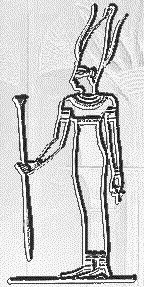
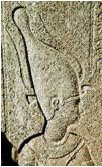
    She is depicted as a woman in human form, wearing the White Crown of Upper Egypt (south), with two long curved antelope horns on the side, and in her hand a payrus plant scepter.    She was originally worshiped as an antelope goddess.    She was sometimes shown carrying a bow and arrows.    More often she was shown carrying a sceptre and the ankh symbol.

    She is also associated with the triad of Abu (Elephantine) with Anuket (Anukis) and Khnum.
    By the New Kingdom she was believed to be the wife of Khnum and the mother or sister of Anqet and made the third member of the Abu triad.    Like Anqet, she was originally thought to have been a daughter of the sun god Ra, his protector.    As Khnum was related to Osiris, and Anqet was to Nephthys, Satet was connected with Isis, especially at the time of the Nile flood.
    When Khnum later was identified with Re, Satis became the "Eye of Re" and assuming some of Hathor's aspects, seen as a goddess of women and love.

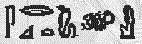
    Originally, Satet's name was written with the hieroglyph for a shoulder knot and was replaced with a sign of a cow's skin pierced by an arrow.    This was probably in relation to her function as a goddess of the hunt, giving her the name "She who Shoots."    The sign was not only used for "to shoot," but with water related words as well meaning "to pour."    Satet could also mean "She who Pours," a link with her guardianship over the Nile cataracts.    "...And behold Satet washes him with the water which is in her four vases in Abu (Elephantine)."
-- Pyramid Text of Pepi I


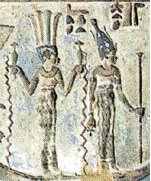
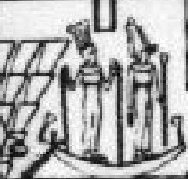
    One source claims that the image above is Anqet and Satis, but upon further investigation it is seen on Aquarius Decan as seen below.

    Above the Grand Temple Decan 37 is a boat with two figures, which may be Argo Navis (Sextant).    The first figure is holding up two vials and pouring water out as seen with Aquarius, but wearing a plumed headdress.    The next figure has a Atef crown with a cup-like (papyrus-shaped) scepter.    These could be the deities Jupiter and Mercury.
    As seen on "http://home.main.rr.com/imyunnut/Den.Round.html" by Joanne Conman, "When the stars of Leo rose heliacally (before sunrise), the land of Egypt was drowned in the river.    That is why the two goddesses associated with the flood, Anuket (reference to Crater) and Satet (reference to Argo Navis) are directly beneath Leo.    These two goddesses together with Khnum formed the Great Triad of Elephantine.    They were seen as the guardians of the Nile and were responsible for dispensing its waters in the annual Flood.    Their position on the round zodiac coincides with the decan stars that rise heliacally (just before sunrise) at the time of the flood.

    Behind the Sirius cow
(reference to Canis Major/Minor) is the figure of a young woman with a bow and arrow.    She is the goddess Satet (reference to Argo Navis, or Satis, to the Greeks).    She is the daughter of the goddess Anuket and Khnum, the ram-headed god from Elephantine who fashions men's bodies on a potter's wheel.    Satet is also a consort to her father.    She is linked to the star Sirius and her temple in Upper Egypt has connections to the star Sirius.    Her name is connected with pouring water or shooting in the Egyptian language.    She wears the Upper Egyptian white crown, decorated with two gazelle horns, which link her, like her mother, to the Sudan.    The Greeks associated her with Hera."
    On Denderah Decan 17 seen below the feet of Sextant (Argo Navis) is a young male figure (possibly a female) in a long robe with two vertically curving horns coming out of the top of his/her head.    Under his left hand are three stars (in an upward pointing triangle).    No direct connection is seen here with the Grand Temple Decan 4.    The goddess Satis is the only one that I have seen depicted in human form, wearing the White Crown of Upper Egypt, with two curved antelope horns on the side.

    What other sources state about Satet.
    As a goddess of the hunt, she was also believed to be a protector of Egypt and of the pharaoh.    It was her arrows that protected the southern border, keeping the enemies at bay.    Yet she was more closely linked to water than to the bow and arrow.    There may be a connection between water and the bow and arrows she sometimes was shown to wield: The name probably means "to pour out" or "to scatter abroad," so that it might signify a goddess who wielded the powers of rain.    She carries in her hands a bow and arrows, as did Nit, typical of the rain or thunderbolt.
-- Egypt, Myths and Legends, Lewis Spence
    To the dead, she was one who washed them to purify them so that they might enter through the gates of the Egyptian heaven.    Her water was the water that came up from the underworld, where the Nile was believed to have poured out into the world.    It was this water that she used to cleanse the departed so they were washed clean of all impurities for their afterlife.
    It was believed that she released the inundation while the star Sirius appeared in the sky.    In this, she was also linked to the goddess Sopdet (Sothis), a personification of that star.    In Iunyt (Esna) she formed a triad with Khnum and another huntress, the goddess Nit.
    The inundation itself was known as the Night of the Teardrop.    Every year, Isis would shed a single tear, which would be caught by Satet in her jars, then poured into the Nile. -- Satet, TourEgypt
    It was due to her link with the inundation that she was a fertility goddess.    She gave fertility to the land by releasing the flood and the Nile's silt, allowing the land to be able to grow crops again, and to give the life-giving water back to the Egyptians each year.    She was eventually linked with Hathor, and became not just a goddess of the flood, but a goddess of human fertility and love as well.


    This file was created on June 18, 2005.

Return to the Table of Contents or the Zodiac of Denderah