From The Alpha and the Omega - Volume III
by Jim A. Cornwell, Copyright © July 20, 2002, all rights reserved
"Volume III - Gods/Goddesses of Ancient Egypt"
ANQET
(Anuket, Anukis, Anket, Anjet)


    To return to the
Virgo Decan (Companion of Satis),
Leo Decan (Companion of Satis),
Argo Navis Decan (flood goddesses),
Crater Decan (flood goddesses),
Aquarius Decan (Satis and Anqet),
Selket (also known as Satis),
or List of Netjeru.
    Anqet means "Embracing Lady," "She Who Embraces," thought to hold the Nile in her arms.    She is probably Nubian in origin, and was worshipped at the islands of Abu/Elephantine and Sehel (Setet) in the Old Kingdom Period related to the Nile in the Aswan area, and was associated together with Satet in inscriptions.
    Originally a daughter of the sun god Ra during the New Kingdom, she became either the wife or the daughter of Khnum.    She was also a goddess of the hunt whose sacred animal was the gazelle.    She is depicted as a woman wearing a tall feather crown (ostrich plumes) or (reeds), maybe holding a papyrus sceptre and the ankh symbol.    The headdress was probably of Nubian origin.    She was, very occasionally, shown in the form of a gazelle.    The water goddess' link to the gazelle was probably because the Egyptians saw these animals always around water.    As a huntress, she was probably thought to be fleet of foot and agile like the gazelle.    There is an ostracon on which she is depicted in the form of a gazelle and called "lady of heaven" and "mistress of the gods," though she is mostly shown in human form.    Her image can be seen in the Temple of Ramses II at Abu Simbel and at other Nubian temples.    Anqet's temple on Setet Island was called "Amen-Hery-Ab," meaning "Amen's Heart is Content," where she was known as nbt the "Lady of Setet Island."    Her temple on Iat-Rek (Philae) island was called "Per-Mer" or "House of Love," where she was identified with Nephthys due to Satet's links with the goddess Isis and Khnum's link with Osiris.
    During the month of Thuti (Leo) is the Feast of Anuket: Welcoming the rising of the Nile.
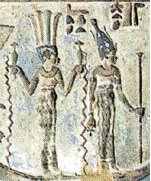
    Compare the Denderah image seen below of Crater, who is holding two papyrus sceptres to the image of Anqet.
    Satis is also associated with the triad of Anuket (Anukis) and Khnum.
    One source claims that the image above is Anqet and Satis, but upon further investigation it is seen on Aquarius Decan as seen below.
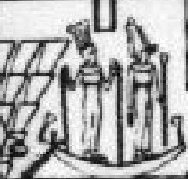
    Above the Grand Temple Decan 37 is a boat with two figures, which may be Argo Navis (Sextant).    The first figure is holding up two vials and pouring water out as seen with Aquarius, but wearing a plumed headdress.    The next figure has a Atef crown with a cup-like (papyrus-shaped) scepter.    These could be the deities Jupiter and Mercury.
    As seen on "http://home.main.rr.com/imyunnut/Den.Round.html" by Joanne Conman, "When the stars of Leo rose heliacally (before sunrise), the land of Egypt was drowned in the river.    That is why the two goddesses associated with the flood, Anuket (reference to Crater) and Satet (reference to Argo Navis) are directly beneath Leo.    These two goddesses together with Khnum formed the Great Triad of Elephantine.    They were seen as the guardians of the Nile and were responsible for dispensing its waters in the annual Flood.    Their position on the round zodiac coincides with the decan stars that rise heliacally (just before sunrise) at the time of the flood.
    Behind the Sirius cow
(reference to Canis Major/Minor) is the figure of a young woman with a bow and arrow.    She is the goddess Satet (reference to Argo Navis, or Satis, to the Greeks).    She is the daughter of the goddess Anuket and Khnum, the ram-headed god from Elephantine who fashions men's bodies on a potter's wheel.    Satet is also a consort to her father.    She is linked to the star Sirius and her temple in Upper Egypt has connections to the star Sirius.    Her name is connected with pouring water or shooting in the Egyptian language.    She wears the Upper Egyptian white crown, decorated with two gazelle horns, which link her, like her mother, to the Sudan.    The Greeks associated her with Hera."

    Other sources claim Anqet that Satet were connected with Isis, taking on the attributes of fertile waters as well as being a form of the star Sirius (the goddess Sopdet).    Dr Brugsh considered her a personification of the waters of the Nile, and thought that her name signified "to surround," "to embrace" and that it had reference to the embracing and nourishing of the fields by the river.
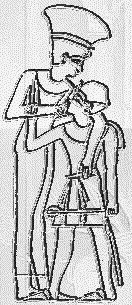
    She was also a nourisher not only of the land, but of the pharaoh as well.    She has been shown suckling a young Ramses, while being described as the "Giver of Live, and of All Power, and of All Health, and of All Joy of the Heart."    Probably because of her status as a fertility goddess, she became a goddess of lust by the Greek and Roman periods, and was related to things of a very sexual nature.


    This file was created on June 18, 2005.

Return to the Table of Contents or the Zodiac of Denderah