Leo and its Decan Constellations.
Leo
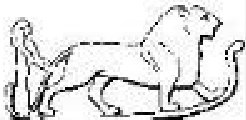
On the Denderah Zodiac, Coma Berenices is at Leo's tail, Hydra the serpent is at its feet with the crone, Corvus at the end of the tail.
Leo
is seen as a kingly lion figure, and some sources claim it is named by the Coptic as Pi-Mentikeon, "the pouring out (of Divine Wrath)," by one source and "the plucking asunder," by another. Above Leo is a throne figure with a scepter, which is Leo Minor. One source claims that the small seated figure above Leo may represent the star Regulus.
In "The Witness of the Stars," by E.W. Bullinger, page 162-163 "In the ancient Zodiacs of Egypt (Denderah, Esneh) and India we find the Lion. In the Denderah Zodiac he (Leo) is treading upon a serpent..." |
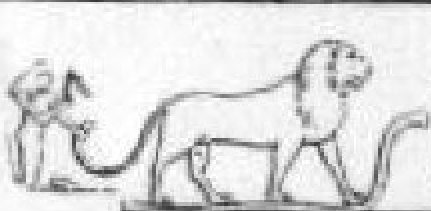 Coma Berenices and Leo (standing on the serpent) as seen on the Grand Temple are located above Decan 2-3. 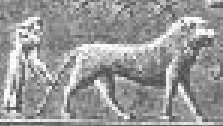 As seen above on ESNE Plate 79 we also see Coma Berenices and Leo. 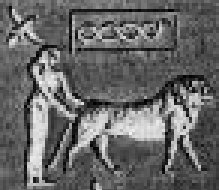 On the upper section of ESNE Plate 87 as seen above Coma Berenices is behind Leo . Note the bird in this image could be Corvus. The figure directly above Leo may be the constellation of Leo Minor, "Prince of Peace," which also is seen below on the Grand Temple located above Decan 4. 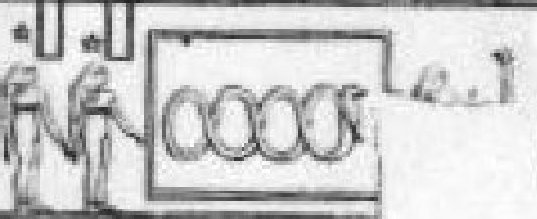
In "The Witness of the Stars," by E.W. Bullinger, page 163-164 "The Denderah picture exhibits all four in one. The Lion is presented treading down the Serpent. The Bird of prey is also perched upon it, while below is a plumed female figure holding out two cups, answering to Crater, the cup of wrath." |
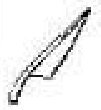
The hieroglyphic origin of Leo is a feather. The Feather of Maat represents truth, justice, morality and balance, a status for a pharaoh to uphold.

Demotic

Leo Sign
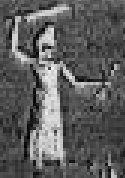 ESNE Plate 87 upper section shows the figure above as between Leo and Cancer, but seen with a knife in the raised right arm, and a bow and arrow in the left hand. It is probably Bootes a constellation that I propose is in Virgo. |
In the season Akhet I (Aakhet also Hiver) - Nile overflow, Inundation or "the Rising."
The month of Leo, as seen on Calendar Dates the month dates as: 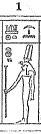 The star is in Leo (Regulus).
On the Grand Temple these first two deities seen below are between Virgo and Leo and located above Decan 4-5. Note that the constellation Leo Minor is possibly the symbol to the right of them, and is also seen in the upper section of ESNE Plate 87 above Leo. The deity seen below is shown on the Grand Temple after Leo and located above Decan 1. 
Some claim that the Morning Star is Regulus, at the back front foot of the constellation Leo. On the back of the Denderah Zodiac Leo rides a young prince (Leo Minor) who holds a flail in his hands. This is the Prince of Peace. Even the Egyptians see him coming in Leo as the opposite of Aquarius. Persian Zoroastrian wisdom did influence the icons of Egypt, and the temple of Denderah is claimed to be an attempt to reestablish the Kingdom of Heaven after the defeat of the Zoroastrians. The Egyptians associated Leo with the helical rising of the sacred star Sirius (in Canis Major), a portent of the coming Nile flood of the summer. Cyril Fagan comments on the image in the column to the left, "Leo rose at eve during the lunar month of Phameoth (Sun in Aquarius). Leo's stars known as the Sickle, the Egyptian m3 (ma), the same root for a lion m3i (may) a homophone or rebus for a Sickle. But in the Egyptian zodiac they were known as the 'Bow Stars' and were included in the constellation Cancer. Both the 'Bow' and 'Arrow' (Sirius) rose simulataneously in Egypt during the dynastic period. The Bow Stars were the goddess Satis, who holds a bow and arrow [See Argo Navis or Canis Major Star Names], beneath the lion. In the Esne zodiac she walks before the lion holding in her right hand a reed sickle above her head while carrying her bow and arrows in her other hand. Satis' companion Anqet [See Crater], goddess of the inundation, is seen seated behind Satis, and holding in each had a water vase." |