From The Alpha and the Omega - Volume III
by Jim A. Cornwell, Copyright © July 20, 2002, all rights reserved
"Volume III - The Fifth Month - Constellation Names for Leo"
 LEO
LEO
Leo, the Lion.
The constellation name for Leo:
- Sumerian UR.GU.LA, "The Lion," Leo, or Ur-gula.
(ur, carnivorous beast + gu-la: great).
- Sumerian ur: n., dog; carnivorous beast; servant; young man, warrior; enemy; v., to tremble; adj., humble.
- Sumerian ur(2,3,4): to surround; to flood; to drag (over the ground) (often with -ni-); to shear (reduplication class) (cf., gur10).
- Sumerian úr: floor; base; lap, loins; thighs, legs; root; trunk of a tree.
- Sumerian ùr: roof; entrance; mountain pass; beam, rafter (cf., ur(2,3,4)).
- Sumerian ur4: (cf., gur10,14) see sickle.
- Sumerian ur5: (cf., har).
- Sumerian ur-mah: lion ('carnivorous beast' + 'mighty').
- Sumerian ug(2): lion; anger, fury; storm.
- Sumerian ug5,7,8: n., death; dead person; v., to kill; to die (singular and plural marû stem; plural hamtu, which is sometimes reduplicated; cf., úš).
- Sumerian ug6, u6: v., to look at; to stare at, gaze, adj., astonishing.
- Sumerian pirig(3): lion (poetic); light (bar6/7, 'to shine', + ní , 'thing').
- Sumerian GU.LA, which means "Great," representing Aquarius, the opposite of Leo.
- Sumerian gu-la: large, great (cf., gal; gu-ul).
- Sumerian gu-ul: to enlarge; to increase; to make numerous; sometimes = gul, 'to destroy' (cf., gal; gu-la).
- Hebrew gelal (Chaldean), ghel-awl', from a root corresponding to Heb. galal, weight or size (as if rolled) - great.
- Hebrew gadowl, gaw-dole', or gadol, from Heb. gadol, gaw-dal', great (in any sense).
- Hebrew gabar, gaw-bar', a primary root to be strong, prevail, exceed, be great, be mighty.
- Hebrew 'el, ale, shortened, means strength, as adj., mighty, especially the Almighty (but used also of any deity) - God, great, idol, might (-y, one), power.
- Reference to the Hebrew 'elohiym.
- Sumerian la: abundance, luxury, wealth; youthful freshness and beauty; bliss, happiness; wish, desire.
- Sumerian lá: to penetrate, pierce, force a way into (in order to see); to know; to look after; to have a beard (cf. also, lal).
- From www.lexiline.com, "The Great God Ea (GULA d.Ea), the Star of Eridu (NUN.(KI), d.Ea." "GULA 'lying down' and represents EA pictured above another heavenly 'reclining' lion both symbols for 'earth,' with rivers springing forth from both sides." "This is related to Sumerian AB.ZU, hole, underground."
- The Babylonian kudurru, boundary stones from the twelfth century B.C., may denote the Earth-goddess Gula, (also Ninmah, goddess of the underworld), where the cosmic serpent begins to rise.
- Some sources call her "The Great Doctoress," because she was the patroness of herbs, healing, life, as her flowered garment shows. She is seen with hands lifted in prayer, with her dog at side, defender of homes, while before her a Scorpion Archer mounts guard at the uttermost bound of the earth (cosmic sea), to defend against demonic powers and protect the rising and setting sun. She was the daughter of Anu, the remote, horned head-dressed, heaven-god of Mesopotamia, or An, Sumerian "overlord of the gods."
- From www.lexline.com, makes a reference to "The star to his right: NIN.MACH."
- Richard H. Allen in his work "Star Names" claims the following:
- On Ninevite cylinders Leo is depicted as in fatal conflict with a bull, typifying the victory of light over darkness;
- and in Euphratean astronomy it was additionally known as Gisbar-namru-sa-pan, variously translated, but by Bertin as the Shining Disc which precedes Bel; the latter being our Ursa Major, or in some way intimately connected therewith.
- Hewitt says that it was the Akkadian Pa-pil-sak, the Sceptre, or the Great Fire;
- and Sayce identifies it with the Assyrian month Abu, our July-August, the Fiery Hot; Minsheu assigning as the reason for this universal fiery character of the constellation, "because the sunne being in that signe is most raging and hot like a lion."
- From www.lexiline.com, "The lion (UR.GU.LA), d.Latarak."
- Akkadian Ka-lab-me-e, "Big Dog" or "Big Lion."
- "Great dog, a watchdog and protector of herdsmen and caravans."
- Babylonian Aru rabu (Leo) "The Great Lion."
- In his work “BABYLONIAN STAR-LORE: An Illustrated Guide to the Star-lore and Constellations of Ancient Babylonia,” by Gavin White gives this image of Leo which is seen on page 41 shown here as
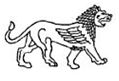
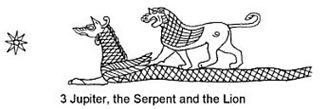 and comments, "As a predatory beast the Lion naturally symbolizes war and death; its astrological omens mostly concern the vagaries of war and the occurrence of natural disasters such as famine. But I believe that the Lion has a further significance within the stellar calendar - as a seasonal symbol it represents the heat of high summer its radiant mane being a simple metaphor for the overbearing rays of the summertime sun."
As you can see for yourself the image for Leo above has some correlation with the Round Denderah image  and the Square Denderah image
 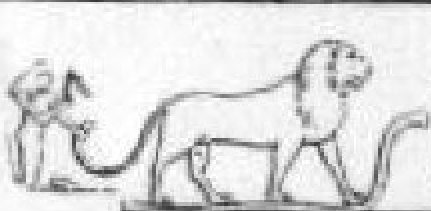 and the hieroglyphic image
  .
.
- Leo, The Lion [Middle English, from Old French, from Latin leo, leon-, from Greek leon, of Semitic origin Hebrew labi'], was recognized as a lion by the ancient Sumerians, Babylonians, Persians, Syrians, Greeks, and Romans.
- Some claim that in Arabic, Hebrew, Coptic, or Syriac the name of this constellation means "He That Rends, That Tears Asunder."
- In "The Witness of the Stars," by E.W. Bullinger, page 164 "The Syriac name is Aryo, the rending Lion, and the Arabic is Al Asad; both mean a lion coming vehemently, leaping forth as a flame." The Vulgate has the same.
- Rolleston states "Syriac Aryo, the lion, who rends."
- In the "Gospel of the Stars," by Joseph Seiss, page 134 "Aryeh, He who rends."
- In the "Gospel of the Stars," by Joseph Seiss, page 134 "Al Sad, He who tears and lays waste."
- Rolleston claims "Arabic Al Asad, who rends, who wasteth (Psalm 91:6)." See Minchir al Asad in Leo's star names.
- Wasteth.
- Hebrew shuwd, shood, a primary root, to swell up, i.e. fig. (by implication of insolence) to devastate, waste.
- Allen comments under Bootes section: Al Haris al Sama’ of Arabic literature originally was for Arcturus, although eventually applied to the constellation. But long before these ideas were current in Arabia, that people are supposed to have had an enormous Lion, their early Asad, extending over a third of the heavens, of which the stars Arcturus and Spica were the shin-bones; Regulus, the forehead; the heads of Gemini, one of the fore paws; Canis Minor, the other; and Corvus, the hind quarters.
- Allen comments under Cancer section: The Arabs also knew it as Al Fum al Asad and as Al Anf al Asad, the Mouth, and the Muzzle, of the Lion, both referring to the early figure.
- Allen comments under Canis Minor section: In Canis Minor lay a part of Al Dhira’ al Asad al Makbudah, the Contracted Fore Arm, or Paw, of the early Lion; the other, the Extended Paw, running up into the heads of Gemini.
- Allen comments under Corvus section: ... but Firuzabadi, as interpreted by Lach, said that they were theta, kappa, psi, and g; and the same stars were Al ‘Ajz al Asad, the Rump of the ancient Lion (Leo).
- Persian Sar, Ser Shir, similar to Arabic Asad, Sarfah.
- Allen claims the same stars were included in the 8th, 9th, and 10th manazil of Arabia as Al Jabhah, the Forehead; Al Zubrah, the Mane; and Al Sarfah, the Turn,
- The ancient Chinese zodiac it was a figure of a horse, the Incan lore represented it as a springing puma, and the Turks called it Artan.
Regarding the Head of Leo.
- As seen under the Bootes Constellation in Virgo and Auriga in Taurus.
- Sickle (i.e. ploughshare).
- Found in the Bible in Deut. 16:9; 23:25.
- Used mostly for cutting grain but on occasion they were used for pruning.
- Mark and John use the sickle in a figurative sense as the instrument of God's judgment (Mark 4:29; Rev. 14:14-20).
- Under the Leo constellation names for Hebrew/Greek words for Sickle we find:
- Hebrew chermesh, kher-mashe', or hermesh, from Heb. charam, khaw-ram', a primary root to seclude, to devote to religious uses, thus a sickle (as cutting), a reaping hook (Deut. 16:9; 23:25.)
- Hebrew maggal, mag-gawl', from an unused root meaning to reap, a sickle, a reaping hook (Jer. 50:16 and Joel 3:13).
- Greek drepanon, drep'-an-on, from drepo (to pluck), a gathering hook (for harvesting), a tool used for cutting grain.
- Under the Leo constellation names for Sumerian words for Sickle we find:
- The very early Sumerians saw in the curve of stars we call the Sickle an asterism (head of Leo) they knew as Gismes, the "curved weapon."
- I have not found this Sumerian word as of yet. As Allen claims the same stars were included in the 8th, 9th, and 10th manazil of Arabia as Al Jabhah, the Forehead; Al Zubrah, the Mane; and Al Sarfah, the Turn, whereas the Sickle stars were a lunar asterism with the Akkadians as Gis-mes, the Curved Weapon; with the Khorasmians and Sogdians as Khamshish, the Scimetar; but with the Copts as Titefui, the Forehead. A sickle is a curved weapon, and the following are examples of the Sumerian words:
- Sumerian giš, geš: tree; wood; wooden implement; scepter; tool; organ; plow; natural phenomenon.
- Sumerian gur10,14; ur4: n., sickle; v., to reap, harvest; to pluck; to shear (sheep); to gather in; to catch (in a net); to gather together; to join in assent (probably reduplication class).
- Sumerian še-gur10-ku5: harvest ('grain' + 'sickle' + 'to cut').
- Sumerian zubu, zubi: sickle (zú, 'flint; tooth', + bu[r], 'to pull, draw, cut off').
- Sumerian gàm: n., sickle; handle; v., to shine, glitter.
- Under the Auriga constellation in Taurus is this name the Sumerian GÀM, Akkadian gamlu, "The Crook," one source claims that it is associated with Auriga, but it seems to fit better with Leo, and the Sumerian words for the "curved weapon."
- Sumerian gam: n., decline, incline (cf., gúr); v., to bow down, kneel (for someone: dative; direction: terminative); to bend, curve; to shrivel.
- From www.lexiline.com, "The Crook Staff (GAM), god of the crook staff (d.Gamlum), one source claims this is the staff in the hand of Orion (note that it is an Egyptian waas scepter on the Denderah Zodiac)."
- The Sickle was also recognized as a backwards question mark or fishhook opposite of the Aquarius lucky stars.
- The esoteric meaning of Aquarius's Hebrew letter Tzaddi, was a fishing hook, and is seen in Matthew 17:21 where the Lord told him to cast a hook (KJV).
- The lion is a majestic, kingly, and noble creature. It is king of beasts in the jungle and spiritually represented by the King of Kings.
- Just why these stars came to be known as a lion is disputed. Some say the Sun was among them during the hottest days of summer in the last two millennia B.C., they were associated with the most powerful beast known.
- Others say that because the lions came to cool themselves on the banks of the Nile in summer, people connected them with the constellation through which the Sun passed at that time of year.
- Egyptian/Coptic:
- On the Denderah Zodiac, Coma is at its (Leo) tail, Hydra the serpent is at its feet with the crone, Corvus at the end. Leo is seen as a kingly lion figure, and some sources claim it is named by the Coptic Pi-Mentikeon, "the pouring out (of Divine Wrath)."
- Richard H. Allen states: Distinct reference is made to Leo in an inscription on the walls of the Ramesseum at Thebes, which, like the Nile temples generally, was adorned with the animal's bristles; while on the planisphere of Denderah its figure is shown standing on an outstretched serpent. The Egyptian stellar Lion, however, comprised only a part of ours, and in the earliest records some of its stars were shown as a Knife, as they now are as a Sickle. Kircher gave its title there as Pimentekeon, Cubitus Nili.
- In "The Witness of the Stars," by E.W. Bullinger, page 163-164 "The Denderah picture exhibits all four in one. The Lion is presented treading down the Serpent. The Bird of prey is also perched upon it, while below is a plumed female figure holding out two cups, answering to Crater, the cup of wrath."
- In "The Witness of the Stars," by E.W. Bullinger, page 162-163 "In the ancient Zodiacs of Egypt (Denderah, Esneh) and India we find the Lion. In the Denderah Zodiac he (Leo) is treading upon a serpent ..."
- In "The Witness of the Stars," by E.W. Bullinger, page 162-163 "Its Egyptian name is Pi Mentekeon, which means the pouring out (as in a cup of Divine wrath on that Old Serpent)."
- In the "Gospel of the Stars," by Joseph Seiss, page 134 "Pi-mentekeon, the Pourer-out of rage, the Tearer asunder."
- Rolleston claims "Coptic Pi-Mentekeon means the plucking asunder."
- Pluck.
- Hebrew 'arah, aw-raw', a primary root to pluck, gather (in the sense of violence), a (young) lion, plus pierce [from the margin].
- Of interest is the Hebrew Pi ha-Chiyroth, pee hah-khee-roth, mouth of the gorges, Pi-ha-Chiroth, Pi-hahiroth.
- Others claim K3 = KR or KRL = KARAL = LARAK.
- Above Leo is a throne figure with a scepter, which is Leo Minor.
- Some claim that the Morning Star is Regulus, at the back front foot of the constellation Leo.
- On the back of the Denderah Leo rides a young prince (Leo Minor) who holds a flail in his hands. This is the Prince of Peace.
- Leo Minor, the lesser lion.
- Star name 46 Praecipula, "principal star."
- Other names are Al Haud, Thiba' wa-Auladuha.
- Persian Zoroastrian wisdom did influence the icons of Egypt, and the temple of Denderah was an attempt to reestablish the Kingdom of Heaven after the defeat of the Zoroastrians.
- The Egyptians associated Leo with the helical rising of the sacred star Sirius (in Canis Major), a portent of the coming Nile flood of the summer.
- Leo originally had a longer tail with a tuft of hair at the end, but these stars now make up the constellation Coma Berenices, which is in the Virgo age.
The Lion from the Holy Bible
- In the Old Testament:
- Hebrew 'ariy, ar-ee', or 'aryeh, ar-yay', from Heb. 'arah, aw-raw', a primary root to pluck, gather (in the sense of violence), a (young) lion, plus pierce [from the margin].
- Of note also is Hebrew 'ariy'el, ar-ee-ale' or 'ari'el, from Heb. 'ariy and Heb. 'el, ale; lion of God, i.e. heroic: -- lionlike men.
- Rolleston claims that "Hebrew Arieh, the lion rending (biblical pluck, Psalm 80:12)."
- Pluck.
- Heb. 'arah, aw-raw', a primary root to pluck, gather (in the sense of violence), a (young) lion, plus pierce [from the margin].
- Seen earlier is the Babylonian Aru rabu (Leo) "The Great Lion."
- In "The Witness of the Stars," by E.W. Bullinger, page 164 "The Syriac name is Aryo, the rending Lion, and the Arabic is Al Asad; both mean a lion coming vehemently, leaping forth as a flame."
- Rolleston states "Syriac Aryo, the lion, who rends."
- In the "Gospel of the Stars," by Joseph Seiss, page 134 "Aryeh, He who rends."
- Rolleston claims "Arabic Al Asad, who rends, who wasteth (Psalm 91:6)."
- In the "Gospel of the Stars," by Joseph Seiss, page 134 "Al Sad, He who tears and lays waste."
- Hebrew kephiyr, kef-eer', from Heb. kaphar to cover; a village, but also a young lion.
- Hebrew labiy', law-bee', or (Ezek. 19:2) lebiya', leb-ee-yaw', irregular masc. plural leba'iym, leb-aw-eem', irregular fem. plural leba'owth, leb-aw-oth', from an unused root meaning to roar, a lion, lioness, young [lion].
- Seen earlier is the Akkadian Ka-lab-me-e, "Big Dog" or "Big Lion."
- Hebrew layish, lay'-yish, from Heb. luwsh, loosh, to knead, in the sense of crushing: a lion (from his destructive blows): (old) lion.
- Hebrew shachal, shakh'-al, from an unused root probably meaning to roar; a lion (from his characteristic roar): (fierce) lion.
- From the New Testament:
- Greek leon, leh-ohn', a primary word a "lion." The word "lion" (panthera leo) appears 98 times and with "lion's" and "lionesses," they total about 150 places in Scripture.
- Allen states: In Greek and Roman myth this was respectively Leon and Leo, representing the Nemean Lion, originally from the moon, and, after his earthly stay, carried back to the heavens with his slayer Hercules, where he became the poet's Nemeaeus; Nemeas Alumnus; Nemees Terror; Nemeaeum Monstrum; and, in later times, No Animal Nemaeo truculento of Camoes. It also was Cleonaeum Sidus, from Cleonae, the Argolic town near the Nemean forest where Hercules slew the creature; Herculeus; and Herculeum Astrum. But the Romans commonly knew it as Leo, Ovid writing Herculeus Leo and Violentus Leo.
- Daniel's testing in the lion's den (Dan. 6) demonstrate an oriental rulers use of the lion as a means of execution, and protection by the Almighty.
- The Lion "mighty among beast, who retreats before nothing" (Prov. 30:30) symbolizes the unvanquished hero.
- The lion is shown in an orthostat found in Hazor dated to 1500-1200 B.C.
- Hosea 13:7, 8 "Therefore I will be unto them as a lion: as a leopard by the way will I observe them ... them as a bear that is bereaved of her whelps, and will rend the caul of their heart, and there will I devour them like a lion: the wild beast shall tear them." Noted as "He That Tears Asunder."
- Revelation 5:5 "Weep not: behold, the Lion of the tribe of Judah, the Root of David, hath prevailed to open the book."
- We see a connection between the Lamb of God, which taketh away the sin of the world, and the Lion of the tribe of Judah. Lion of Judah, is a symbol of the Israeli tribe of Judah. At His first coming into this world, Jesus, as the Lamb of God, came meekly and humbly to lay down His life, and to shed His blood for the sins of the world. As the Lion of God, which represents His Second Coming, where He shall come in great power and glory. Leo is clearly and incontestable that this is a picture of the destruction of the wicked.
- Daniel described Babylon as a winged lion--a religious symbol used in the ancient pagan world--while Peter warned his contemporaries that the devil prowls around like a roaring lion (1 Peter 5:8).
- One of the twelve simple Hebrew Letters is Teth (KJV Teth, also Teyth, tayth, Ps 119:65), the English letter is t which has a numerical value equal to 9, and an esoteric meaning of "Serpent," or "Snake."
- Serpent.
- Hebrew nachash, naw-khawsh', from Heb. nachash, naw-khash', a primary root properly to hiss, thus a snake (from its hiss), serpent.
- Hebrew tanniyn, tan-neen', or tanniym, tan-neem', intens. from the same as Heb. tan, tan, from an unused root probably to elongate, a monster, thus a marine or land monster, i.e. sea-serpent or jackal, dragon, sea-monster, serpent, whale.
- Hebrew saraph, saw-rawf', from Heb. saraph, saw-raf', a primary root to be on fire, thus burning, poisonous (serpent), spec. a saraph or symbolic creature (from their copper color), fiery (serpent), seraph.
- Greek ophis, of'-is, through the idea of sharpness of vision, a snake, Satan, serpent.
- Under Sagittarius under Draco, the Dragon, one of the star names d Nodus II sometimes, "second knot," or Altais which is Arabic for "serpent."
- Under Leo see Hydra, the Water-Snake (The Sea Serpent).
- Other names for Leo: Alasid, Ala'sado, Ala'tid, Ale'ser, Ale'zet, Dafi'ra, Elle'sed, Al Nahran (stars), A'sedaton, A'sid, A'sis, As'sid.
- Allen states: .. later Arabians also adopted Ptolemy's Leo and transferred to it the Asad of the early constellation. This appeared in the various corrupted forms cited by Bayer, — Alasid, Aleser, Asis, Assid, and others similar, of which Assemani gives a long list; Schickard adding Alasado and Asedaton; and Riccioli, specially mentioning Asid and Ellesed, cautioned his readers against the erroneous Alatid and Alezet.
- Allen states: Bacchi Sidus was another of its titles, that god always being identified with this animal, and its shape the one usually adopted by him in his numerous transformations; while a lion's skin was his frequent dress. But Manilius had it Jovis et Junonis Sidus (Jovis = Roman Jupiter or Greek Zeus; Junonis = Roman Juno or Greek Hera), as being under the guardianship of these deities; and appropriately so, considering its regal character, and especially that of its lucida (Regulus).
- Allen states: The Arabian astronomers knew Coma as Al Halbah, or Al Dafirah, the Coarse Hair, or Tuft, in the tail of the Lion of the zodiac, thus extending that figure beyond its present termination at the star Denebola.
- Seen as Lion in France, Lowe in Germany, and Leone in Italy. In Anglo-Norman times it was Leun.
Continue to Star Names of Leo or return to Introduction of Leo.
This file was updated on July 15, 2008, and March 30, 2010.
Return to the Table of Contents or the Zodiac of Denderah