From The Alpha and the Omega - Volume III
by Jim A. Cornwell, Copyright © July 20, 2002, all rights reserved
"Volume III - Gods/Goddesses of Ancient Egypt"
HAPI
(Hapy, Ahephi, Hep, Hap)


    To return to the
Scorpius Decan (netjer of the Flood season Akhet IV),
Libra Decan (netjer of the Flood season Akhet III),
Virgo Decan (netjer of the Flood season Akhet II),
Leo Decan (netjer of the Flood season Akhet I),
Aquarius Decan (Greeks identified Hapi with Aquarius-Ganymede),
Denderah Decan 2 - Grand Temple Decan 19 (Deity),
Denderah Decan 10 - Grand Temple Decan 11 (Hapy's connection to Hebrew Rimmon),
Denderah Decan 11 - Grand Temple Decan 10 (Deity),
Denderah Decan 26 - Grand Temple Decan 31 (Deity),
Denderah Decan 15 - Grand Temple Decan 6 (Deity with Amset),
Heru (One of Heru's sons),
or List of Netjeru.
    Hapi was probably a predynastic name for the Nile and the personification of the Inundation of the Nile (Iterw), meaning "the river" than the river Nile itself, for its life-bringing to Egypt and so it became the name of the god of the Nile.
    One source claims that "Nile" comes from the Greek corruption of Neilos from the Egyptian "nwy" which means "water."    He was an ancient god, mentioned in the Pyramid Texts in Utterance 581 as "who comest forth from Hep" where he was to send the river into the underworld from certain caverns, where he was thought to have lived at the 1st Cataract.    The Nile was thought to have flowed from the primeval waters of Nun, through the land of the dead, the heavens and finally flowing into Egypt where it rose out of the ground between two mountains which lay between the Islands of Abu (Elephantine) and the Island of Iat-Rek (Philae).    Hapi was also mentioned in the Pyramid Texts as a destructive power, but one that worked for the pharaoh.
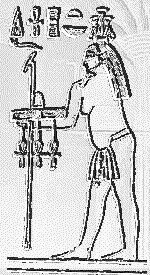
    He was depicted as an overweight or well-fed, blue or green man, symbolizing abundance, with the false beard of the pharaoh on his chin.    The Egyptians showed Hapi as having rather large female breasts, like those of a mother with a baby, which symbolize the rivers fertile properties.
    From the Middle Kingdom onwards we find Hapi depicted as a statue wearing a regent's features, to point at the king's importance to the regeneration of the land.    The statue is standing behind an offering table which is decorated with flowers and fruits, denoting rich vegetation, some of them are tied together to show the unification of the Two Lands.
    Other epithets for Hapi as a water god, were "lord of the fishes and birds of the marshes," and he is followed by crocodile-gods and a company of frog-goddesses with braided tresses of hair.    Hapi provided water, food and the yearly inundation of the Nile, preventing Egypt from dying, thus revering him even above Ra, the sun god.
    At a very early period he absorbed the attributes of Nun, the primeval watery mass from which Ra, the Sun-god, emerged on the first day of the creation; and as a natural result he was held the father of all beings and things, which were believed to be the results of his handiwork and his offspring.
    There are no known temples of Hapi, but his statues and reliefs are found in the temples of other deities.    In the temple of Abydos, he is depicted with a double-goose head.    He was worshipped at Gebel el-Silsileh (El-Silisila), Aswan (Swentet) and Abu (Gr. Elephantine) where he was associated with the god Khnum.
    He carries a tray of offerings with the gift of the Nile, the produce of the Nile silt.    He wears a crown of either the lotus of Upper Egypt or the papyrus of Lower Egypt.    Hapi influenced the whole stretch of the Nile, and is seen holding both papyrus and lotus plants, or two vases in his hands.    In the Luxor Temple, Thebes, there is a relief showing two Hapi figures standing over a lotus and papyrus plant, tieing the two plants of the northern or southern region into a knot, symbolising the union of Upper and Lower Egypt into the windpipe (sema) hieroglyph which denoted the Unification of the Two Lands (Also see Serket).    This duality was shown by one wearing the papyrus of the north (Lower Egypt) as a headdress, the other wearing the south's (Upper Egypt) water lily (lotus) as a headdress.    The Upper Egyptian Hapi was called "Hap-Meht" while the Lower Egyptian Hapi was known as "Hap-Reset."
    He was a funery god, one of the sons of Horus who looked after the human viscera after embalming.    The jars used for preservation are called Canopic jars.    The ape-headed god was guardian of the lungs and assisted by the goddess Nephythys.
    He was thought to be the husband of the vulture goddess Nekhbet in Upper Egypt, and of the cobra goddess Wadjet (Edjo) in Lower Egypt.    When he took on the attributes of Nun (Nu), Hapi became husband to Nun's wife, the primeval goddess Naunet of the Ogdoad.    He was also linked with Osiris - another water-related fertility god - and thus Nekhbet and Wadjet were also seen as a form of Isis, Osiris' wife. ...the Egyptians had no clue how or why the Nile flooded each year.    They believed that the deities Khnum, Satet, and Anqet were the guardians of the source of the Nile.    Their duty was to make sure that the right amount of silt was released during the yearly inundation.    Hapi was in charge of the waters that flowed during the floods.
    Cyril Fagan comments, "Aquarius identified by the Greeks as Ganymede, the most beautiful boy born of mortal parents, identified as the Egyptian Hapi, the god of the Nile.    The flooding of the Nile occurred when the stars of Aquarius rose immediately after sunset (Sun in Leo) in July."
    On Denderah Decan 10 - Grand Temple Decan 11 it is noted that Hapy (Ahephi), son of Horus, is seen as a mummified man with a baboon head, protector of lungs, protected by the goddess Nephthys.
    The hieroglyph for a baboon is .
    As seen above the figure to the right is Denderah Decan 10 and is seen as mummified figure with a lion-like face with the (Hedjet) white crown of Upper Egypt on its head.
    On Denderah Decan 11 - Grand Temple Decan 10 and Denderah Decan 26 - Grand Temple Decan 31
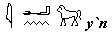
the deity is called     Hapy (Hapi).
    On Denderah Decan 15 - Grand Temple Decan 6 its deity is called Amset Hapy?, Mestha-Hapi or Tuamutef.    Amset, (Imsety, Mestha, Ameshet) son of Horus, was also seen as a mummified man, who protected the liver of the deceased, protected by the goddess Isis.

    In the season Akhet I-IV (Aakhet also Hiver) - Nile overflow, Inundation or "the Rising," we find that the netjer of the Flood season (Leo-Scorpius) was Hapi.

    Other information on Hapi:
Homage to thee, O Hapi.
Thou appearest in this land
And thou comest in peace to make Egypt to live.
Thou art the Hidden One
And the guide of the darkness
On the day when it is thy pleasure to lead the same.
Thou art the waterer of the fields which Ra has created,
Thou givest life unto all animals,
Thou makest all the land to drink unceasingly
As thou descendest on thy way from the heavens
.
-- Hymn to Hapi, 18th or 19th Dynasty

    During the inundation flood, the Egyptians would throw offerings, amulets and other sacrifices into the Nile at certain places, sacred to Hapi.    Hapi was thought to come with the inundation (the "Arrival of Hapi") with a retinue of crocodile gods and frog goddesses, and the sacrifices were given in the hopes that the flood would not be too high, nor too low.    If the inundation was too high, many homes would be destroyed (the Egyptians built their homes and even palaces out of mud brick, which was easily washed away in a large flood).    On the other hand, if the flood was too low, there would not be enough water for the fields and cattle - Egypt would be in drought.    During inundation, statues of Hapi were carried about through the towns and villages so that the people could honor and pray to him - it was a solemn occasion.
    Even Akhenaten, the "heretic king," could not banish Hapi completely as he did with the other gods.    Instead, he tried to suggest that Hapi was an incarnation of the Aten (Akenaten's god, the sun disk): I propitiate him who lives by truth, The Lord of Diadems, Akhenaten,
Great in his lifetime.

O Hapi, by whose command
One is powerful
The food and nourishment of Egypt,
The vital ruler who forms me,
Makes me, fosters me...


    This file was created on June 18, 2005.

Return to the Table of Contents or the Zodiac of Denderah