Libra and its Decan Constellations.
Libra
As to the Denderah Zodiac, there is a controversy that Libra was originally part of Scorpius, and it is claimed that in Roman times that those stars were changed to represent Libra. The Egyptians here began the pattern of the Divine Child, Osiris, next to his mother Isis (Virgo).
On the Denderah Zodiac, Libra is seen as what appears to be a female image dressed in white, but some sources show this as a young male with long hair, holding his left hand up to his lips, with the same posture as seen in the Grand Temple Decan 27 image below giving it a connection to its opposite Aries.  In other sources this scene is enclosed in a circle, or sun disk, which is balanced or is supporting a scale figure. The Grand Temple image shows the enclosed circle seated in the hieroglyph sign for the sun rising between the mountains.
To the Coptic this is Lambadia, meaning station of propitation. |
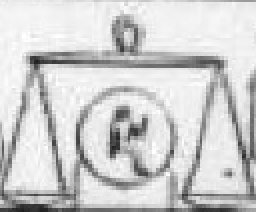 Libra as seen on the Grand Temple located above Decan 8, shows a young male inside the sun disk which appears to be rising between the mountains.
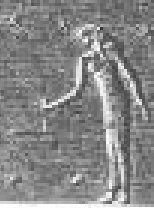 As seen above ESNE Plate 79 shows Libra with scales being held in her right hand.
Cyril Fagan made this comment about: "Libra, the Scales, rose at dusk during the lunar month of Pakhons, when the sun was in the opposite constellation, Aries. When the Pascal New Moon is first seen, first appears just above the western horizon. Simultaneously, Libra rises in the east, as the first constellation, although Taurus is the first one, cosmically speaking. Libra represented as a beam of a scales, but is a very ancient Egyptian ideogram, 3t (Akhet), which depicts the Sun in the process of rising over the hilltops, and which translated reads 'the place where the sun rises,' meaning of course, the Ascendant. During this lunar month the Egyptian harvest was weighed, stored and sold." |
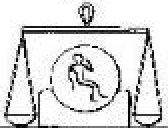

The hieroglyphic origin is seen as the sun rising between the mountains. This is known as Akhet representing the horizon (i.e. sunrise/sunset) which the sun emerged and disappeared. It is similar to the two peaks of the Djew or mountain symbol (i.e. western peak is Manu, the eastern peak is Bakhu) with the solar disk in the center. This was guarded by Aker, a double lion god, seen as a sphinx with the body of a lion (i.e. Great Sphinx of Giza) which may be seen on ESNE Plate 79, and getting the name Harmakhet, "Horus in the Horizon."

Demotic

Libra Sign |
In the season Akhet III (Aakhet also Hiver) - Nile overflow, Inundation or "the Rising."
The month of Libra, as seen on Calendar Dates the month dates as: 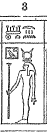 This was the time of the autumnal equinox seen on the fifth day of the Egyptian month, Gregorian: Sept. 21, Julian: Oct. 5, which also includes "Honors to Het-hert." On the sixth Egyptian day is the New Moon Festival and in comparison the Hebrew month celebrates the Feast of Trumpets, Rosh Hashanah, and the New Moon. The star is in Bootes (Arcturus), which is relevant, even though the constellation is connected more to Virgo. Even in Virgo the star Denebola in Leo was acknowledged in lieu of Spica.
On the Grand Temple as seen below these first two deities are located between Ara (in Sagittarius) and Libra, which is located above Decan 10. The figure to the right may be Lupus. 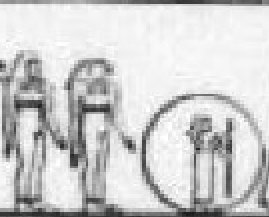
In "The Witness of the Stars," by E.W. Bullinger, page 47 "Libra is called in the Akkadian Tulku. Tul, means mound (like dhul and dul), and ku, means sacred. Thus the sacred mound or the holy altar."
On the Grand Temple this deity is located between Capricornus and Draco (in Libra) just above and between Decan 17 and 18. 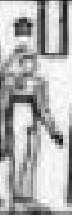 |