From The Alpha and the Omega - Volume III
by Jim A. Cornwell, Copyright © July 20, 2002, all rights reserved
"Volume III - Gods/Goddesses of Ancient Egypt"
HATHOR
(Athyr, Het-Her, Het-heru,
Het-Hert, Hwt-Hert,
Hethara, Hat-hor
)


    To return to the
Libra Decan (netjer of the third month named Athyr, Het-Her, Hathor),
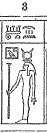
Canis Major Decan (Hathor a standing female figure on ESNE Plate 87),
Canis Minor Decan (cow-deity "the House Above/Horus"),
Coma Decan (wig of Hathor),
Venus Decan (Hathor the female soul with two faces),
Bast (as the Northern one and Hethert the Southern goddess),
Nebethetepet (is a manifestation of Hathor),
Denderah Serpent Crypts (association with Hathor),
or List of Netjeru.
    Hathor means "The House of Horus [the Elder],"which may be a reference to her as the embodiment of the sky in her role of the Celestial Cow, being that which surrounds the decidedly sky-oriented hawk-deity, Horus, when he takes wing.    If Horus was the god associated with the living king, Hathor was the god associated with the living queen.    Seen as a sky-goddess celestial goddess, The Mistress of Heaven and known as the Mother of Mothers and the Celestial Nurse who presided over women, fertility, children and childbirth, who was the mother of Horus, in the New Kingdom before she was merged with Isis (Aset).
    Yet she was also a goddess of baser things - she was the Vengeful Eye of Ra, the Lady of Drunkeness, and a goddess of the dead as Lady of the West.    As Lady of the Southern Sycamore, the sycamore was sacred to her.    It was from the sycamore tree that she was thought to hand out good things to the deceased in the afterlife, and so she was thought to be a friend to the dead.
    She was also known as the Mistress of Life, the Great Wild Cow, the Golden One, the Mistress of Turquoise, Lady of Iunet (Dendera, where her cult centre was located at Iunet), Mistress of Qis, Lady to the Limit (of the Universe), Lady of Punt (perhaps an area in present day Somalia - a famous expedition to this land was commissioned by Hatshepsut, 1473-1458 B.C., of the 18th Dynasty), the Powerful One, the Mistress of the Desert.    Other titles are Lady of Amenty, the Dweller in the Great Land, the Lady of Ta-Tchesert, the Eye of Ra, the Dweller in his breast, the Beautiful Face in the Boat of Millions of Years, the Seat of Peace of the doer of truth, Dweller in the Boat of the favoured ones.
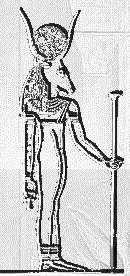
    Shown with a woman's head and cow ears holding a cup-like (papyrus-shaped) scepter.    Also with a sun-disc on her head and cow's horns, but also with a cow's head, a lioness, a snake and a tree nymph.    Generally, Hathor was pictured as a woman with cow's horns with the sun between them, giving her the title of "Golden One," or as a beautiful woman with cow's ears, or a cow wearing the sun disk between her horns, or even as a lioness or a lion-headed woman showing her destructive side.    It was only in later Egyptian history that she was shown as a woman with the head of a cow.
    She often is seen carrying a sistrum, an ancient musical instrument played by the priestesses.    The sistrum usually had the face of Hathor where the handle adjoins the rest of the instrument.    This particular instrument was thought to have sexuality overtones, relating to fertility.    Hathor has a rather odd title, "Hand of God."    This might be related to how the handle of the sistrum is held, just as the relationship of the loop ajoined to the handle (the naos) might be related to her title of "Lady of the Vulva"!
    In the Old Kingdom her cult centered at Iunet/Tentyris/Dendera or Denderah, Edfu and Ombos.    Other temple sites were at Iunu/Heliopolis/Cairo, Aphroditopolis/Atfih, Quis/Cusae/el-Qusiya, Per-Hathor/Pathyris/Gebelein, P-aaleq/Philae.    In Thebes she was worshipped as a goddess of the dead.
    Of interest is the fifth plague in Egypt was called murrain (plague -- cow pox) on the Egyptian cattle.
    She is the goddess of love, tombs and the sky.    Daughter of Ra, an aspect of Isis, sometimes mother of Horus.    She was used by Ra to slay mankind or bringing disaster to her enemies, using the "Eye of Ra," see Sekhmet and the story below about how Sekmet became Hathor.
    Also Hathor has a reference as sometimes being called the "female soul with two faces," which can be seen on Venus Decan a figure who has two faces, the one to the left seems to be a normal human face and looking backwards and the one on the right has a lion-like face and looking forward.    This may concur with the bovine goddess Bat a primeval deity from the 7th Upper Egyptian Nome, depicted on the Narmer Palette (ca 3100) with cow's horns and two faces or actually two different human faced bovines.    In the New Kingdom she was assimilated with Hathor, an ancient goddess mentioned as early as the 2nd Dynasty.
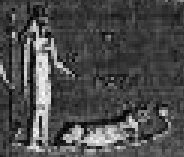
    As seen above on the lower section of ESNE Plate 87, we see a figure which appears to have two faces similar to the one on the Denderah Zodiac for Venus.
    She is sometimes identified with the star, Sept, Sothis or Sirius, but more often with Venus-Aphrodite.
    Cyril Fagan in referring to Aries the opposite of Libra, "The lunar regent of this month (Athyr in Libra) was Hathor, the cow-headed goddess.    Hathor literally means 'House of Horns' (The Sun) or 'the visible heavens.'    In the great temple of Hathor at Denderah, the massive head of the goddess marks the eastern horizon or place of the Ascendant."
    As seen on the Egyptian Canis Minor, who is Hathor, (Het-heru, Het-Hert) the cow-deity "the House Above," and "the House of Horus."    This goddess is often represented as a cow, or as a goddess wearing the horns of a cow on her head.    She is frequently shown with a golden disk representing Re (the Sun) between her horns.    A star is also sometimes depicted between her horns.    When the star is placed before the golden disk, it represents the helical rising of Sirius.
    The netjer of the month of Libra was Het-Hert (Hathor), same at Ramesseum, unknown at Edfu.
    The third month was named Athyr, Het-Her, Hathor, Hethara, Hat-hor, whereas the Christian coptes called it Hator.
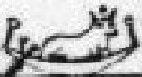
    Sirius (Canis Major) is depicted on the Denderah Zodiac Stone as a star between the horns of the ruminating Hathor cow on Canis Minor or of a cow riding in a boat (or barge), or on top of a serpent.
    As seen above on the upper section of the ESNE Plate 87 to the left is Hathor a standing female figure with Hathor style horns and sun disk and to the right we can see Canis Minor and Canis Major in the cow figure, which is lying down on either a serpent or a boat.
    Above the cow we can see hieroglyphs (a star, two vertical objects, and then three objects in a triangular pattern), which are too small to be read from this image.
    Canis Major is seen as the star between the horns of Canis Minor on the Grand Temple which is located above Decan 36.

    Of interest is that the second Egyptian month (Phaophi - Virgo Decan) of the calendar where the Christian Coptics call it Baba, which is the opposite of Pisces, where under Pisces Decan on Denderah Decan 33 we see Grand Temple Decan 24 is called     Baba, Bawey, or Tepi-a Bawey, a goose sign, Egypt. b3, (ba) is doubled here.    This leads to an interesting story involving Hathor, also very similar to the Japanese tale of the sun goddess who leaves the company of the gods to sulk - is the story of Ra's temper tantrum.    Baba a predynastic baboon god, taunted Ra who stood for Set becoming ruler rather than Horus, "Your shrine is empty!"    With that, Ra stormed off to be alone - presumably this is a story about a solar eclipse - and refused to join the other gods.    Realising that they'd gone too far, the others sent Baba away, but still Ra refused to stop sulking.    Finally, Hathor decided on a plan.    She went into Ra's presence and stood before him and started to dance and strip, revealing her nakedness and lewdly showing him her private parts.    The dance caused Ra to laugh, forget his hurt feelings and he once again rejoined the gods.
    Another interesting thing about Hathor is found in one particular Egyptian tale - when the hero of the story was born, the "Seven Hathors," disguised as seven young women, appeared and announced his fate.    They seemed to be linked with not only fortune telling, but to being questioners of the soul on its way to the Land of the West.    These goddesses were worshiped in seven cities: Waset (Thebes), Iunu (On, Heliopolis), Aphroditopolis, Sinai, Momemphis, Herakleopolis, and Keset.    They may have been linked to the Pleiades in later times, but this is debated.    Hathor herself was known as "Lady of Stars" and "Sovereign of Stars" and linked to Sirius, the goddess Sopdet.    The day that Sirius rose originally on the first day of the first month, known as Thuthi by Greek times was a festive occasion to the followers of Hathor - it was the day they celebrated her birth.
    Hathor was also known as the "Great Menat".    The menat, a necklace with a special counterweight, is not actually jewelry - it is a musical instrument sacred to Hathor!    The counter piece is similar to the fertility dolls found in ancient tombs, while the beaded necklace was believed to represent the womb.    It was held in the hand and rattled to convey the blessing of the goddess.
    Hathor was also the "Lady of Greenstone and Malachite" and "Lady of Lapis-Lazuli", presiding over these materials as well as being a goddess of the fringes where they were mined.    Malachite is a banded light and dark green semi-precious stone that was ground up and mixed with eye make up and Lapis-lazuli adorned many pieces of ancient Egyptian jewelry.    This fits in well with Hathor's role of a goddess of beauty.    She was a goddess of the west, and a goddess of Punt and Sinai and so was a goddess of far off places.    This is perhaps why she was also known as the "Lady to the Limit" - the Egyptians believed her to be a goddess who ruled over the known universe!
    She was said to be the mother of the pharaoh, and is often depicted in a nurturing role, suckling the pharaoh when he was a child.    Other than the pharaoh - a living god - she was believed to have a son with Horus-Behdety, a form of Horus the Elder, known as Ihy (Ahy, Horus-Sematawy, Harsomtus), a falcon-god and child-god of music and dancing who carried a sistrum.    The three were worshiped at Iunet.    My majesty precedes me as Ihy, the son of Hathor
I am the male of masculinity... I escaped from her blood, I am the master of the redness
.
    But it is the following tale for which she is most remembered today: The Eye of Ra
    One of the tales of Hathor was how she was originally a goddess of destruction (Hathor-Sekhmet), and how she came to be the goddess of happier things:
    Then Ra took on the shape of a man and became the first Pharaoh, ruling over the whole country for thousands and thousands of years, and giving such harvests that for ever afterwards the Egyptians spoke of the good things "which happened in the time of Ra".
    But, being in the form of a man, Ra grew old.    In time men no longer feared him or obeyed his laws.    They laughed at him, saying: "Look at Ra!    His bones are like silver, his flesh like gold, his hair is the colour of lapis lazuli!"
    Ra was angry when he heard this, and he was more angry still at the evil deeds which men were doing in disobedience to his laws.    So he called together the gods whom he had made - Shu and Tefnut and Geb and Nut - and he also summoned Nun.    Soon the gods gathered about Ra in his Secret Place, and the goddesses also.    But mankind knew nothing of what was happening, and continued to jeer at Ra and to break his commandments.    Then Ra spoke to Nun before the assembled gods: "Eldest of the gods, you who made me; and you gods whom I have made: look upon mankind who came into being at a glance of my Eye.    See how men plot against me; hear what they say of me; tell me what I should do to them.    For I will not destroy mankind until I have heard what you advise."
    Then Nun said: "My son Ra, the god greater than he who made him and mightier than those whom he has created, turn your mighty Eye upon them and send destruction upon them in the form of your daughter, the goddess Sekhmet."
    Ra answered: "Even now fear is falling upon them and they are fleeing into the desert and hiding themselves in the mountains in terror at the sound of my voice."
    "Send against them the glance of your Eye in the form Sekhmet!"    cried all the other gods and goddesses, bowing before Ra until their foreheads touched the ground.
    So at the terrible glance from the Eye of Ra his daughter Sekhmet came into being, the fiercest of all goddesses.    Like a lion she rushed upon her prey, and her chief delight was in slaughter, and her pleasure was in blood.    At the bidding of Ra she came into Upper and Lower Egypt to slay those who had scorned and disobeyed him: she killed them among the mountains which lie on either side of the Nile, and down beside the river, and in the burning deserts.    All whom she saw she slew, rejoicing in slaughter and the taste of blood.
    Presently Ra looked out over the land and saw what Sekhmet had done.    Then he called to her, saying: "Come, my daughter, and tell me how you have obeyed my commands."
    Sekhmet answered with the terrible voice of a lioness as she tears her prey: "By the life which you have given me, I have indeed done vengeance on mankind, and my heart rejoices."
    Now for many nights the Nile ran red with blood, and Sekhmet's feet were red as she went hither and thither through all the land of Egypt slaying and slaying.
    Presently Ra looked out over the earth once more, and now his heart was stirred with pity for men, even though they had rebelled against him.    But none could stop the cruel goddess Sekhmet, not even Ra himself: she must cease from slaying of her own accord - and Ra saw that this could only come about through cunning.
    So he gave his command: "Bring before me swift messengers who will run upon the earth as silently as shadows and with the speed of the storm winds."
    When these were brought he said to them: "Go as fast as you can up the Nile to where it flows fiercely over the rocks and among the islands of the First Cataract; go to the isle that is called Abu (Elephantine) and bring from it a great store of the red ochre which is to be found there."
    The messengers sped on their way and returned with the blood-red ochre to Iunu, the city of Ra where stand the stone obelisks with points of gold that are like fingers pointing to the sun.    It was night when they came to the city, but all day the women of Iunu had been brewing beer as Ra bade them.
    Ra came to where the beer stood waiting in seven thousand jars, and the gods came with him to see how by his wisdom he would save mankind.
    "Mingle the red ochre of Abu with the barley-beer," said Ra, and it was done, so that the beer gleamed red in the moonlight like the blood of men.
    "Now take it to the place where Sekhmet proposes to slay men when the sun rises," said Ra.    And while it was still night the seven thousand jars of beer were taken and poured out over the fields so that the ground was covered to the depth of nine inches -- three times the measure of the palm of a man's hand-with the strong beer, whose other name is "sleep-maker."
    When day came Sekhmet the terrible came also, licking her lips at the thought of the men whom she would slay.    She found the place flooded and no living creature in sight; but she saw the beer which was the colour of blood, and she thought it was blood indeed -- the blood of those whom she had slain.
    Then she laughed with joy, and her laughter was like the roar of a lioness hungry for the kill.    Thinking that it was indeed blood, she stooped and drank.    Again and yet again she drank, laughing with delight; and the strength of the beer mounted to her brain, so that she could no longer slay.
    At last she came reeling back to where Ra was waiting; that day she had not killed even a single man.
    Then Ra said: "You come in peace, sweet one."    And her name was changed to Hathor, and her nature was changed also to the sweetness of love and the strength of desire.    And henceforth Hathor laid low men and women only with the great power of love.    But for ever after her priestesses drank in her honour of the beer of Iunu coloured with the red ochre of Abu when they celebrated her festival each New Year.
    Note that in the above tale, the goddess called "Eye of Ra" was Hathor who became Sekhmet, then Hathor.    But afterwards, Sekhmet and Hathor were two separate deities, both having claim to the title "Eye of Ra!"
    Hathor was a very clear example of the Egyptian idea of duality - Hathor was both the "sweet one" of music, dance and pleasure as well as a goddess of destruction, an ancient goddess who was loved by the people of Egypt.


    This file was created on June 18, 2005 and updated on May 30, 2006, and September 19, 2007.

Return to the Table of Contents or the Zodiac of Denderah