Gemini and its Decan Constellations.
Canis Minor
On the Denderah Zodiac to the right of Sextant (Argo Navis), Canis Minor is seen as a cow lying down or "...ruminating Hathor (Sirius)," which is on top of a serpent figure. On its head it has the Hathor style horns with a star between them. Also around the neck of the cow is a necklace with either a star or gem in its mounting. Some sources claim it has also been given the name Sebak, meaning conquering, victories and also some call it Apes, the head. |
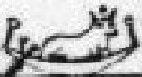 Canis Minor as seen above is on the Grand Temple and located above Decan 36. 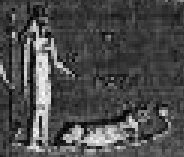
As seen above on the upper section of the ESNE Plate 87 to the left is Hathor a standing female figure with Hathor style horns and sun disk and to the right we can see Canis Minor and Canis Major in the cow figure, which is lying down on either a serpent or a boat.
|
In "The Witness of the Stars," by E.W. Bullinger, page 145 "The Egyptian name in the Denderah Zodiac is Sebak, which means conquering, victorious. It is represented as a human figure with a hawk’s head and the appendage of a tail."
In the "Gospel of the Stars," by Joseph Seiss, page 129 it is claimed that Argos on the Denderah is a "figure of a great ox enclosed, with the cross suspended from his neck, the symbol of the great possession marked with the ancient token of immortality and eternal life, named Shes-en-Fent, rejoicing over the serpent." I wonder if he was talking about Canis Minor and the necklace around its neck as seen on the Denderah Zodiac.
On Grand Temple Decan 37 as seen below, notice the Hathor style cow horns and sun disk.
The star Sirius (Egyptian Sepdet) was sacred to Hathor. See information mentioned about the dog star Sopdet (Sepdet or Sirius on Denderah Decan 22 - Grand Temple Decan 35).
Qetesh, was a Syrian deity, a form of Hathor, a nude woman, is seen standing or riding upon a lion, holding flowers, a mirror, or a serpent. Hathor, (Het-heru, Het-Hert) the cow-deity "the House Above," and "the House of Horus." This goddess is often represented as a cow, or as a goddess wearing the horns of a cow on her head. She is frequently shown with a golden disk representing Re (the Sun) between her horns. A star is also sometimes depicted between her horns. When the star is placed before the golden disk, it represents the helical rising of Sirius. The priest of Heliopolis called her the great Mother, Ra’s consort, mother of Shu and Tefnut, which are associated with Gemini. "Seven Hathors": Hathor of Thebes, Heliopolis, Aphroditopolis (Gr. Aphrodite), Sinai, Momemphis, Herakleopolis, and Keset. |

 Soped or Sirius