Gemini and its Decan Constellations.
Canis Major
Sirius (Canis Major) is depicted on the Denderah Zodiac Stone as a star between the horns of the ruminating Hathor cow on Canis Minor or of a cow riding in a boat (or barge), or on top of a serpent. 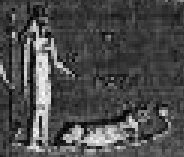
As seen above on the upper section of the ESNE Plate 87 to the left is Hathor a standing female figure with Hathor style horns and sun disk and to the right we can see Canis Minor and Canis Major in the cow figure, which is lying down on either a serpent or a boat. |
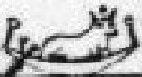 Canis Major is seen as the star between the horns of Canis Minor on the Grand Temple which is located above Decan 36. |
In "The Witness of the Stars," by E.W. Bullinger, page 142 "In the Denderah Zodiac he (Canis Major - Sirius) is called Apes, which means the head. He is pictured as a hawk (Naz, caused to come forth, coming swiftly down). The hawk is the natural enemy of the serpent, and here it has on its head a pestle and mortar, indicating the fact that he shall crush the head of the enemy." I do not see the hawk figure here, unless he is referring to the one seen in Lepus (also known as the Axis). If the hawk figure is named Apes, the head would not be associated with Canis Minor. See information mentioned about the dog star Sopdet (Sepdet or Sirius on Denderah Decan 22 - Grand Temple Decan 35).
The surviving records of observations of the "helical rising" of the dog star Sirius is a mainstay of the Egyptian calendar and a link with Ancient Egyptian chronology. Helical rising is the annual ten day period when Sirius would rise above the horizon at dawn. The "Sothic rising" of Sirius coincided with the beginning of the solar year only once every 1460-1456 years. These "Sothic Cycles" occurred in 2781-2777 B.C., 1321-1317 B.C. and A.D. 139. |