From The Alpha and the Omega - Volume III
by Jim A. Cornwell, Copyright © July 20, 2002, all rights reserved
"Volume III - Gemini and its Decan Constellations"

Gemini and its Decan Constellations.

Jupiter

    On the Denderah Zodiac below Cancer and to the left of Gemini, Jupiter is seen as a male figure with a hawk’s head, and holding an Egyptian waas scepter in his left hand.    On his head is a crown of a sun disk, but extending upward from the crown is a hawk figure.
    Since Jupiter is seen as a netjeru in a human form, therefore it represents a spiritual understanding.
    The Coptic name is Picheus, meaning glorious.
    As seen in the Latin, Jupiter may mean who is revealing, interpreted as Jah.
    Egyptian Ammon, means true.
    Other names mentioned by some sources are:
Hor-sat or Hor-p-sat,
where Hor is planet and
sat means just, true,
thus planet of truth (justice).

    One source calls Jupiter, "Horus who limits two lands," or "Horus Who Bounds the Two Lands."    Another source calls it "Light Scatterer."

    As seen on "http://home.main.rr.com/ imyunnut/Den.Round.html" by Joanne Conman, claims Jupiter is called Hor-up-Sheta, meaning "Horus-Who-Opens-Mystery."
    Another refers to him as Upesh-Pet.

    In the image below as seen on the Grand Temple these two deities, the first being Jupiter and the second is Mercury, both are standing on a boat which is Argo Navis, all located between Cancer and Canis Major (in Gemini) and seen above Decan 37.
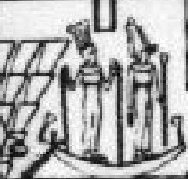
    One source claims, "In front of Leo and on top of the Cow of Hathor (Sirius), which symbolizes Mother Earth, stands the icon of Jupiter.    The implication is the Prince of Peace (Leo Minor) will become the Ruler of the abundant world, for Taurus on the other side of Jupiter is looking toward the Lion with a beckoning glance."


    Jupiter is seen as:

    Hebrew Zedek, just, true, righteous or Gad, good fortune, in Isa. 45:11, i.e. Gad (Jupiter) and Meni (Venus) are the "greater and lesser Fortune."    In the Arabic this is Sadak.
    Even the Babylonian Mylitta may be relevant here as mentioned in "The Alpha and the Omega," Vol. II page 10.


    One source claims that this is the Egyptian TAUT-A-Deg-S.


    Sumerian EN.MER.KAR or SAG.ME.GAR is mentioned, but unsure if connected to Jupiter.
    Sumerian dAMAR.UD, Akkadian dMarduk, which is Jupiter.    Lord Marad.
Thus the Sumerian amar, calf; young animal + ud, sun, storm (demon), would read "The Young (Bull) God of the Sun."
Note on the Sumerian amar-kud: separated, weaned young animal ('calf' + 'to cut away from').
    Sumerian EN.GISHGAL.AN.NA, is also referred to as Jupiter,
which reads in the Sumerian (en, lord + gišgal, throne + an, heaven + na, nominative),
"Lord of the Throne of Heaven."


    Greek eudia, yoo-dee'-ah, fem. from Gr. eu, yoo, good, well, and the alt. of Gr. Zeus, dzyooce, of uncertain affinity, in the oblique cases there is used instead of it a (prob. cognate) name Greek Dis, deece, which is otherwise obsolete, Zeus or Dis (among the Latin's Jupiter or Jove), the supreme deity of the Greeks, Jupiter (as the god of the weather), a clear sky, i.e. fine weather, fair weather.


    Arabic Al Mashtari, means having dominion.


    In "Hamlet's Mill" by Giorgio de Santillana and Hertha von Dechend, Gambit Inc. 1969 it states on page 444, "ŠUL.PA.E3, Shulpae, the name of Jupiter in the early morning."
    It is not clear if any connection with Jupiter.

  • Sumerian šul: n., young man; warrior; adj., strong, heroic.
  • Sumerian (giš)pa, sprout, branch, wing.
    • Also in consideration is the Sumerian pa...è; pa-è...ak: to show; to make appear; to make resplendent (often with -ni- or bi-) ('bud, sprout' + 'to send forth' + 'to make').
  • Sumerian á-gú-zi-ga: early morning ('side' + 'edge' + 'to rise', + a, nominalizer).


Select one of the following to open it.
Each of these are connected to the constellation Gemini,
Jupiter, Canis Major, Canis Minor, Lepus.
Decan 22, Decan 23, Decan 24.

    This file last updated on February 21, 2004, on March 14, 2005, June 18, 2005, and January 10, 2008.

Return to the Table of Contents or the Zodiac of Denderah