|
Decan 23-24

|
Decan 23 is seen below the front foot of Orion as a male figure with a lion’s head with no crown, standing up and it has three stars (in an upward pointing triangle) under its left hand. We see some connection with Grand Temple Decan 34 in the male figure with (dual crown) sitting on a throne with three stars above his head.
Since Decan 23 is seen as a netjeru in human form, therefore it represents a spiritual understanding.
The hieroglyphics seen below is not easily seen,
as the first could be either
the pool sign, Egypt. sh
or the Egypt. ah,
or the twisted flax wick sign, Egypt. h,
whereas the second looks like
a small round object which could be the sieve sign, Egypt. h, (kh = j as in hose)
or sun sign, as the Egyptian ra,
then the third would be the Egyptian sign for ta or ti,
and then it ends with a star.
Thus we find either
[sh-kh-ta], [ah-kh-ta], or [h-kh-ta]
[sh-ra-ta], [ah-ra-ta], or [h-ra-ta].
|
As compared to Denderah Decan 23, the only connection is with the number of stars above his head.
 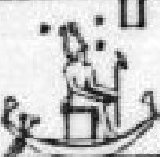
Grand Temple Decan 34 is a male figure with a Atef crown (Osiris' crown made up of the white crown of Upper Egypt and the red feathers of Busiris) and sitting on a throne, which has three stars above his head. Amen (Amon, Amun, Ammon, Amoun, Imen) was seen as a man enthroned.
This Decan was called 
Remen kher sah, Remen-Kher-Sah, and possibly Waret,
and it is seen hieroglypically as
a bent lower arm, Egypt. rm,
then the water sign, Egypt. n,
then an unknown sign possibly an altar, Egypt. kh,
and the mouth sign, Egypt. r,
and the last is the Egyptian sign for sah,
ending with a star ‘gate.’
Thus it reads [rm-n kh-r sah].
Remen is also seen on Grand Temple Decan 32 and 34. Remen would likely mean "forearm."
Kher is seen on Grand Temple Decan 3, 22, 27 and 34. Kher is seen to mean "lower" or "under." Also see the ram god Kherty meaning the "Lower One."
Sah is also seen on Grand Temple Decan 32, 33, 34, 35 and 36.
As seen on "http://www.egyptologyonoline.com/
astronomy.html" a claim is made that "The god Sah (Orion on Denderah Decan 21 - Grand Temple Decan 36) was the personification of the constellation later known as Orion. Sah was described as 'the glorious soul of Osiris' and formed a divine triad with the dog star Sopdet (Sepdet or Sirius on Denderah Decan 22 - Grand Temple Decan 35) and their son Soped (Soped, Sepd on Denderah Decan 37 - Grand Temple Decan 37), god of the 'eastern border'."
As seen on "http://home.main.rr.com/
imyunnut/Den.Round.html" by Joanne Conman, she refers to this decan's possible name as "Waret," and stated the meaning as "District Under."
She also calls it "Remen khery" thus meaning "The Lower Forearm" of Sah (Orion). See Denderah Decan 25 for information about the "The Upper Forearm."
As seen on "http://www.creatures-kbc.com/ ae_senmut_sah.htm" by Ken Bakeman who proposes that on Senmuts' Tomb that Two Decans are assigned the title of "lower Sah" seen in hieroglyph as 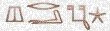 : :
an unknown sign possibly an altar, Egypt. kh; then the mouth sign, Egypt. r; then a bent lower arm, Egypt. rm (if used as a determinative, indicates a 'concept of motion' or as a logogram, 'arm'); and the last is a phonetic equivalent of Egyptian sign for sah; and then ending with a star.
Thus it reads [kh-r (rm) sah], leading to "lower Sah," or the "Lower parts of Sah," and the "Lower Motion of Sah," or the "Lower Arm of Sah."
In the succession of sky events these lower parts may be seen as corresponding to:
Rigel (b Orionis in the left knee or foot and associated with Osiris) and then
Saiph (k Orionis in the right knee or foot).
Cyril Fagan comments on the name in Grand Temple Decan 36, "The glory of the southern skies S3h (Sah), the 'Toe,' but known to us as the mighty constellation of Orion. In the celestial diagrams Sah is shown as a human figure, wearing the hdt (hedjet) or white crown of the south and standing in his boat welcoming the rising of Isis-Sirius, who issues at his toe."
Its Deity was called  Hor, Maat Heru, Heru. Hor, Maat Heru, Heru.
Associated with ORION,
it has stars
in Orion as Saiph,
and possibly a star in Ophiuchus.
|