Gemini and its Decan Constellations.
Gemini
On the Denderah Zodiac, Gemini is seen as a man walking hand in hand with a woman, with its name seen by some sources as Clusus or Claustrum Hori, meaning the place of Him Who cometh, and others it is station of the coming. In "The Witness of the Stars," by E.W. Bullinger, page 137 "The name in the ancient Denderah Zodiac is Clusus, or Claustrum Hor:, which means the place of Him who cometh. It is represented by two human figures walking, or coming. The second appears to be a woman. The other appears to be a man. It is a tailed figure, the tail signifying He cometh." "The old Coptic name was Pi-Mah, the united, as in brotherhood." |
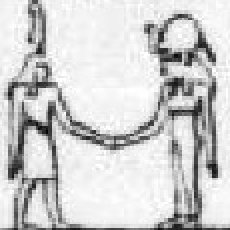 Gemini as seen on the Grand Temple is located above Decan 33. These two figures look very much like Shu and Tefnut. 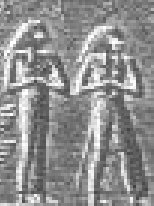 On ESNE Plate 79 the above two figures are in sequence as to be considered as representing Gemini. 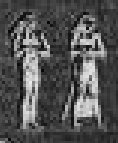 As seen above on the upper section of ESNE Plate 87 these figures are located after Cancer and before Orion, to represent Gemini.
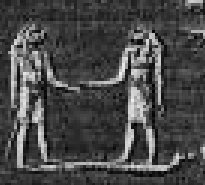 On the lower section of ESNE Plate 87 the above two figures are not Gemini, since they are located between Capricornus and Sagittarius. Note that they both are standing on a serpent. (See Shu). |


The hieroglyphic origin of Gemini is Shu and Tefnut, and seen as two plant shoots. 
Demotic 
Gemini Sign
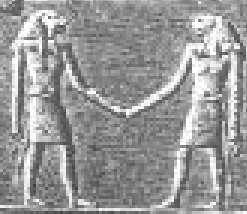 Also as seen above on ESNE Plate 79 these figures are out of sequence if to be Gemini and are shown before Leo. Both have the same appearance as the figures shown in the image to your left. (See Shu). |
In the season Shemu III (Shomu, Ete) - Harvest, Harvests, the Summer.
The month of Gemini, as seen on Calendar Dates the month dates as: 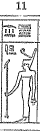 The star is in Orion.
In the image below as seen on the Grand Temple these two deities, the first being Jupiter and the second is Mercury, both are standing on a boat which is Argo Navis, all located between Cancer and Canis Major (in Gemini) and seen above Decan 37. 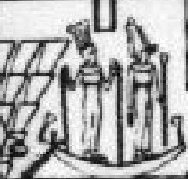 On the Grand Temple the deity below is located between Gemini and Orion (in Taurus) and is located above Decan 34. 
Cyril Fagan comments, "Gemini, the Twins, rose at eve during the lunar month of Tybi when the sun was in the opposite constellation, Sagittarius. The twin stars were known as the air-god Shu and his wife and sister Tefnut, the lion-hearted goddess of the Sun's heat." |