From The Alpha and the Omega - Volume III
by Jim A. Cornwell, Copyright © July 20, 2002, all rights reserved
"Volume III - Gods/Goddesses of Ancient Egypt"
UADJET
(Wadjet, Wadjyt, Wadjit,
Uajyt, Ouadjet, Udjat, Per Uadjit, Uatchet,
Uazel, Uto, Buto, Edjo
)


    To return to the
Gemini Decan (Wadjet the netjer of the eleventh month Epiphi, Epipi, Apethont, Coptic Epep, at Ramesseum: Apet, at Edfu: Apet),
Nefertum (at times son of either Bast or Wadjet at Buto in the Delta),
or List of Netjeru.
    Uadjet was the goddess of Per-Wadjet/Buto, "the papyrus coloured one," meaning "the green one," which is the general name for the cobra, the uraeus (royal symbol), her sacred animal.
    The hieroglyph for a cobra is , which can be seen in the name of Uadjet.
    In one Pyramid Text the papyrus plant emerged from her and as "the green one" she was connected to the forces of growth.
    She was the protective goddess of Lower Egypt, her counterpart being the vulture goddess Nekhbet of Upper Egypt.
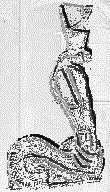
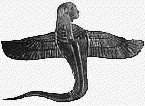
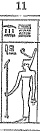
    Wadjet is depicted as a rearing cobra, or a woman-headed cobra, a winged cobra, she was a protector of the pharaoh, ready to strike and kill his enemies.    Where Uadjet was connected to the solar deity and seen with a leonine head crowned with a solar disc and uraeus, or a woman wearing the red crown of Lower Egypt.    And last Ouadjet was seen as a snake.
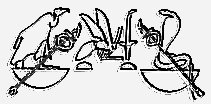
    Both Nekhbet who was in an identical form as a snake or woman, or vulture with Ouadjet were seen standing on a half circle, hovering over the Pharaoh, holding a fly-whisk and a seal as seen below.
    As seen above on the upper section of ESNE Plate 87 Lower Section you can see a similar image of Ouadjet located after Capricornus and before Sagitarrius.
    As seen above on the upper section of ESNE Plate 87 Upper Section you can see a similar image of Ouadjet located between Cancer and Orion.

    Her main sacred animal was the cobra, but by the Late Period she was assigned yet another sacred animal - the ichneumon, a mongoose-like creature known for its ability to kill snakes and crush crocodile eggs.    There are examples of a Late Period coffin of an ichneumon with an image of Wadjet seated on top of the coffin: The ichneumon became a sacred animal of the lion-headed goddess Wadjet as a result of religious developments of the Late Period, when local traditions were frequently linked, and new mythic associations were established.    The deities of the Delta cities of Khem (Letopolis) and Per-Wadjet became associated through myth, and the ichneumon - a sacred animal of Horus of Khem - became a sacred animal of the goddess Wadjet of Per-Wadjet.
    Unlike other sacred animals ... ichneumons were occasionally placed in statuettes of the lion-headed goddess Wadjet.    The most common type depicts the goddess seated on a throne, usually crowned by the uraeus - the rearing fire-spewing cobra at the king's brow, with which Wadjet was identified.    The throne, or a base attached to it, which was usually hollow, contained the mummified ichneumon.
-- Coffin of an Ichneumon, The Israel Museum
    The netjer of the eleventh month of Gemini (Epiphi, Epipi, Apethont, Coptic Epep) was Wadjet (Uadjet, Udjat), at Ramesseum: Apet, at Edfu: Apet, note Apethont mentioned above.

    What other sources state about Wadjet.
    Wadjet was the predynastic cobra goddess of Lower Egypt, a goddess originally of a city who grew to become the goddess of Lower Egypt, took the title "The Eye of Ra," and one of the nebty (the "two ladies") of the pharaoh.    "She of Papyrus/Freshness" rose from being the local goddess of Per-Wadjet (Buto) ("The House of Wadjet (Papyrus/Freshness)") to becoming the patron goddess of all of Lower Egypt and "twin" in the guardianship of Egypt with the vulture goddess Nekhbet.    These two were the nebty (the "two ladies") of the pharaoh and were an example of Egyptian duality - each of the two lands had to have its own patron goddess.    Wadjet was the personification of the north.
    "The goddess Wadjet comes to you in the form of the living Uraeus to anoint your head with her flames.    She rises up on the left side of your head and she shines from the right side of your temples without speech; she rises up on your head during each and every hour of the day, even as she does for her father Ra, and through her the terror which you inspire in the spirits is increased ... she will never leave you, are of you strikes into the souls which are made perfect."
-- The Book of the Dead

    She became a goddess of heat and fire and this enhanced her role as a protector goddess - with such fierce powers she could use not only poison but flames against the enemies of the pharaoh.    Along with her link to this power, she became connected with the Wedjat (the Eye of Ra), and was thus also connected to the other goddesses who took this title - Bast, Tefnut, Sekhmet, Hathor, Isis, and her "twin" in duality, Nekhbet.    Along with this form, she took the form of a lioness, as did many of the other "Eye of Ra" goddesses.    In this form she wore the solar disk of Ra - linking her to the sun - with the uraeus (the rearing cobra) as her headdress.
    In the story of Horus and Set, when Horus is trying to find and rout the followers of Set, Horus pursued them in the form of a burning, winged disk, attended by both Nekhbet and Wadjet as crowned snakes, one on each side of him.    This, too, linked her with the pharaoh, as the Egyptians believed that the pharaoh was the living Horus.    She not only protected Horus in his fight, but she also protected the pharaoh from childhood until death.    As protector, she was known as "The August One, the Mighty One."
    By dynastic times, Wadjet was more a personification than an actual goddess and so she was often used (with Nekhbet) as a heraldic device around the sun disk or the royal name and were part of the royal insignia.    The earliest found representation of the nebty title was in the reign of Anedjib, a pharaoh of the 1st Dynasty.    From the 18th Dynasty onwards, she began to be represented as protecting the royal women in the form of one of the twin uraei on the headdresses of the queens.    Isis retreated to the papyrus swamps after she has conceived her child, and she remained hidden in them until her months were fulfilled, when she brought forth Horus, who afterwards became the "avenger of his father"; Set never succeeded in finding her hiding place, because the great goddess had found some means whereby she caused the papyrus and other plants to screen her from his view, and the goddess Wadjet visited her and helped her retreat.
-- The Gods of the Egyptians, E. A. Wallis Budge
    Yet Wadjet also had a nurturing side, as did Nekhbet.    Wadjet was believed to have helped Isis nurse the young Horus as well as help hide them in the swampy delta area of the Nile - as the goddess of Lower Egypt, she was also a personification of the papyrus-filled delta - and helped to keep the two safe from Set, who wanted to kill Horus and claim the throne for himself.
    Another link to her more gentle side was her link with nature - in the Pyramid Texts it said that the papyrus plant emerged from her, and that she was connected to the forces of growth.    It was also believed that she created the papyrus swamps herself.

    Wadjet was thought to be the wife of Hapi, in his Lower Egyptian aspect.    She was also linked to Set in his role of god of Lower Egypt.    She was also believed to be the wife of Ptah and mother of Nefertem (in place of Sekhmet or Bast), by the people of Per-Wadjet, probably because of her later form of a lioness.
    She was worshiped at the Temple of Wadjet, which was referenced to by the name "Pe-Dep," in the Pyramid Texts, and was by that time believed to be both very old and famous.    It was believed that even at early times, the Egyptians linked Wadjet with Isis and the god Horus, and that both of these deities were also worshiped in the town of Per-Wadjet, which was divided into two parts - Pe and Dep: ... Pe-Dep was a city with two distinct divisions, in one of which Wadjet-Isis was worshiped, and in the other Horus, and that Horus dwelt in Pe, and Wadjet-Isis in Dep.
-- The Gods of the Egyptians, E. A. Wallis Budge
    From local goddess of a predynastic town to the goddess of Lower Egypt, Wadjet became one of the symbols of Egypt.    From the personal protector of the pharaoh and she who bestowed the red crown to the pharaoh, she also became the symbol of rulership.    And from the goddess of papyrus and the Delta to the "Eye of Ra," she took on the role of protector of the ruler.    She was worshiped as a goddess as well as being the personification of the north, the cobra goddess who was one half of a manifestation of the idea of duality that was a basis of ma'at "which the goddess Wadjet worketh."    Not only was she a goddess, but she was one part of the land of Egypt itself.


    This file was created on June 18, 2005, and updated on May 30, 2006.

Return to the Table of Contents or the Zodiac of Denderah