From The Alpha and the Omega - Volume III
by Jim A. Cornwell, Copyright © July 20, 2002, all rights reserved
"Volume III - Gods/Goddesses of Ancient Egypt"
NEKHBET
(Nekhebet, Nechbet)


    To return to the
Aquila Decan (an eagle or vulture of Isis),
Denderah Decan 20 - Grand Temple Decan 1 (hieroglyph of a bird with wings in flight, or Nekhbet portrayed as a vulture),
List of Netjeru.
    Nekhbet was local goddess in Nekheb/Eileithyiaspolis/El Kab, and later one of the two goddesses of Upper and Lower Egypt.
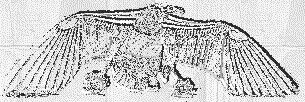
    She was depicted as a woman wearing the crown of Upper Egypt wearing a vulture skin or the vulture headdress, a woman with the head of a vulture, as a full snake or as a full vulture with the White Crown on her head, her wings spread in protection while holding the shen (shn) symbol of eternity in her talons.    She was often shown with Wadjet, who was sometimes shown as an identical goddess, either as a woman or a snake wearing the crown of Lower Egypt.
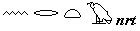
    The hieroglyph for a vulture is .
    Their forms showed Nekhbet as a predynastic vulture goddess, and protectress of Upper Egypt, goddess of childbirth, and protector of the pharaoh.
    Nekhbet was originally a goddess of a city, but grew to become patron of Upper Egypt, a guardian of mothers and children, and one of the nebty (the "two ladies") of the pharaoh.    "She of Nekhb," named after the town Nekhb (El Kab), was a local goddess who, with the rise of the pharaohs, became the great goddess of all of Upper Egypt, while the other "lady," Wadjet (Edjo), became goddess of Lower Egypt.    She and the goddess Ouadjet (Wadjet) represented the symbolical two halves of Egypt.
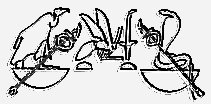
    Ouadjet was seen as a snake (actually a cobra), and both were seen standing on a half circle, hovering over the Pharaoh, holding a fly-whisk and a seal as seen below.
    Linked to the pharaoh and the crown, she often appears in war and offertory scenes, in vulture form hovering over the head of the pharaoh, holding the shen symbol and the royal flail, protecting him from his enemies.
    What other sources state about Nekhbet:
    Nekhbet was given the title the "White Crown," and depicted with this crown, because of her link with the rulership of Upper Egypt.    By dynastic times, she was more a personification than an actual goddess and so Nekhbet was often used (with Wadjet) as a heraldic device around the sun disk or the royal name and were part of the royal insignia.    The earliest found representation of the nebty title was in the reign of Anedjib, a pharaoh of the 1st Dynasty.    From the 18th Dynasty onwards, she began to be represented as protecting the royal women in the form of one of the twin uraei on the headdresses of the queens.
    Yet she also is shown sometimes as a divine mother of the pharaoh, suckling him herself.    It was in her mothering role that she was known as the "Great White Cow of Nekhb," where she was described as having pendulous breasts.    She was seen as the pharaoh's own protective goddess, right from his birth until his death.
    It was mostly during the later times that she was venerated as a goddess of birth, specialising in the protection and suckling of both the gods and the pharaohs.    Unlike Heqet and Taweret, she was never a popular goddess of the people due to her very close association with rulership.    It was only during the New Kingdom that the people started worshiping her as a protector of mothers and children as well as being the goddess of childbirth.    Until then, she had strictly been a protector of the pharaoh.
    In Southern Africa, the name for an Egyptian vulture is synonymous with the term applied to lovers, for vultures like pigeons are always seen in pairs.    Thus mother and child remain closely bonded together.    Pairing, bonding, protecting, loving are essential attributes associated with a vulture.    Because of its immense size and power and its ability to sore high up in the sky, the vulture is considered to be nearer to God who is believed to reside above the sky.    Thus the qualities of a vulture are associated with Godliness.    On the other hand the wide wingspan of a vulture may be seen as all encompassing and providing a protective cover to its infants.    The vulture when carrying out its role as a mother and giving protection to its infants may exhibit a forceful nature whilst defending her young.    All these qualities inspired the imagination of the Ancient Egyptians.    They adopted what seemed to them at the time to be motherly qualities, the qualities of protecting and nurturing their young.
-- Ma-Wetu, The Kiswahili-Bantu Research Unit for the Advancement of the Ancient Egyptian Language
    Nekhbet was thought to be the wife of Hapi, in his Upper Egyptian aspect.    She was also linked to Horus in his role of god of Upper Egypt.    Due to her vulture form, she was linked to the goddess Mut, the mother goddess and wife of Amen.    Both Mut and Nekhbet were a particular type of vulture - the griffon vulture (Gyps fulvus).    It was the griffon vulture that was usually related to the goddesses and to royalty.
    In the story of Horus and Set, when Horus is trying to find and rout the followers of Set, Horus pursued them in the form of a burning, winged disk, attended by both Nekhbet and Wadjet as crowned snakes, one on each side of him.    In this form, she was given the title "Eye of Ra," and was thus linked to the other goddesses who took this title - Bast, Tefnut, Sekhmet, Hathor, Isis, and her "twin" in duality, Wadjet.    There are actually two sections to Nekhb ... In a smaller enclosure is the Temple of Nekhbet, with its several pylons, hypostyle hall in front, a mamissi (birth house) dedicated to Nekhbet (the embodiment of Hathor).    The temple was begun around 2700 B.C., and enlarged in by later pharaohs of the 18th through 30th dynasties, including Tuthmosis III, Amenophis II, and the Ramesids.    The second part of the ruins is the necropolis, which is situated on a rocky outcrop.
-- El Kab and El Ahmar, TourEgypt
    A temple of Nekhbet was built at Nekhb, along with the temple's birth house, smaller temples, the temple's sacred lake and some early cemeteries.    It is possible that it was first built during the Early Period, but major building projects were started during the 18th Dynasty.    The remains of the temple, though, belong to the works of the pharaohs of the 29th and 30th Dynasties.    Nekhbet was venerated at this temple, inside the town of Nekhb itself, throughout most of Egypt's long history.


    This file was created on June 18, 2005.

Return to the Table of Contents or the Zodiac of Denderah