From The Alpha and the Omega - Volume III
by Jim A. Cornwell, Copyright © July 20, 2002, all rights reserved
"Volume III - The Third Month - Constellation Names for Gemini"
 GEMINI
Gemini, the Twins.
The constellation name for Gemini:
- Sumerian MASH.TAB.BA.GAL.GAL, Sumero-Akkadian Mastabba-gal-gal or Masu, correlates to Gemini as
(maš, one-half + [(tab-ba, double + nominative) or (tab, n. pair, companion + ba, v. to give)] + gal, reduplicated great), "The Great Twins."
- Sumerian maš: one-half.
- Sumerian maš; máš: kid; he-goat.
- Sumerian máš; maš: interest (of a loan); rent; profit; yield (of a field).
- Sumerian gag-maš: a peg or nail ('peg' + 'one-half').
- Sumerian maš-dà: (cf., mašda).
- Sumerian maš-gána: settlement ('rent' + 'land').
- Sumerian máš-da-ri-a; maš-da-rá-a: offering ('goat kid' + 'driven [animal]').
- Sumerian šu-maš-gíd-gíd: diviner ('hand' + 'goat kid' + reduplicated 'to reach out').
- Sumerian sum-tab-ba: binding double sheaf ('to give' + 'double' + nominative).
- Sumerian tab: n., sting; fever; companion; pair; v., to burn; to tremble, shake; to make haste; to hold, clasp; to bind; to join (with -da-); to be/make double (sometimes reduplicated).
- Sumerian ad-tab: rein(s) ('shout' + 'to hold; to be double').
- Sumerian mana, mìna, man, mìn, men5: partner; companion; equal; two (ma, 'to bind', + na, 'human being').
- Sumerian ba: n., share, portion; rations, wages; v., to give; to divide, apportion; to pay; modal prefix, used when there is no transitive subject.
- Sumerian gal, gal: n., a large cup; adj., big, large, great.
- Sumerian example gud-gal-gal: full-grown ox ('bull, ox' + reduplicated 'great').
- Other names for MASH.TAB.BA.GAL.GAL: Al M'absutak, Mab'suthat.
- From www.lexiline.com it claims, "The Large Twins (MASH.TAB.BA.GAL.GAL), MASH is not twin, but applies to Ninurta (a single being). TAB.BA is 'Double.' GAL.GAL is word for dual or plural." "Associated with d.Lugulgirra and d.Meslamtaea." "The Twins (MASH.TAB.BA) who are near the loyal shepherd of heaven: d.LU.LAL and d.Latarak. This is Gemini, the twins, i.e. TAB.BA, double, twins."
- Under Pisces in Cetus constellation names, under the Egyptian/Coptic section:
- The Babylonian slant.
- In his work “BABYLONIAN STAR-LORE: An Illustrated Guide to the Star-lore and Constellations of Ancient Babylonia,” by Gavin White in his exerts claims, "Finally, set below the figure of Aries, we have a pair of staff-wielding gods who could well be a representation of the lion-headed Babylonian constellations known as Lulal and Latarak. Like the Wolf and Plough, they have proved difficult to locate on the celestial sphere. Their placement on the Circular Zodiac suggests that they are located among the stars of Cetus."
White's image of the Lulal and Latarak is seen on page 40 shown here  compared to the Round Denderah image
  , which White claims, "A similar set of meanings could be ascribed to the lion-headed figures known as Lulal and Latarak. In the main body of the book I suggest that they may act as guardians of the year - banishing any lingering influence of the closing year and purifying the start of the new calendrical cycle."
- Another source claims for The Great Twins, "Lugal-irra and Mesiamta-ea, 'The Gate Keepers,' they stood at the gate to the underworld, their hatchets upraised, ready to dismember the dead (later identified as Castor and Pollux)."
- Allen states: On the Euphrates, with the Hyades, they seem to have been Mas-tab-ba-gal-gal-la, the Great Twins of the ecliptic, Castor and Pollux (Gemini) being the same in the zodiac.
- Egyptian/Coptic Pi Mahi, "The United," or "the completely joined," as in brotherhood.
- In "The Witness of the Stars," by E.W. Bullinger, page 75 "The name in the ancient Denderah Zodiac is ... the old Coptic name was Pi-Mahi, the united, as in brotherhood."
- Akkadian tu'amu rabûtu, "The Great Twins."
- Akkadian rabbu, rabû, "The Great," same as Sumerian GAL.GAL, Akkadian rabûtu.
- As seen in the Introduction of Gemini, one source claims that Sivanu (May-June) in Akkad this month was called:
- Mun-ga, "The Making-of-Bricks."
- Kas, "the Twins."
- Allen comments: Brown derives it from the cuneiform …, the ideograph of the Akkad month Kas, the Twins,
the Assyrian Simanu, corresponding to parts of our May and June when the sun passed through it. The constellation was certainly prominent on the Euphrates, for five of its stars marked as many of the ecliptic divisions of that astronomy.
- Babylonian-Assyrian Tuame-rabuti, "The Great Twins."
- Hebrew Thaumin, "The United." One source calls this Teomaim, as in Te maîm, means "double."
- Twins.
- Hebrew ta'owm, taw-ome', or ta'om, from Heb. ta'am, taw-am', a primary root to be complete as denom. to be twinned, i.e. (fig.) duplicate or (arch.) jointed, coupled (together), bear twins, thus a twin (in plural only), lit. or fig., twins.
- Unity, United.
- Hebrew yachad, yakh'-ad, from Heb. yachad, yaw-khad', a primary root to be (or become) one, join, unite, thus properly a unit, i.e. (adv.) unitedly, both, together, another form as Hebrew yahadh, unitedeness.
- Greek henotes, oneness.
- In "The Witness of the Stars," by E.W. Bullinger, page 137 "The Hebrew name is Thaumin, which means united." "As seen in Exodus 26:24 'They (the two boards) shall be coupled together beneath'." "In the margin we read, 'Hebrew twinned'." (R.V. double).
- Arabic Al Tauman, Al Tau'aman, "The United," like the Hebrew, but as Betelgeuse, "house of the twins." Another name is Burj al Jauza'.
- In "The Witness of the Stars," by E.W. Bullinger, page 137 "The Arabic Al Tauman means the same as Hebrew Thaumin."
- Roman, the Twins are star names in Geminorium. They are the Greek Dioskyroi, "sons of Zeus," see Acts 28:11 for their connection to sailors as tutelary deities and the constellation.
- a Castor (Greek Apollo, "The Ruler," or "Judge").
- b Pollux (Greek Hercules, "The Strong One Coming to Labor," or "Suffer"), "who cometh to labour and suffer."
- Egyptian/Coptic:
- See the Denderah Zodiac, for more on Gemini.
- Denderah Zodiac: Clusus or Claustrum Hor, "the place of Him who cometh," showing a man walking hand in hand with a woman.
- In "The Witness of the Stars," by E.W. Bullinger, page 137 "The name in the ancient Denderah Zodiac is ... Clusus, or Claustrum Hor, which means the place of Him who cometh." "It is represented by two human figures walking, or coming." "The second appears to be a woman. The other appears to be a man." "It is a tailed figure, the tail signifying He cometh."
- In his work “BABYLONIAN STAR-LORE: An Illustrated Guide to the Star-lore and Constellations of Ancient Babylonia,” by Gavin White gives this image of Gemini which is seen on page 42 shown here as
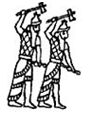 and comments, "The theme of war and death already seen in Inanna and her Lion continues in the form of the Great Twins and their lesser counterparts, the Little Twins, who are all depicted on the star-map as fully armed warriors. The Great Twins in particular, are closely associated with the gods of the underworld and one of them is known to travel back and forth between the realms of the dead and the upper worlds. We can infer that the function of the Twins winthin the stellar calendar was to guard the summertime entranceway to the realm of the dead that was located in the region of the Serpent and Crab."
As you can see for yourself the image for Gemini above has some correlation with the Round Denderah image  and the Square Denderah image
 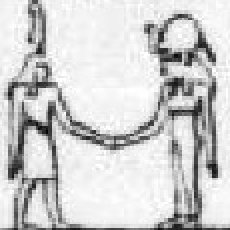 and the hierogyphic image
 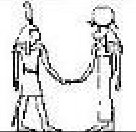 , but see the Denderah Decan information for more detail.
- Chinese Jid-im.
- Richard H. Allen states: The Gemini were the Ape of the early Chinese solar zodiac, and were known as Shih Chin; Edkins, calling it Shi Ch’en, says that this title was transferred to it from Orion. Later on the constellation was known as Yin Yang, the Two Principles; and as Jidim, an important object of worship.
- Other names of Gemini: Algeuze', El geuz'I, Aliour'e, Gieuz'.
- Richard H. Allen stated: ... but in early Desert astronomy their two bright stars formed one of the fore paws of the great ancient Lion; although they also were Al Burj al Jauza’, the Constellation of the Twins. From this came Bayer's Algeuze, which, however, he said was unrecht, thus making Riccioli's Elgeuzi and Gieuz equally wrong.
One of the twelve simple Hebrew Letters is Zayin, (KJV, Zain, Ps 119:49) the English letter is z, which has a numerical value equal to 7, and an esoteric meaning of "Weapon."
- Weapon.
- Hebrew keliy, kel-ee', from Heb. kalah, kaw-law', to end, cease, be finished, thus something prepared, an apparatus (as a weapon).
- Hebrew 'azen, aw-zane', from Heb. 'azan, aw-zan', a primary root to expand, a spade or paddle (as having a broad end).
Other subjects and Constellation Name for Gemini:
Sumerian MASH.TAB.BA.TUR.TUR, "The Little Twins." In the constellation Geminorium, one source claims this to be a combination of the g (gamma) in Arabic Alhena or Al Henah, the z (zeta) star named Mekbu'da and the l (lamda) star (no name).
- [See notes above on the Great Twins for Sumerian meaning of MASH.TAB.BA as to "Twins."].
- Sumerian tur-tur: little ones (reduplicated 'little').
- Sumerian tur: n., child; young (of herd animals); v., to be/make small; to be insufficient; to reduce; adj., small, little, young; di4: (cf., tur).
- Sumerian tùr; tur5: birth-hut; sheepfold; stable.
- Sumerian tur5mušen, tumušen: bird of the pigeon and dove family.
- Other sources show TUR, a tomb, defined as "dig, dwelling, cave, fold."
- Sumerian dun, du24; tun, tu10; tu11: v., to scrape, dig (a field, furrow, hole); to strike, smite; to heap, pile up; to open.
- Sumerian duruna, durun, dúru, dúr: n., buttocks; dwelling; v. plural, to sit; to be seated; to break wind; to dry out; to occupy, dwell; to set down (plural, cf., singular tuš) (dur, 'bond', + ùga/un, 'people').
- From www.lexiline.com it claims, "The Small Twins (MASH.TAB.BA.TUR.TUR), d.LAL and d.NIN.EZENxGU4, is stated that Sumerian TUR is a small child, Pharaonic TAURIS, goddess of pregnancy, Sumerian EZEN is a feast, and Sumerian GU4 is a domestic cow."
Another source mentions:
Sumerian TIR.AN.NA, "The Rainbow," although mentioned here with Gemini, it may be associated with Canis Major, in regard to the Later Persians who called Tir, "the Arrow," or a connection to the "Bow."
- Sumerian tir: forest, grove, thicket.
- Sumerian Ú-NINNI5 [TIR/TIR]: a resin measured by volume.
- Sumerian Ú-TIR: a spice or seed measured by weight.
- [See notes under Cancer for details of AN.NA, of Heaven].
- The Akkadian Manzât, is called "The Rainbow."
- Bow.
- Hebrew qesheth, keh'-sheth, from Heb. qashah, kaw-shaw', a primary root properly to be dense, i.e. tough or severe, thus in the original sense of (Heb. qowsh, koshe, a primary root to bend) of bending, a bow, for shooting (hence fig. strength) or the iris, arch (-er), bow.
- Rainbow.
- Greek iris, ee'-ris, perhaps from Gr. ereo, er-eh'-o, probably a fuller form of Gr. rheo, hreh'-o, an alternative for Gr. epo, ep'-o, a prime verb, in certain tenses, to utter, i.e. speak or say, call, tell, thus (as a symbol of the female messenger of the pagan deities), a rainbow ("iris"), rainbow.
- Winged Fire-head is under the opposite Sagittarius.
- Also see Hebrew Qashot in Sirius.
Other words of interest are:
GI-TAB, Tab or Dab, is suggested to mean "two," or Twain or Double, "Twins."
Which lines up as (gi, 'length measure' + tab, 'companion, pair, to be/make double'), thus a "doubled measure."
- Sumerian gi: reed; length measure.
- Sumerian gí, gé: reed mat.
- Sumerian gi(n), ge(n): v., to act justly; to stabilize, strengthen; to confirm; to establish something as the property of someone (dative); adj., just; firm; fixed; reliable.
- Sumerian gi4, ge4: to return, come back; to send (back) (with -ši-); to restore; to answer (person to whom answer is given resumed by dative prefix, and with -ni-).
- Sumerian gi(4): to surround, besiege; to lock up.
- Sumerian gi7: (cf., gir15).
- Sumerian gi(17): n., young man; adj., small.
- Sumerian tab: n., sting; fever; companion; pair; v., to burn; to tremble, shake; to make haste; to hold, clasp; to bind; to join (with -da-); to be/make double (sometimes reduplicated).
- Sumerian dab(2,4,5), dib(2): to hold; to take, seize, catch; to hire; to receive.
- Sumerian da5: to surround, beset, besiege (cf., dab).
- Sumerian gír-tab: scorpion ('knife' + 'sting').
- Sumerian gíri, gír: n., knife, dagger, sword; thorn; scorpion; lightning flash; road; expedition, trip; v., to stab; to fulgurate, lighten, flash.
- Sumerian -tab: sting.
From Volume I "The Alpha and the Omega," pg. 129, I mentioned the following terms.
- Deluge Individuals.
- Sumerian Ziusudra, "he who laid hold on life of distant days."
- In the Gilgamesh Epic, Babylonian Utnapishtim.
- Akkadian Uta-Napishtim, "Day of Life," "son of Ubar-tutu," "Man of Shruppak," the tenth king before the Flood.
- Semitic Noah.
- Deluge Goddesses.
- Ninurta (nin.ur.ta, "foremost warrior").
- Akkadian Ishtar, ir.ni.ni, "the strong, sweet smelling lady."
- Deluge Equipment.
- Sumerian magurur, "a giant boat." See Mag.GUR8.
- Semitic elippu rabitu, "a great ship," from a Babylonian deluge fragment from Nippur.
- Gilgamesh version:
- elippu, "ship" or "boat."
- ekallu, "great house," or "palace."
- Biblical boat.
- Hebrew tebah, tay-baw'. perhaps of foreign der., a box, thus ark (i.e. "ark" or "chest").
- Egyptian db'at, "chest," "box."
- Bitumen or pitch:
- Hebrew kopher, ko'-fer, from Heb. kaphar, kaw-far', a primary root, properly a cover, i.e. (lit.) a village (as covered in), (spec.) bitumen (as used in coating), and the henna plant (as used for dyeing) fig. a redemption-price, pitch.
- Hebrew zepheth, zeh'-feth, from an unused root (meaning to liquify), asphalt (from its tendancy to soften in the sun), pitch.
- Babylonian/Assyrian kupra.
- Deluge Landmarks.
- Mountain or mountains of Ararat.
- Hebrew Ararat, ar-aw-rat', of foreign origin, Ararat (or rather Armenia), Ararat, Armenia.
- Assyrian Urartu.
- Sumerian words of interest.
- Sumerian lugal: king; owner, master (lú, 'man', + gal, 'big').
- Sumerian lu: n., many, much; man, men, people; sheep; v., to be/make numerous, abundant; to multiply; to graze, pasture (reduplication class [?]) (cf., lug).
- Sumerian lú: grown man; male; human being; someone; gentleman.
- Sumerian lù: to disturb, agitate; to fluster, embarrass; to stir.
- Sumerian lu5: (cf., lul).
- Sumerian lúen-nu: guardian ('lord' + 'statue').
- Sumerian lí: true measure; fine oil.
- Sumerian abul: city gate (loanword from Semitic for 'door').
- The Underworld.
- Sumerian urugal, 'the netherworld' = uru, 'city' + gal, 'big'.
- Sumerian ganzer(2,3): darkness; the netherworld.
- Sumerian gansis: darkness; the netherworld; eclipse.
- Sumerian hilib: netherworld (possible foreign loanword).
- Sumerian hubur: netherworld (hab, 'to rot, stink', + úr, 'root; base').
- Sumerian arala, arali: the netherworld (hara/àra, 'to pulverize', + la, 'youthful freshness and beauty').
- Sumerian lam: n., abundance, luxuriance; almond tree; netherworld.
- Sumerian kur: n., mountain; highland; (foreign) land; the netherworld. v., to reach, attain; to kindle; to rise (sun).
Continue to Star Names of Gemini or return to Introduction of Gemini.
This file was updated on July 15, 2008, and March 30, 2010.
Return to the Table of Contents or the Zodiac of Denderah