From The Alpha and the Omega - Volume III
by Jim A. Cornwell, Copyright © July 20, 2002, all rights reserved
"Volume III - Gods/Goddesses of Ancient Egypt"
SHU

(Su)


    To return to the
Gemini Decan (The hieroglyphic origin of Gemini is Shu and Tefnut as two plant shoots),
Denderah Decan 31 - Grand Temple Decan 26 (ESNE plate 79 has a male figure whose head is an Ostrich feather, which may represent Shu),
Anhur (temple connection),
or List of Netjeru.
    Shu a cosmic deity is one of the Heliopoliton Ennead, god of sunlight, dry air, wind and the atmosphere.    Shu was also related to the sun, possibly as an aspect of sunlight.    His name possibly was derived from the word for dryness, shu, the root of words such as "dry," "parched," "withered," "sunlight" and "empty."    His name could also mean "He who Rises Up."
    He was the son of the creator god, father of the twin sky and the earth deities and the one who held the sky off of the earth.    Shu was one of the first two deities created by Atum, the sun-god of Heliopolis, apparently by masturbation or by spitting.    He seems to be more of a personification of the atmosphere rather than an actual god.
    His wife and twin sister is Tefnut, the goddess of moisture and both were parents of the earth god Geb and the sky goddess Nut.    Shu was identified with the Meroitic (of Nubia) god Arensnuphis, known as Shu-Arensnuphis.    He was also identified with the war god Onuris (Egyptian Anhur), known as Onuris-Shu.    His links with Onuris are probably because the two gods had wives who took the form of a lioness (Mehit was the wife of Onuris), and both gods were thought to have brought their consorts back from Nubia.    In Shu's case, when Tefnut went off in anger to Nubia, Ra sent both him and Thoth to get her, and they found her in Begum.    Thoth began at once to try and persuade her to return to Egypt.    In the end Tefnut (with Shu and Thoth leading her) made a triumphant entry back into Egypt, accompanied by a host of Nubian musicians, dancers and baboons.
    Shu holds aloft the sky, and keeps separate his two children Geb the earth, and Nut, the goddess of the sky.
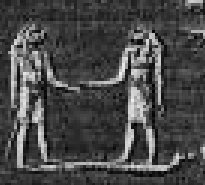
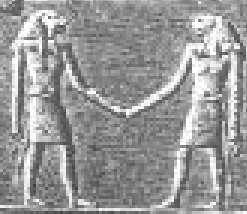
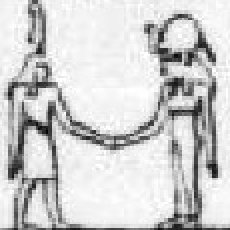
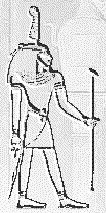
    In sacred art, Shu is shown as a male in human form with an ostrich feather on his head, the hieroglyph of his name, holding a sceptre and the ankh sign of life.    Sometimes he was shown wearing the sun disk on his head, linking him to the sun.    Occasionally, when shown with his sister-wife Tefnut, he is shown in lion form and the two were known as the "twin lion gods."    Regarding that statement of interest is the images seen on Gemini Decan, with the Esne images of Gemini Lion Twins.    The figure below to the left is on the lower section of ESNE Plate 87 which may or may not represent Gemini, since they are located between Capricornus and Sagittarius.    Note that they both are standing on a serpent.    Also as seen below on the right on ESNE Plate 79 these figures are out of sequence if to be Gemini and are shown before Leo.    Both have the same appearance as the figures shown in the image to your left.
   
    At other times, he was shown with the hind part of a lion as his headdress, linking him to his leonine form.    Mostly, he was shown with his arms raised, holding up the goddess Nut as the sky, standing on the body of Geb.

    There are no known temples to Shu, but Akenaten's distaste for the gods of Egypt, he and Nefertiti used Tefnut and Shu for political purposes.    They depicted themselves as the twin gods in an apparent attempt to elevate their status to that of being a living god and goddess, the son and daughter of the creator, on earth.    Akenaten, not the monotheist that most believe him to be (as Assmann and Hornung point out), put out the belief that Shu lived in the sun disk.    At Iunet (Dendera), though, there was a part of the city known as "The House of Shu" and at Djeba (Utes-Hor, Behde, Edfu) there was a place known as "The Seat of Shu."    He was worshiped in connection with the Ennead at Iunu, and in his lion form at Nay-ta-hut (Leontopolis).
    In the Underworld, Shu had a darker side as being dangerous, leading a band of torturers and executioners, whose slaughtering-block represents a great peril for the deceased and corrupt souls.
    Shu was one of the gods who protected Ra on his journey through the underworld, using magic spells to ward off the poisons of the water snake-demon god Apophis (i.e. Apep, Hydra).
    As seen on the image above of Gemini as seen on the Grand Temple which is located above Decan 33.    These two figures look very much like Shu and Tefnut.
    Cyril Fagan comments, "Gemini, the Twins, rose at eve during the lunar month of Tybi when the sun was in the opposite constellation, Sagittarius.    The twin stars were known as the air-god Shu and his wife and sister Tefnut, the lion-hearted goddess of the Sun's heat."
    The hieroglyphic origin of Gemini is Shu and Tefnut, and seen as two plant shoots.
    is the Demotic symbol     and     is the Gemini Sign.

    As seen above on Denderah Decan 31 seen below Pisces is a mummified figure with wavy horns as a head or crown, with no arms and is seated on a throne.    In front of its body are three stars in an upward pointing triangle.
    A similar figure can be seen above on ESNE plate 79 before Aquarius seated on a throne, as a male figure with arms extended outward, and its head is an Ostrich feather, which may represent Shu.
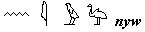
    The hieroglyph for a ostrich is .
    Shu as god of air and the atmosphere was one of the gods discredited by the seventh plague of Egypt regarding the hail storms of fire.
    What other sources state about Shu.
    One story says that Shu and Tefnut went to explore the waters of Nun.    After some time, Ra believed that they were lost, and sent the his Eye out into the chaos to find them.    When his children were returned to him, Ra wept, and his tears were believed to have turned into the first humans.
    "That is my daughter, the living female one, Tefnut,
who shall be with her brother Shu.
Life is his name, Order is her name.
[At first] I lived with my two children, my little ones,
the one before me, the other behind me.
Life reposed with my daughter Order,
the one within me, the other without me.
I rose over them, but their arms were around me
."
-- Spell 80, Coffin Texts
    As a god of the wind, the people invoked him to give good wind to the sails of the boats.    It was he who was the personification of the cold northern winds; he was the breath of life - the vital principle of all living things.    His bones were thought to be clouds.    He was also called to "lift up" the spirits of the dead so that they might rise up to the heavens, known as the "light land," reached by means of a giant "ladder" that Shu was thought to hold up. ...Shu, the "space," the light cavity in the midst of the primordial darkness.    Shu is both light and air, and as the offspring of god he is manifest life.    As light he separates the earth from the sky and as air he upholds the sky vault.
-- Myth and Symbol in Ancient Egypt, R. T. Rundle Clark
    Despite being a god of sunlight, Shu was not considered to be a solar deity.    He was, though, connected to the sun god as one who was thought to bring Ra (and the pharaoh) to life each morning, raising the sun into the sky.    During his travels through the underworld, he protected Ra from the water snake-demon Apep, with spells to counteract the serpent and his followers.    He participated in the judgement of the deceased in the Halls of Ma'ati as the leader of aggressive, punishing beings who were to eliminate the ones not worthy of the afterlife.    THE CHAPTER OF NOT PERISHING AND OF BEING ALIVE IN KHERT-NETER.    Saith Osiris Ani: "Hail, children of: Shu!    Hail, children of Shu, [children of] the place of the dawn, who as the children of light have gained possession of his crown.    May I rise up and may I fare forth like Osiris."
    THE CHAPTER OF NOT GOING IN TO THE BLOCK.    Saith Osiris Ani: "The four bones of my neck and of my back are joined together for me in heaven by Ra, the guardian of the earth.    This was granted on the day when my rising up out of weakness upon my two feet was ordered, on the day when the hair was cut off.    The bones of my neck and of my back have been joined together by Set and by the company of the gods, even as they were in the time that is past; may nothing happen to break them apart.    Make ye [me] strong against my father's murderer.    I have gotten power over the two earths.    Nut hath joined together my bones, and [I] behold [them] as they were in the time that is past [and I] see [them] even in the same order as they were [when] the gods had not come into being in visible forms.    I am Penti, I, Osiris the scribe Ani, triumphant, am the heir of the great gods."
-- The Book of the Dead, Chapters XLVI and XL
    He also was believed to hold up Nut, the sky goddess and his daughter, above his son the earth god Geb.    Without Shu holding the two apart, the Egyptians believed that there would be no area in which to create the life they saw all around them.    The Egyptians believed that there were also pillars to help Shu lift up the sky - these pillars were on the four cardinal points, and were known as the "Pillars of Shu."    "Shu hath raised thee up, O Beautiful Face, thou governor of eternity.    Thou hast thine eye, O scribe Nebseni, lord of fealty, and it is beautiful.    Thy right eye is like the Sektet Boat, thy left eye is like the Atet Boat.    Thine eyebrows are fair to see in the presence of the Company of the Gods."
-- The Speech of Anubis (from the Papyrus of Nebseni)
    The Egyptians believed that Shu was the second divine pharaoh, ruling after Ra.    Apep's followers, though, plotted against him and attacked the god at his palace in At Nub.    Despite defeating them, Shu became diseased due to their corruption, and soon even Shu's own followers revolted against him.    Shu then abdicated the throne, allowing his son Geb to rule, and Shu himself returned to the skies.    "I am Shu.    I draw air from the presence of the Light-god, from the uttermost limits of heaven, from the uttermost limits of earth, from the uttermost limits of the pinion of Nebeh bird.    May air be given unto this young divine Babe.    [My mouth is open, I see with my eyes.]"
-- The Chapter of Giving Air in Khert-Neter (From The Book of the Dead)
    To the Egyptians, if there was no Shu, there would be no life - Egypt existed thanks to Shu.


    This file was created on June 18, 2005.

Return to the Table of Contents or the Zodiac of Denderah