From The Alpha and the Omega - Volume III
by Jim A. Cornwell, Copyright © July 20, 2002, all rights reserved
"Volume III - Gods/Goddesses of Ancient Egypt"
TEFNUT
(Tefenet, Tefnet)


    To return to the
Gemini Decan (The hieroglyphic origin of Gemini is Shu and Tefnut seen as two plant shoots),
Anhur (Nubia note),
or List of Netjeru.
    Tefnut, was the lunar goddess of moisture (like rain), humidity and water (dew and clouds) who was also a solar goddess connected with the sun and dryness (more specifically, the absence of moisture).    Her name itself is related to water, tf is the root of the words for "spit" and "moist."    Her name translates to something like "She of Moisture," and according to myth created by the primeval god Atum of the Ennead of Iunu/Heliopolis/Cairo together with her twin brother the air-god Shu, and husband.    With them duality started and the sexual cycle was begun.
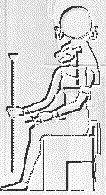
    She can be depicted as a full lioness and generally as a woman with a lion's head like Sekhmet whose ears are rounded while Tefnut's are pointed.    She was occasionally shown as a woman, but this is rare.    She is seen sitting on a throne with the solar disk and uraeus, linking her with the sun, holding a papyrus plant headed scepter and the ankh sign of life.
    When Atum later was assimilated by Re, they were considered children of Re, the sungod.     Tefnut was the daughter of the creator god, mother of the twin sky and the earth deities and the "Eye of Ra" as well as a creative force as the "Tongue of Ptah."
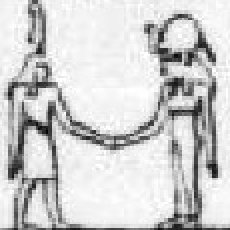
    As seen on the image above of Gemini as seen on the Grand Temple which is located above Decan 33.    These two figures look very much like Shu and Tefnut.
    Cyril Fagan comments, "Gemini, the Twins, rose at eve during the lunar month of Tybi when the sun was in the opposite constellation, Sagittarius.    The twin stars were known as the air-god Shu and his wife and sister Tefnut, the lion-hearted goddess of the Sun's heat."
    The hieroglyphic origin of Gemini is Shu and Tefnut, and seen as two plant shoots.
    Demotic        Gemini Sign.

    In the beginning Tefnut was regarded as the Lunar Eye of Ra and thus linked to the night sky (the moon) as well as to dew, rain and mist, but in myth she developed into the solar "Eye of Ra," and later the uraeus.    She then acquired the name "Lady of the Flame" and the "Uraeus on the Head of all the Gods."
    In Buto she and Shu were worshipped as the flamingo-like "children of the Lower Egyptian king," a mythical image for the sun and the moon.
    In connection with the Ennead at Iunu, and in her lion form at Nay-ta-hut/Leontopolis/Tell el-Muqdam they were identified with the lion worship there.
    At Iunet (Dendera) there was a portion of the city named after her, "The House of Tefnut."

    What other sources state about Tefnut.
    As with other water deities, she took on some form of a goddess of creation.    As the "Tongue of Ptah," she was one of the gods in Mennefer (Hikuptah, Memphis) who helped Ptah - that city's main god - with creation by carrying out his will.    Yet in the cities of Iunu (On, Heliopolis) and Waset (Thebes) she was more of a female form of her husband-brother Shu, whose main task was to start the sexuality, creative cycle and give birth to Shu's children.    Atem is he who masturbated in Iunu.    He took his phallus in his grasp that he might create orgasm by means of it, and so were born the twins Shu and Tefnut.
-- Pyramid Text 1248-49
    Tefnut and Shu - god of dry air - were the children of Atem (a form of the sun god Ra), who in turn created the twins Nut and Geb.    Originally, though, rather than being paired with Shu, she had been paired with a god called Tefen.    Other than his name, little is known about this Tefen.    It seems, though, that he and Tefnut were linked together in connection with the goddess Ma'at: "Tefen and Tefnut have weighed Unas and Ma'at has listened, and Shu has born witness."
-- Pyramid Text of Unas
    During the Middle Kingdom Tefnut became connected to Ma'at, and as such this goddess is sometimes seen assisting Shu in his task of holding Nut above Geb.    More often he is alone in the task.    "O Amen-Ra, the gods have gone forth from thee.    What flowed forth from thee became Shu, and that which was emitted by thee became Tefnut ... thou was the lion god of the twin lion gods (Shu and Tefnut)."
-- The Gods of the Egyptians, E. A. Wallis Budge
    One story says that Shu and Tefnut went to explore the waters of Nun.    After some time, Ra believed that they were lost, and sent the his Eye out into the chaos to find them.    When his children were returned to him, Ra wept, and his tears were believed to have turned into the first humans.
    Tefnut was thought to have been the upset goddess who fled into Nubia, taking all of her water and moisture with her.    Egypt soon dried, and the land was in chaos while in Nubia, Tefnut turned herself into a lioness and went on a killing spree in her anger at her father, from whom she had fled.    Eventually Ra decided that he missed her, and wanted her back.    Ra sent Thoth and Shu to get her, and they found her in Begum.    Thoth began at once to try and persuade her to return to Egypt.    In the end Tefnut (with Shu and Thoth leading her) made a triumphant entry back into Egypt, accompanied by a host of Nubian musicians, dancers and baboons.    She went from city to city, bringing back moisture and water (the inundation), amid great rejoicing, until finally she was reunited with her father, and restored to her rightful position as his Eye.
    This story also explains how the goddess of moisture could also be the goddess of dryness, heat and the negative aspects of the sun.    The people believed that without her water, Egypt could dry and burn in the sun.    So she took on the form of a lion - as did the other goddesses with the "Eye of Ra" title - and was also strongly linked to the sun.
    As the "Eye of Ra" she was also linked to Bast, Sekhmet, Hathor, Isis, Wadjet and Nekhbet.    This story is very similar to another tale of the "Eye of Ra," where Sekhmet slaughters mankind before getting drunk, returning to heaven and turning into the sweet goddess Hathor.
    Despite Akenaten's distaste for the gods of Egypt, he and Nefertiti used Tefnut and Shu for political purposes.    They depicted themselves as the twin gods in an apparent attempt to elevate their status to that of being a living god and goddess, the son and daughter of the creator, on earth.    As Assmann and Hornung point out, Akenaten was not a monotheist.    Despite raising the Aten above all other gods, and attempting to quash the worship of some other deities, Akenaten did not drop all links with other deities.    Ra, Shu, Tefnut, Thoth, Ptah and Hathor were still prominent gods in Akenaten's religion.
    However, with Atenism's emphasis upon Akhenaten and Nefertiti as Shu and Tefnut, and thus as the divine children of the Aten, a "true" monotheism is not present... Re, Shu, Tefnut, Thoth, Ptah, Hathor, and several other deities figure prominently in texts of Atenism, and the King and Queen, in particular, identified themselves with the deities Shu and Tefnut, respectively.    Amen was targeted by the main prophet of the cult, the king, likely not in Year 6 of the reign (as has been traditionally proposed), but more likely in the very late years of the reign (possibly as late as years 16-17), dues to the somewhat limited damage to names and figures of Amen/Mut/Khons, the erasure of the word "gods," and the personification of "ma'at" on existent monuments....
-- Katherine Griffis-Greenberg


    This file was created on June 18, 2005.

Return to the Table of Contents or the Zodiac of Denderah