From The Alpha and the Omega - Volume III
by Jim A. Cornwell, Copyright © July 20, 2002, all rights reserved
"Volume III - Gods/Goddesses of Ancient Egypt"
SEKHMET
(Sakhmet, Sekhet)


    To return to the
Scorpius Decan (Sekhment the netjer of the fourth month
Choiach, Koiak, Khoiak, Choiak, Choiako, Kaherka, Coptic Kiahk,
at Ramesseum: Pak-t, Pachet, at Edfu: Kehek
),
Lupus Decan (Sekhmet, a lioness-goddess, wife of Ptah
was worshipped in Memphis
),
Denderah Decan 24 - Grand Temple Decan 33 (GT Decan 33
similar to Sekhmet
),
Mihos (often confused with Sekhmet, son of Sekhmet),
Nefertum (the son of Sekhmet and Ptah),
Sokar (Ptah-Sokar took Sekhmet as his spouse),
List of Netjeru.
    Sekhmet means "Mighty One" or "Powerful Feminine," and had two different aspects, one protective and healing, the other destructive and retaliating.    Associated with war and retribution, her weapons were arrows to pierce hearts of her enemies with fire.    She was depicted with a lioness' head and her breath like the hot winds of the desert as her body took on the glare of the midday sun.    She represented the destructive force of the sun.
    Also called "The Eye of Re" or "Daughter of Re," her solar association and "Mistress of Ankh-Tawy (Two Lands)."
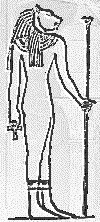
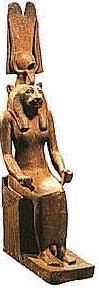
    Sekhmet was depicted as a lion-headed woman with the sun disk and uraeus serpent headdress.    Her scepter is in the form of a papyrus plant with an ankh in her other hand.     Also of interest is that Sekhmet whose ears are rounded, giving a difference, while Tefnut's ears are pointed.
    Her cult centre was in Mennefer (Hikuptah, Memphis), but during the New Kingdom when the seat of power shifted to Waset, Sekhmet's powers were absorbed by Mut.    Sekhmet was soon represented as Mut's aggressive side, rather than a goddess in her own right.    The lion-headed goddess Sekhmet was a member of the Memphite Triad, thought to be the wife of Ptah and mother of Nefertem, though the motherhood of Nefertem was in dispute, as Bast and Wadjet (Edjo) were touted as his mother in their respective cities.
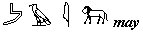
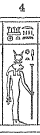
    The hieroglyph for a lion is .    Also see Grand Temple Decan 33 under Denderah Decan 24 in Gemini to see an image of Sekhmet with a uraeus on her head.
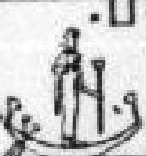
 
    As seen above Grand Temple Decan 33 is a female figure with a lion’s head and a cobra on her head (Uraeus, the cobra is an emblem of Lower Egypt, and if worn as a crown is a symbol of royalty), with one star above, and standing and holding a scepter with a cup like object (papyrus plant) on it.    A similarity here is to Sekhmet, a lioness-goddess, wife of Ptah, who was worshipped in Memphis.    She was also worshipped with Bast (Bastet) and Ra.    Although she is connected with Bast, she has no family relationship with the cat goddess.    They are two distinct goddesses in their own rights, and are not siblings of any kind.    Bast and Sekhmet were an example of Egyptian duality, Sekhmet was a goddess of Upper Egypt, Bast of Lower Egypt, just like the pharaoh was of Upper and/or Lower Egypt.
    The netjer of the fourth month of Scorpius (Choiach, Koiak, Khoiak, Choiak, Choiako, Kaherka, Coptic Kiahk) was Sekhmet, at Ramesseum: Pak-t (Pachet), at Edfu: Kehek (note Coptic name Kiahk).
    During the Middle Kingdom, she was associated with the more or less local leonine goddess Pakhet at Beni Hassan in Middle Egypt.

    What other sources state about Sekhmet.
    "The good god, the lord of action, Neb-Ma'at-Ra [Amenhotep III], Beloved of Sekhmet, the Mistress of Dread, who gives life eternally.    The son of the God Ra of His own body, Amenhotep, ruler of Waset (Thebes), Beloved of Sekhmet, the Mistress of Dread, Who gives life eternally." -- Inscription on a statue of Sekhmet
    According to the legends, she came into being when Hathor was sent to earth by Ra to take vengeance on man.    She was the one who slaughtered mankind and drank their blood, only being stopped by trickery (this story can be found under Hathor's story).    She was, thus, the destructive side of the sun, and a solar goddess and given the title Eye of Ra.
    Being mother of Nefertem, who himself was a healing god, gives her a more protective side that manifested itself in her aspect of goddess of healing and surgery.    Part of her destruction side was also disease and plague, as the "Lady of Pestilence," but she could also cure said ailments.    The priests of Sekhmet were specialists in the field of medicine, arts linked to ritual and magic.    They were also trained surgeons of remarkable caliber.    Pharaoh Amenhotep III had many statues of Sekhmet, and it has been theorised that this was because he had dental and health problems that he hoped the goddess may cure.    Hundreds of Amenhotep's Sekhmet statues were found in the Theban temple precinct of the goddess Mut at South Ipet-Isut (Karnak).    The statues may have been made for the king's funerary temple on the West Bank of the Nile and may have been dispersed to other sites at Waset and elsewhere beginning with the reign of Rameses II.
    Sekhmet was mentioned a number of times in the spells of The Book of the Dead: The Chapter of Driving Back the Slaughters Which are Performed in Hensu, "My belly and back are the belly and back of Sekhmet.    My buttocks are the buttocks of the Eye of Horus."
The Chapter of Giving a Heart to the Osiris
    "May the goddess Sekhmet raise me, and lift me up.    Let me ascend into heaven, let that which I command be performed in Hikuptah.    I know how to use my heart.    I am master of my heart-case.    I am master of my hands and arms.    I am master of my legs.    I have the power to do that which my KA desireth to do.    My Heart-soul shall not be kept a prisoner in my body at the gates of Amenty when I would go in in peace and come forth in peace.
The Osiris Whose Word is Truth
    I have made supplication to the Khati gods and to Sekhmet in the temple of Nit, or the Aged Ones ... I have approached with worship the two Khati gods and Sekhmet, who are in the temple of the Aged One [in Anu]
."
The Chapter of Opening the Mouth
    "I am the goddess Sekhmet, and I take my seat upon the place by the side of Amt-ur the great wind of heaven."


    This file was created on June 18, 2005 and updated on May 30, 2006.

Return to the Table of Contents or the Zodiac of Denderah