From The Alpha and the Omega - Volume III
by Jim A. Cornwell, Copyright © July 20, 2002, all rights reserved
"Volume III - Gods/Goddesses of Ancient Egypt"
BAST
(Ubast, Pasht,
Greek Bastet, Bubastis
)


    To return to the
Lupus Decan (Bast worshipped with Sekhmet and Ra),
Eridanus Decan (connection with Adept),
Cetus Decan (Adept and Bastet),
Denderah Decan 24 - Grand Temple Decan 33 (worshipped with Sekhmet and Ra),
Nefertum (at times son of either Bast or Wadjet at Buto in the Delta),
Pakhet (associated with Bast and Sekhmet),
Sekhmet (Bast worshipped with Sekhmet and Ra),
or List of Netjeru.
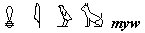
    Bast means "She of the Bast," and bast meaning "oinment jar," the same form of her hieroglyph name, some say this is an alternative translation, refering to the city of Per-Bast.    Others say the name of Bast means "Devouring Lady," from bas meaning "devour" and with a feminine "t" added.    Others claim that in early times Bast (written as Bastet by scribes in later times to emphasise that the 't' was to be pronounced).    While others claim her name has the hieroglyph of a "bas"-jar with the feminine ending of 't', reading "She of the bas-Jar."    These jars were heavy perfume jars, often filled with expensive perfumes - they were very valuable in Egypt, considering the Egyptian need in the hot weather of makeup, bathing, hygiene and perfume.    Bast, by her name, seems to be related to perfumes in some way.    Her son Nefertem, a solar god, was a god of perfumes and alchemy, which supports the theory.
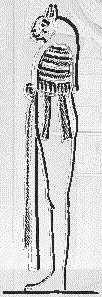
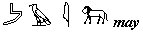
    The hieroglyph for a cat is and for lion .    Bast wore an aegis or shield in the form of a semi-circular plate, with an image of a lion's head.    She was either a cat-headed sun goddess, and was also considered the goddess of pleasure.    Bast was associated with the cat around 1000 B.C., and shown as a goddess with the head of a lion or usually depicted as a desert sand-cat, or as a woman with the head of a cat or lion.
    Also b>Bast was regarded as mother of the savage lion- headed god Mihos/Maahes (Gr. Miysis), the "lord of slaughter," and wife of Ptah.    Bast was also mentioned as being fathered by Ra.
    She was also connected to Hathor, Sekhmet, Tefnut, Atem (her father) and Mut.    It was only in the New Kingdom that she gained the head of a house cat and became a much more 'friendly' goddess, though she was still depicted as a lion-headed woman to show her war-like side.    As with Hathor, Bast is often seen carrying a sistrum.
    In Dynasty Four they displayed Het-Hert as the Southern goddess and Bast as the Northern one.    In time Bast took on traits as Het-Hert and the Greeks likened her to their own Artemis, developing the concept of the cat as a form of female sexuality.
    Others pose there is confusion over Bast and Sekhmet.    She is given the title the "Eye of Ra" when she's in her protector form... but Bast and Sekhmet are not the same goddess (unlike Hathor who becomes Sekhmet as the "Eye of Ra").    This all gives rise to a lot of confusion about these goddesses.    Bast and Sekhmet were another example of Egyptian duality - Sekhmet was a goddess of Upper Egypt (Southern), Bast of Lower Egypt (Northern), just like the pharaoh was of Upper and/or Lower Egypt, and they were linked together by geography, not by myth or legend.    These two feline goddesses were not related by family, they were both very distinct goddesses in their own rights.
    Bast had a cult center at Per Bast, meaning "the House of Bast," its modern name is Tell-Basta and made of red granite with a sacred grove in the center, the Greeks called it Bubastis.    In excavated cemeteries of cats at Per-Bast along the Nile, among them Saqqara, Memphis, Bast had the title "Lady of Ankhtawy" meaning "life of the Two Lands," or "Bast guards the Two Lands."    The mummified cats were buried in large numbers in the so-called "Bubasteion" situated not far from the pyramid of King Teti.
    As seen on the image above on the Denderah Zodiac beneath Aries’ hind feet and at the end of the band of Pisces there are two figures.
    The first is Cetus and is seen as a female figure with a cat-like face, seen as wearing a long robe and holding the Egyptian waas-scepter in front of her with both hands.    This cat-like face leads us to surmise that this is (Adept and Bastet), where Bastet was known as a cat goddess.
    The second figure at the end of the band of Pisces is Eridanus, possibly a male figure, which would mean it is known as Adept, but is actually Bastet, but other sources claim that Eridanus is to be known as Peh-ta-t, the mouth of the river.

    Other sources claim She was one of the older goddesses, mentioned in The Book of the Dead: "The breast of this Meri-Ra is the breast of Bast; he cometh forth therefore and ascendeth into heaven."
    Rubric - If this Chapter be known by the deceased upon earth, he shall become like unto Thoth, and he shall be adored by those who live.    He shall not fall headlong at the moment of the intensity of the royal flame of the goddess Bast, and the Great Prince shall make him to advance happily.
-- The Chapter of the Deification of the Members (From the Pyramid of Pepi I)
    Even from very old times, as protector, Bast was seen as the fierce flame of the sun who burned the deceased should they fail one of the many tests in the underworld.
    Some of Bast's festivals included the "Procession of Bast," "Bast appears to Ra," the "Festival of Bast," and "Bast Goes Forth from Per-Bast (Bubastis)."    There was even a "Festival of Hathor and Bast," showing the connection between the two goddesses.
    Herodotus describes the "Festival of Bast" where thousands of men and women travelled on boats, partying like crazy.    They had music, singing, clapping and dancing.    When they passed towns, the would call out dirty jokes to the shore-bound, often flashing the townsfolk by lifting up their skirts over their heads!    When they reached Per-Bast, they made their sacrificies of various animals, and drank as much wine as they could stomach.    No wonder it was such a popular festival!    When the people are on their way to Per-Bast, they go by river, a great number in every boat, men and women together.    Some of the women make a noise with rattles, others play flutes all the way, while the rest of the women, and the men, sing and clap their hands.    As they travel by river to Per-Bast, whenever they come near any other town they bring their boat near the bank; then some of the women do as I have said, while some shout mockery of the women of the town; others dance, and others stand up and lift their skirts.    They do this whenever they come alongside any riverside town.    But when they have reached Per-Bast, they make a festival with great sacrifices, and more wine is drunk at this feast than in the whole year besides.    It is customary for men and women (but not children) to assemble there to the number of seven hundred thousand, as the people of the place say.
-- Herodotus, Histories Book II Chap 60


    This file was created on June 18, 2005.

Return to the Table of Contents or the Zodiac of Denderah